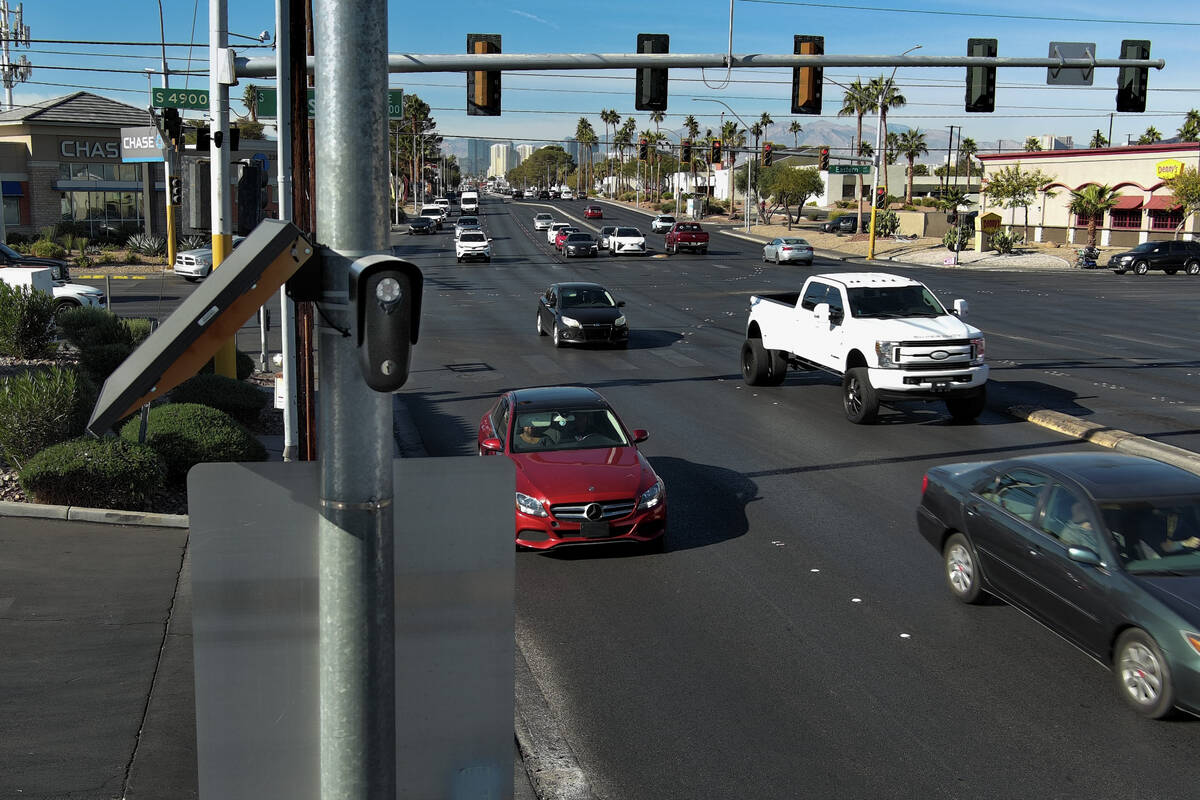
Solving crimes is a means to an end, not an end in itself. This is why police departments shouldn’t use Flock cameras.
There are now more than 120,000 Flock cameras deployed around the country. That includes around 180 Flock cameras in Clark County and another 130 similar Motorola cameras. The cameras take pictures of passing cars, including each car’s license plate number. The cameras also capture details such as a car’s make, model and color.
Police can then check license plates against law enforcement databases and see if a vehicle is connected to a crime. This Big Brother technology allows police to track a vehicle’s route or establish someone’s routine. “It is one of the single most effective tools that we have in law enforcement to solve some of the crimes we have,” Sheriff Kevin McMahill said in a recent interview.
He insists that the Metropolitan Police Department doesn’t use the Flock cameras for facial recognition. But if the public accepts McMahill’s logic, it’s easy to see that police will soon push to use facial recognition technology, too. After all, who could oppose helping police solve crimes?
That framing may sound convincing — until you consider the Constitution. It is filled with limitations on law enforcement and protections for people accused of crimes.
The Fourth Amendment gives people the right “to be secure in their persons, houses, papers, and effects, against unreasonable searches and seizures.” It also requires probable cause for warrants.
This isn’t the only amendment that makes it harder for police to solve crimes. No one “shall be compelled in any criminal case to be a witness against himself,” the Fifth Amendment states. The Sixth, Seventh and Eighth amendments guarantee the right to a jury trial in criminal and civil cases and prohibit “cruel and unusual punishments.”
The Founding Fathers didn’t have a soft spot for criminals. They understood the proper role of government. As laid out in the Declaration of Independence, God gives individuals unalienable rights, including “Life, Liberty and the pursuit of Happiness.” Government exists “to secure these rights.”
Criminals threaten individual rights. A murderer deprives someone of his or her life. But lawbreakers aren’t the only threat to liberty.
The Founders knew that government itself could become tyrannical. That’s why the Bill of Rights contains so many limits on the government’s police power. It’s why the Founders divided power among the different branches of government. It’s why they created checks and balances.
“Ambition must be made to counteract ambition,” James Madison wrote in Federalist 51. He continued, “If men were angels, no government would be necessary. If angels were to govern men, neither external nor internal controls on government would be necessary. In framing a government which is to be administered by men over men, the great difficulty lies in this: you must first enable the government to control the governed; and in the next place oblige it to control itself.”
Flock cameras give law enforcement — and hence government — too much power. A government that continually monitors its citizens has restricted their liberty. Someone who is under constant surveillance isn’t free. And anyone who thinks the government can be trusted not to abuse this should remember what some government officials did during COVID. Or look at China.
What Las Vegas needs help with isn’t solving crimes. It’s punishing criminals who’ve already been caught. In 2019, Nevada Democrats significantly reduced punishments for many crimes. McMahill should push to keep criminals in jail rather than moving to increase surveillance on the general public.
Here is the problem even the most advanced camera can’t see: Omnipresent surveillance violates our God-given rights — even when done to solve crimes.
Get rid of Flock cameras.
Contact Victor Joecks at vjoecks@reviewjournal.com or 702-383-4698. Follow @victorjoecks on X.