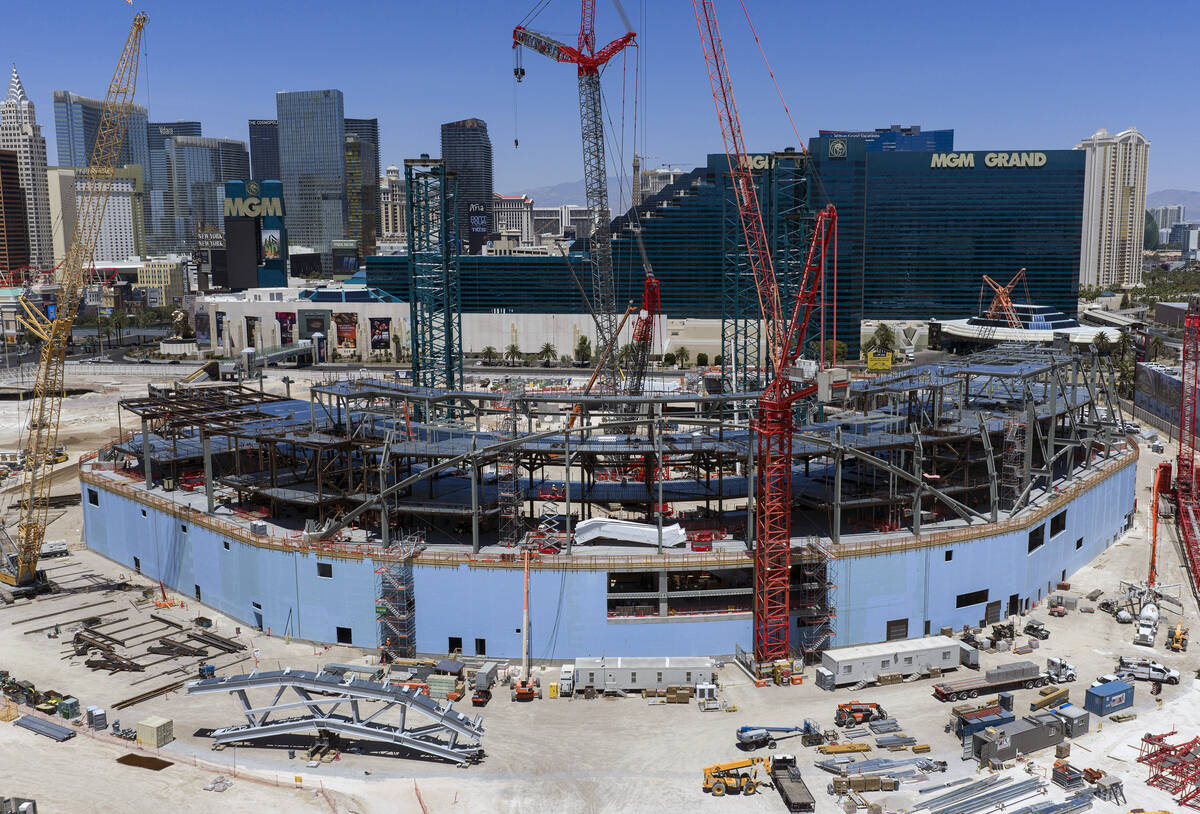
The Athletics have spent over $400 million on their $2 billion Las Vegas ballpark as preparations for the start of roof work are underway, team vice chairman Sandy Dean confirmed Tuesday following an update on the project to the Clark County Commission.
Dean was among those representing the project who updated the progress of the 33,000-fan capacity stadium to the county commission. The A’s future home is being built on the southeast corner of Las Vegas Boulevard and Tropicana Avenue.
Concrete work on the first two levels of the ballpark has been completed, with the first loop around the ballpark done on the lower plaza level. Steel work has progressed about the two concourses, with work on the third and fourth seating levels well underway, according to Tyler Van Eeckhault, project manager from the Mortenson-McCarthy joint-venture contractor.
Four shoring towers, which will support the steel roof trusses once work on the roof begins in June are in place, with a fifth being constructed. The shoring towers are 200 feet tall each and give an idea of just how tall the stadium will be once completed. The first of four roof trusses that will be hoisted into the air and installed next month are also being assembled on the ground at various portions of the stadium site.
Crews are also beginning to enclose the stadium, that will allow for work to occur on the interior in the coming months, Van Eeckhault said.
There are about 550 craft workers on the ballpark site working each day. The A’s and Legends, which the team hired to handle premium seating and ticket sales for the ballpark, have 56 employees who are based out of Las Vegas, according to A’s president Marc Badain.
“If we had this meeting a year ago, that number would have been two,” Badain said. “We’ve been relocating a number of people, and we’ve been hiring a number of people and that will continue.”
Over the next four months other work that will occur on the project includes interior masonry work, precast platforms where stadium seating will be installed will begin to be added, dry wall will be added on the 100, 200 and 300 levels of the ballpark, and concrete will be poured on the third and fourth levels of the ballpark that comprised of steel.
The project remains on budget and on time for the planned completion date of Feb. 29, 2028, according to Eeckhault.
The ballpark is being constructed on nine acres of the 35-acre site, with Bally’s Corp. planning a mixed-used development, that includes a hotel/casino, shopping, dining and retail and a 2,500-seat theater, which will be built in phases.
Initial plans for shared infrastructure that Bally’s is tasked to build, including a central utility plant, 2,500-space parking garage and a nine-acre northwest plaza that would feature dining, retail and entertainment options, have been altered.
The utility plant that was going to be built at once to serve both the ballpark and Bally’s project is now being shifted to two phases. The first phase will be used for the ballpark and a portion of Bally’s project, including the northwest plaza and potential Bally’s theater. The second phase that will be built a later date will be used by the remaining Bally’s project.
The utility plant will be responsible for the chilled water, hot water and some electrical infrastructure for the ballpark and eventual Bally’s project, Dean said.
Dean said with Bally’s still figuring out the phased approach to their project, including the financing, that it was decided that it didn’t make sense for the entire central utility plant to be built, opting to build the facility in a phased approach.
Additionally, the planned 2,500-space parking garage is also going to be phased, with the initial portion being a 1,500-space garage, with the option to add 1,000 more spaces in the future, Dean said.
The initial phase of the utility plant will be a 50-foot extension to the parking garage, which is slated to be constructed near the southeast corner of the site.
Contact Mick Akers at makers@reviewjournal.com or 702-387-2920. Follow @mickakers on X.