The news from the grape is gloomy these days. From a pandemic-era peak in 2020 fueled by home drinking, wine consumption has fallen for five consecutive years in the United States with sales nationally at their lowest in 20 years, according to industry research.
Wine prices are rising (in part because of rising production costs), people are drinking less alcohol because of health concerns, and among younger people in particular, wine consumption has decreased because wine is often seen as too expensive, too stuffy and less exciting than cocktail culture. Wild reports have even emerged of California wine growers burning their vineyards because it didn’t pay to stay in business.
All that said, the story is more nuanced in Las Vegas. To get the word from the local grapevine, we spoke with folks from across the business: the proprietors of a new downtown wine bar, the head sommelier for a big-time Strip steakhouse and an importer of wines that challenge mainstream stylistic conventions but have nevertheless found local success.
Is wine dead in Vegas? Far from it. But the reasons why people are drinking, and the kinds of wines they want, are evolving. And continuing change is so very Vegas, isn’t it?

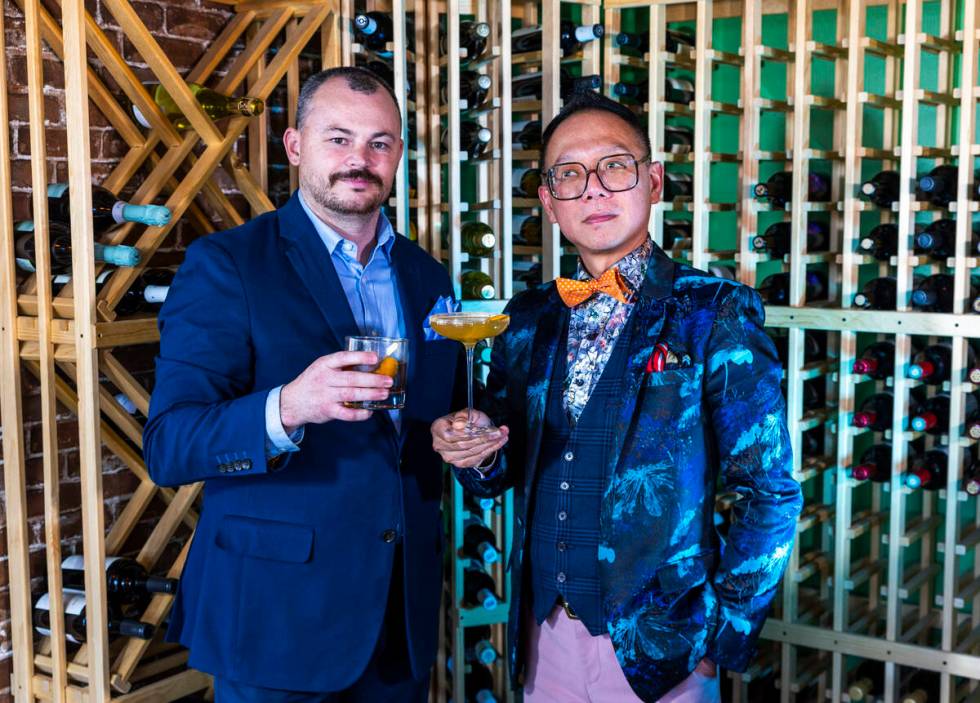
Hung Nguyen and Anthony Defalco
For almost 20 years, Nguyen, in his late 40s, was the sommelier and manager of the Cellar at the Rio and the wine director of the property at large. Defalco, 38, who had previous stints at the M Resort and as general manager of Libertine Social in Mandalay Bay, met Nguyen while working as the fine dining general manager of the Rio.
The business partners opened Hung Up on Wine in May in a sleek, loftish space on the ground floor of the Juhl condominium building in downtown. They’re navigating the challenges in the wine industry — and the competitive Las Vegas beverage scene — one flight of wine at a time.
People have a lot of places they can drink downtown. What’s your approach to make Hung Up on Wine distinctive?
Nguyen: The wine business is not intimidating here. It’s more fun, more social. A younger crowd, in their 20s and 30s, they love the idea of drinking wine and socializing and learning something new about wine. The goal is to have a tasting room that is open and accepting for everyone. You get three or four glasses of wine in a flight and experience and learn. The flights are five different reds and five different whites. Each one has a theme, like Chasing Chardonnay or Around the World reds. The wine rotation changes every two months.
You also serve spirits. Why serve spirits at a wine bar?
Defalco: Vegas is a cocktail-focused town in many ways. Someone wants to do a wine flight here, but someone else might want to do bourbon. We have tequila flights, vodka flights, bourbon flights to learn about different spirits, too. We have a Hung Margarita — a margarita with a float of pinot. That’s the beauty of doing a cocktail in a wine bar. You can incorporate wine into some of the spirits.
The Cellar at the Rio was known for including food — from charcuterie boards to sit-down dinners — in its wine program. Have you continued that practice here?
Defalco: Food has always been important to us. Most wine bars are going to have a charcuterie board. We have more: charcuterie boards to starters, salads to flatbreads to steaks. There’s even a dessert menu with after-dinner wine pairings. We do tasting dinners, with Hung and winemakers, every single month on Saturday. We recently had a five-course Taittinger Champagne dinner.
Nguyen: You don’t have to go somewhere else to get a cocktail, to get a bottle, to get food — it’s a whole package deal.
What else is worth noting about what you’re doing?
Defalco: There is a secret special menu of hard-to-find wines. It’s called Hung’s Cellar — Boutique Selections. It’s rare selections that Hung is able to obtain because of his longtime connections. We also want to expand the wine club, expand the wine locker program and expand to outdoor space, to be that special experience for the guests.
353 E. Bonneville Ave., Suite 115, in Juhl, hunguponwine.com

Josh Brunson
Brunson deepened his interest in wine while studying at the Culinary Institute of America, one of the world’s leading culinary schools, in Napa Valley. After graduating, he joined Cameron Mitchell Restaurants, parent of Ocean Prime, as a bartender and server. He rose through the ranks as a wine trainer and educator with the company, as beverage operations manager at the home office and, since 2023, as head sommelier at Ocean Prime in 63 CityCenter.
As Brunson, now 31, relates, leading the wine program at a Strip steakhouse requires balancing wines that appeal to mainstream steakhouse tastes with less-familiar releases that add interest, all while managing inventory needs created by the flows of visitor traffic.
How do you describe the wine program at Ocean Prime?
We do the broad strokes of the world that pair with seafood and steaks. We are strongest in our cab and pinot selections.
What makes the wine program at a Strip steakhouse different than one somewhere else?
The Strip is a beast in and of itself. We do a lot of volume at odd times. Certain wines aren’t available from producers in large quantities. It’s a fun interplay trying out new grape varietals on the premium side while also catering to the Napa cabernet lovers of the world. I try to format the list in a way to spread our selections out to have what we need at all times. There’s buying power in the volume that we’re able to move through. Because we can move more product, more product tends to get allocated to us, and we try to use that to the best of our advantage.
Who are the wine drinkers at Ocean Prime?
That depends on the time of year. The tech conventions, there is a larger range of drinkers as far as age goes. Some people have a lot of money, and they are in their 20s and are able to access expensive wines. In the summer, there are more entry-level drinkers. Sancerre (a crisp white varietal from France’s Loire Valley) is a buzzword now.
Wine drinking is down significantly among those 40 and younger. What are your thoughts about that?
I believe wine is currently a victim of hyperinflation. Some costs and prices of wine have risen dramatically; that makes it too expensive for most younger people. In addition to that, there is a strong desire for perceived value. And younger drinkers are surrounded by cocktail trends, surrounded by theatrics in beverages. It’s hard to do that with a glass of wine; it’s not going to have the action of a cocktail. Celebrity engagement is a big part of it, too. With tequila, for instance, there’s a lot of marketing energy behind that. Wine forces people to slow down. Wine can also be fun, but it’s not necessarily as high-energy environment as the cocktail sphere.
So, what do you do about the perception that wine is too expensive? About the allure of cocktail party culture? Do you bring in wines specifically for younger drinkers?
You’ve got to take a step back and make them feel inspired again. We have an entrée of miso black cod. You might be considering having a cocktail, but you’re teetering on the fence. We’ll bring in some wine to taste, show them what the pairing can do. It doesn’t have to break the bank. We’re also bringing in tastings, bringing in wine dinners, keeping customers engaged. I should note, as well, that a lot of drinking trends are cyclical. I think the tide will eventually shift back in a more balanced way.
3716 Las Vegas Blvd. South, in 63 CityCenter, ocean-prime.com

Emily Baddock
Baddock began her professional wine career about a decade ago when she took a job as a server while attending graduate school in Washington, D.C. Serving turned into wine education, wine classes and a gig at a pioneering natural wine bar.
In Vegas, Baddock became a beverage manager with the Momofuku group, purchasing wine from, among others, ALT Imports, a supplier of small-production, low-intervention natural wines. She later joined ALT, working in sales for three years. In summer 2024, she bought the company.
Baddock, 36, lies squarely within the generation that many wine producers bemoan because of generationally falling wine consumption. For her, that discussion seems somewhat beside the point. Instead, she selects wines whose quality she believes in, and she finds places where drinkers (younger or otherwise) might be open to sipping them. Find your style and stick with it.
Describe the wines you look to showcase in the ALT portfolio.
Our portfolio is mostly wine but also craft beers and geeky spirits. The main feature for us is wine production. We work with small producers that focus on farming, that are certified organic or biodynamic. Low-intervention small producers who care a lot about the fruit that they are using, and the goal is to show off the wine and the skill of the winemaker. They’re not adding sugar or tannins or alcohol to cover up anything. They’re using neutral barrels so you’re not imparting extra flavor dimension that’s not part of the fruit itself.
What are people gravitating to in your portfolio?
People are looking for new, interesting things. Orange wine (made by fermenting white grapes with their skins, imparting an amber hue) is huge for us. It used to have this reputation of being the odd thing, of trying something just for the sake of being different, but there are pretty ones, light ones, then wild and funky ones — you have to be specific who you sell that to. There have been Strip buyers wanting an orange glass — I did not expect to see that. Pet-nats (rustic sparkling wines that undergo a single fermentation, without added sugar or yeast), we do well with that. Glou-glou style chilled reds (light, fruity, easy-drinking wines) are also bread and butter for us.
Have you noticed younger people drinking less wine?
We are sort of a niche within that conversation. I think that what we do, it’s small, it’s artisanal, it’s about the story. I think the wine trend you’re seeing is bigger producers used to seeing big placements. We’re working in places that are not necessarily dialing into big producers. We see a lot of younger people come out to our tastings. There is something specific for everyone now if you’re willing to be open and adventurous. Is wine dead? There are parts of the industry that are dying, certain things that were once ripping and super profitable, those sections are drying up, and that’s tough. People are looking for something more interesting with a story, even if it costs a couple dollars more.
What role do you think social media plays in the wine trade?
Wine is a sensory thing, and you can’t pick that up through the phone. I think things like orange wines have more of a visual impact. Wine social media tends to be more about the somms and the people building programs or expressing a particular point of view than expressing the experience of wine. But social media has been really good for wine education, putting together different wine events. In terms of really articulating a tasting note, that’s really tough.
altimports.com ◆
Contact Johnathan L. Wright at jwright@reviewjournal.com. Follow @JLWTaste on Instagram.