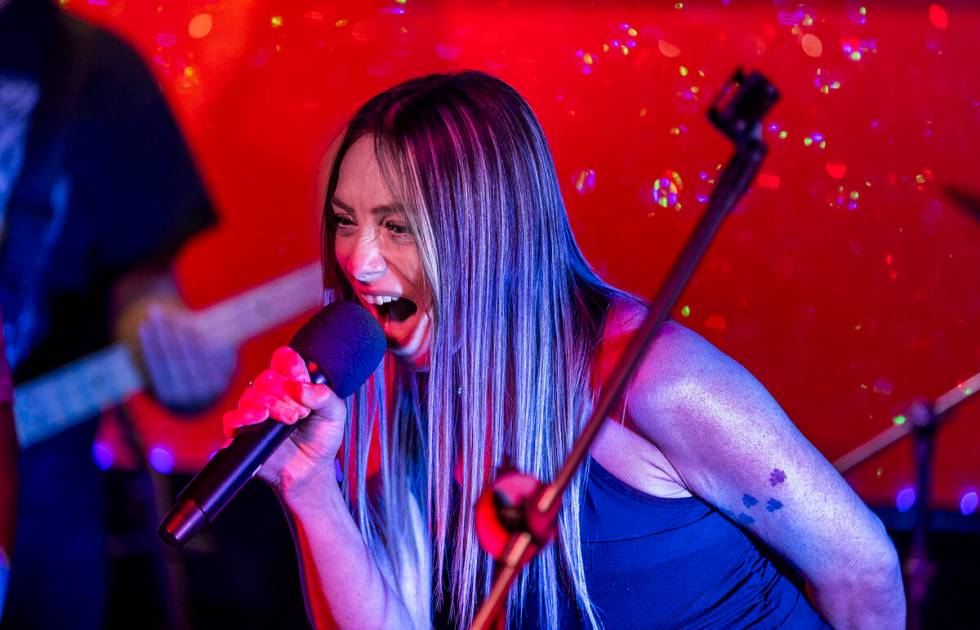
The song is “Highway to Hell,” and the woman on the mic has barreled down that road before, made it a round trip.
“Hey, Satan, payin’ my dues,” Kristen Nolen sing-howls, her words a roar of melody and experience alike. “Playin’ in a rockin’ band.”
About those dues: Consider them paid in full, the grit in Nolen’s voice doubling as her receipt.
“When I was a kid, I used to sing a lot,” she tells us a few weeks later. “I was a really good singer as a child.”
Then came drugs and booze, a decade and a half of active addiction after dropping out of high school at 16.
“My voice went,” she recalls. “I ended up getting really raspy.”
After eight years sober, Nolen’s voice is back.

“I still have a little bit of a rasp,” she notes. “It’s, like, rockin’.”
And so she rocks, currently flanked by seven bandmates on a recessed stage at the Neighborhood Bar, a come-as-you-are locals hang nestled in a west valley strip mall.
It’s the last Tuesday of April, which means the Recovery Band is in the house tonight for its monthly jam session.

Guitarist and group founder Dave Nooks explains the concept to newbies.
“We meet every Saturday, we get together, we get loud and we recover together,” he says by way of introducing the group. “There’s no f – – – – – – reason that you can’t have a good time and be sober at the same time.”
Yes, everyone here grasps the irony of a bunch of Budweiser-free types playing a tavern.
“A guy opens a business to sell booze, and here comes the Recovery Band,” guitarist Jerry Koren quips during a practice session beforehand.
No need to sweat it; there will still be a bar tab.
“We’re going to drink f – – – – – – Cokes and coffee,” Nooks says. “And we’re gonna rock out.”
He speaks from experience: A lifelong musician, he’s toured the country in ’90s buzz bands, been on MTV, been in prison and been homeless on the streets of Las Vegas — in that order.
Now, he’s leading this rotating cast of musicians and nonmusicians, veteran players and total neophytes who never touched an instrument before coming to Recovery Band Camp, where they all work through their addictions together, one AC/DC banger at a time.

“It’s rock ’n’ roll therapy, man,” Nooks explains. “Whatever that means to you, whatever therapeutic benefits you get out of loud-ass rock ’n’ roll and connecting with people on that level. You know, feeling it.”
Tonight, he’s doing something he never did when he was playing 4,000-seaters on the road opening for Sublime back in the day: performing sober.
“We’re going to do a couple songs,” Nooks tells the crowd before glancing at his bandmates, his eye contact the green light to get started. “All right, let’s do it, man.”
‘I’m an alcoholic … but that’s not all that I am’
We first meet the Recovery Band in their artfully graffitied rehearsal space at the Shine a Light foundation downtown, the large backroom brightened by works from local creatives.
The walls here don’t talk; they sing: “Be uncommon,” a mural of piano keys reads next to a smiling face with vinyl records for eyes.
It’s 3 p.m. on a Saturday a few weeks before the show at the Neighborhood Bar, and around a dozen or so have showed up for the weekly practice session.
Some come every week, some more sporadically; some come to play, some to just listen.
Some, like Koren, a first-wave L.A. punk who cut his teeth at shows by pioneers such as X and The Go-Gos, have been gigging since the early ’80s. Others have never been on a stage until joining Nooks on the one on the far right of the hall.

“Early in recovery, it’s like, ‘Oh, now I have to do the steps, then I have to get a sponsor, then I gotta get a job,’ and you forget about that creative part of your brain,” Nooks says as the band gets ready to do its thing. “You gotta let it out, man.”
For the next two hours, that’s just what they do, banging out alt-rock karaoke staples (The Cranberries’ “Zombie”) alongside the occasional original (“Higher Ground,” a bluesy slow burner with lyrics by singer Krista Wells).
At the beginning of each practice, everyone briefly checks in and shares how they’re doing with the rest of the group. But then, it’s all about the music, because here’s the thing about being an addict in recovery: You spend a lot of time talking about being an addict in recovery.
It’s part of the process — a process that Nooks wholly embraces.
“I’m an AA guy, saved my life, 12 steps — genius,” he says.
It’s a balancing act, though, acknowledging your addictions without being defined by them.
“When I’m in an AA meeting, I’m Dave, I’m an alcoholic,” he says. “But that’s not all that I am, right?”
Right, but as Nolen shares, it can feel that way at the beginning of recovery — emotions, self-worth, tender as a fresh bruise.
“Living a life in addiction, deep down, we know that how we’re living is not dignified,” she explains. “So, living that way for years and years and years — letting our family down, losing everything, shrinking, not having s – – -, all the things that we go through, the guilt — our self-esteem when we get into recovery is, like, nil. We feel like the biggest pieces of crap when we come in here.
“Being an addict or an alcoholic, like, ‘OK, yeah, I used to drink,’” she continues. “Now, I play music.”
This being said, you don’t have to play music to be here.
“It’s very much a ‘Come bang on something, come yell, come scream, come whatever. Come listen,’” says Rob Banghart, director of community outreach at Shine a Light and a recovering addict himself. “A part of recovery is finding who you are — this is an outlet for that.
“You get to these places, these little bumps in the road, where you feel like maybe you don’t have your uniqueness, you don’t have your individuality, you feel like you’ve kind of lost yourself,” he continues. “Some of that’s the transition from active addiction into recovery, where you’re learning who you are again and trying to find out who you are — and recovery does become who you are. This is a way to have that space in a safe environment where you can be authentically you.”
And today, they are authentically rocking.
The Recovery Band might be open to anyone regardless of instrumental proficiency — or complete lack thereof — but the core of the group is anchored by serious players: Nooks; fellow guitarist Jacob Andrzejczak, a total shredder fond of Pantera riffs; seasoned drummer Jarrin Mose and Nolen, the group’s de facto frontwoman and a powerhouse vocalist, rasp and all.
Midway through rehearsal, the band takes a swing at Sublime’s “What I Got.”
Nooks smiles knowingly, a little ruefully, as Nolen wraps her lithe voice around playfully debauched lyrics that have taken on a whole new, sad meaning since the song was originally recorded over three decades ago.

“I got a Dalmatian,” she sings. “I can still get high.”
A month later, over a whole lot of caffeine at the Coffee Pub, Nooks tells us about how he once helped Sublime frontman Bradley Nowell kick heroin while his band was on tour with the future ska-punk stars in the fall of 1995.
The following spring, the 28-year-old Nowell relapsed and died.
Eighteen years later, Nooks nearly did the same.
Drugs, death, prison: A rocker’s downfall
In late summer 2014, Nooks had a massive heart attack and flatlined, dead but not gone.
After two decades of crack, heroin and booze, his body just gave out.
He was revived, shuttled to Valley Hospital Medical Center for emergency surgery.
“I was in a coma for about a month,” he recalls. “Everything changed after that, man.”
And not for the better.
Married at the time, he walked out on his wife and two young stepdaughters.
“I went off the deep end,” he says. “I was befuddled. I turned to the streets.”
Nooks spent the next five years homeless, copping dope in the drainage tunnels beneath the city, each day an indivisible blur from the next.
“There was no time horizon. It’s just, like, from minute to minute,” he remembers, his existence — a loose term at this point — reduced to an endless, tiresome series of unanswered questions. “Where am I? What’s the hustle? How am I gonna get high? Where am I gonna be? What am I gonna do?”
It was a hard, crushing fall from the heights he once scaled as a professional musician.
Born and raised in Akron, Ohio, Nooks moved to Chicago after graduating high school in 1988 to join the city’s then-booming alt-rock scene, flush with burgeoning greats such as Urge Overkill, Jesus Lizard and the Smashing Pumpkins.
He’d become roommates with Wesley Willis, a music-obsessed bear of a man who struggled with schizophrenia and who’d become the beaming, head-butting face of outsider music in the early ’90s.

Nooks helped found the Wesley Willis Fiasco, the band briefly becoming an underground sensation thanks to Willis’ poignant, self-effacing, shout-punk earworms and a famously endearing 1996 interview with MTV News.
Among the Wesley Willis Fiasco’s biggest boosters was Sublime, who brought the band on the tour and took them under their wings — though not without some ruffled feathers.
Nooks recalls a tense backstage encounter with Nowell at a gig in Boston as the singer battled heroin withdrawals.
“I went and got him some food, and he’s like, ‘F- – – you, man,’ grabbed the hamburger from me, threw it on the ground, threw a beer at me,” he says. “He was kicking, and I helped him along with that. By the time we got to Detroit, it was like, ‘There he is.’ He was with us, you know? He was just such a good dude.”
But Nowell’s sobriety wouldn’t last, and by the time of the Sublime singer’s death, Nooks had plunged deeper and deeper into the grips of the very drug that claimed his buddy.
“I had to go through my own addictions,” he says. “Crazy how it works, right?”
Nooks suffered another devastating loss when Willis died of leukemia in 2003.
He was a full-blown addict by then, and he attended Willis’ funeral strung out, which led to an incoherent NPR interview at the memorial service.
“The next day my uncle from Cleveland called me up,” he recalls, “and he’s like, ‘Dude, what the f- – – is your problem? I just heard the interview on NPR. What’s going on with your life? Do you need to make some changes or what?’ And then it just got worse after that.”
Nooks and his girlfriend decided to relocate to Las Vegas to join a recovering addict friend who was planning on starting a record label, which Nooks was going to help run — but then the friend relapsed and overdosed.
Death was everywhere, it seemed.
Still, the couple made the move.
“I just wanted to survive; the focus was making a change in my life,” Nooks says. “I thought I was gonna move out here and get sober, but I moved my crackhead a- – out here and found the first dope dealer, because you attract what you are.”
A year and a half later, Nooks did seven months at High Desert State Prison in Indian Springs after a probation violation on an assault charge.
His girlfriend was pregnant. Nooks was behind bars when his son was born.
Light — and really loud guitars
After his 2014 heart attack, Nooks did another stint in prison on another probation violation, this time on an attempted forgery charge.
When he got out 15 months later, he still wasn’t ready to get clean.
“It took me about 12 hours before I had a pipe in my mouth and a needle in my arm,” he says. “Back to it, man.”
But Nooks’ health woes mounted — he was on prescription medication for congestive heart failure and would often botch the dosage.
“I couldn’t take my medication right on the street — I was on more pills than my friggin’ grandpa,” he says. “When I didn’t take my medication, my legs would swell up like Fred Flintstone and I couldn’t walk.”
He ended up at Desert Springs Hospital Medical Center after suffering another heart attack, along with hepatitis A and double pneumonia.
He’d finally had enough.
“2019 is when I decided, I’m done,” he says. “Now what?”
The answer came when a caseworker took Nooks to the now-shuttered Serenity Club recovery center in Chinatown, where Nooks started going to Alcoholics Anonymous meetings and became friends with fellow recovering addict and musician Andrzejczak.
“I just hung out there, met some people and tried to do what they were doing, listened to what they were talking about,” Nooks says. “I didn’t look back.”
He kicked his habit while still on the streets. Nooks would go to meetings by day, then get dropped off at a homeless camp near Valley View Boulevard and Tropicana Avenue at night.
Paying it forward, he started volunteering as a peer support coach for the Foundation for Recovery, working the emergency rooms in the Dignity Health system. He was eventually offered a full-time gig, signing up for a 3 p.m. Saturday slot to run his own program.
He didn’t know what it would entail exactly, but he knew it would involve rock ’n’ roll.
He thought back to Willis, and how he used music to combat his mental illness.
“I saw how Wesley was tortured by voices in his head,” Nooks remembers. “He had their names; he had been hearing them for years.
“The life that he came from, and the things that he was able to do in spite of that, was one of the most inspirational things I’ve ever seen in my life,” he continues. “That was a huge driver for me doing band camp.”
Nooks recruited Andrzejczak, who’d been collecting a sizable amount of music equipment.
“I got an OK job, started making some money, and I just started buying gear,” Andrzejczak says. “I had a whole house full, just trying to get back into music. Dave had the great idea, ‘Why don’t we start this program? You want to do this with me?’ And I’m like, ‘Sure, we’ve got everything.’”
They started small, just jamming in a room at the Foundation for Recovery with anyone who wanted to drop by.
Like a hit song taking over the airwaves, word spread, more people started coming, and they eventually relocated to their current, much bigger practice spot at Shine a Light in early 2025, invited by Nooks’ friend Banghart.
“We saw how the connection of music and having something in common besides just recovery was helpful to us,” Andrzejczak explains. “So, why not start it up and let everybody be a part of that? And it’s fun. A lot of times recovery can be boring. But it doesn’t have to be.”
‘I need music right now’
“OK, my name is Britney,” she begins, her dark, wavy hair darting over black-rimmed glasses during a band camp practice in April. “I am a recovering addict, alcoholic. I come here because I love music — and it’s helped me get through.”
For seven years, Britney Hawks had that music taken away from her.
A victim of human trafficking, she was denied one of her most profound passions by her abuser.
“I wasn’t allowed to sing, I wasn’t allowed to listen to this, I wasn’t allowed to have instruments,” she recalls from a booth at a Panera Bread restaurant by her home in May. “It was the guy’s rules or nothing at all.”
Hawks escaped in 2020, only to then get lost in addiction, eventually getting sober two years ago and then moving to Vegas from Jacksonville, Florida, last September.
Two weeks after she left, her younger sister died. Hawks’ sobriety was imperiled by the devastating loss — and she knew it.
Hawks, who lived near the Foundation for Recovery, stopped in one day and attended her first band camp practice a short time later.
“I went in there, and I was like, ‘I need music right now,’” recalls Hawks, a regular ever since.
“I felt like I was heard and understood for the first time,” she says. “It felt like there’s other people that understand why I needed that music, and needed that connection of other people — like-minded people.
“When I walked in, I really felt like I belonged,” she continues. “I get to be around people that have experienced life stuff, that have come through it — we’re at the other end, and music is helping us get through it. If I didn’t have what I have today, I think I would have relapsed. It’s just a given.’”
Blake Rosen can relate.
Before he started coming here a year and a half ago, he’d never played the drums.
“I have pretty low self-esteem — always did, my whole life — being bullied and everything as a kid, and always a shy person,” he says. “That’s one of the reasons I never played the drums or ever tried to do new things like that, because I was always nervous of screwing up, getting made fun of, that type of thing.”
During an RBC rehearsal session in June, he drums the air from his seat near the stage, waiting for his turn behind the kit.
Nooks gestures to Rosen. He takes the sticks, and we see him come alive.
“I was nervous at first, and then once you start doing it, you realize there’s no judgment in there,” Rosen shares. “It just very quickly becomes a family. I never really had that before, which is one of the reasons I drank, every night, alone and everything. I’m finally, actually, like, living a life now.”
Why does Nooks think that jamming can generate that kind of connection?
“There’s something about playing a song with somebody, it’s like jumping on a f – – – – – – ride,” he says. “It’s like jumping on a really fast motorcycle ride or roller coaster ride.
“Looking over and communicating that energy,” he continues, “sharing that energy, even if it’s for, like, three minutes, that’s just deeper, man.”

‘This is where I belong’
On a Tuesday night in April, Hawks plays the very first show of her life.
Wearing a black T-shirt adorned with a heart and a bouquet of roses, she taps out the beat to The Cranberries’ “Zombie” on her hip with her left hand, cradles her cellphone with the song’s lyrics in her right as she backs Nolen’s lead vocals.
Hawks sings with an oomph you can see in her diaphragm, Rosen behind her, anchoring the rhythm section, driving the beat.
It wasn’t easy getting here: Battling a deep depression that she attributes to not fully grieving the loss of her sister, Hawks attempted to take her own life in March.
She ended up in the hospital. Nolen and Nooks were among the first people she called.
“They’re like, ‘It’s OK. Next time, just talk to us. We’re here.’ They really showed up,” she says. “I just started really going back and digging into the band again. I’ve been going every Saturday, showing up, to be with other people that are like me.”
For some, the Recovery Band is a means of reclaiming that part of themselves they sacrificed to addiction.
“My recovery was getting back to who I was,” Andrzejczak says. “I had a half-a-million-dollar house at 23. I was super successful, went down the path, ended up with nothing. Homeless.
“Luckily somebody gave me an opportunity; I was able to come back,” he continues. “But in that process, you lose yourself — a lot of yourself. It’s down deep in there, but this helped me dig out a big part of myself — who I used to be — to bring me back to who I was before I fell.”
For others — like Hawks — it’s about taking new steps to distance themselves from old hurts.
She might have had music taken from her once, but tonight, she’s taking it back.
As the band’s set at the Neighborhood Bar ends with a suitably fiery “Highway to Hell,” there she is by Nolen’s side as they belt out the chorus together.
A few weeks later, we catch up with Hawks. She’s still buzzing from her first time onstage.
“It honestly felt like I belong there. Like I got up there, I’m just like, ‘Whoa,’” she says. “It felt like a good feeling, like, ‘This is what I’m supposed to be doing. This is where I belong.’”
She tells us she wrote a song for her late sister.
It’s called “Forever 32,” a nod to her sibling’s age at the time of her death.
She intends on sharing it with the band.
Maybe you’ll hear it someday.
If you’re thinking about suicide, or are worried about a friend or loved one, help is available 24/7 by calling or texting the Lifeline network at 988. Live chat is available at 988lifeline.org. Additionally, the Crisis Text Line is a free, national service available 24/7. Text HOME to 741741. ◆