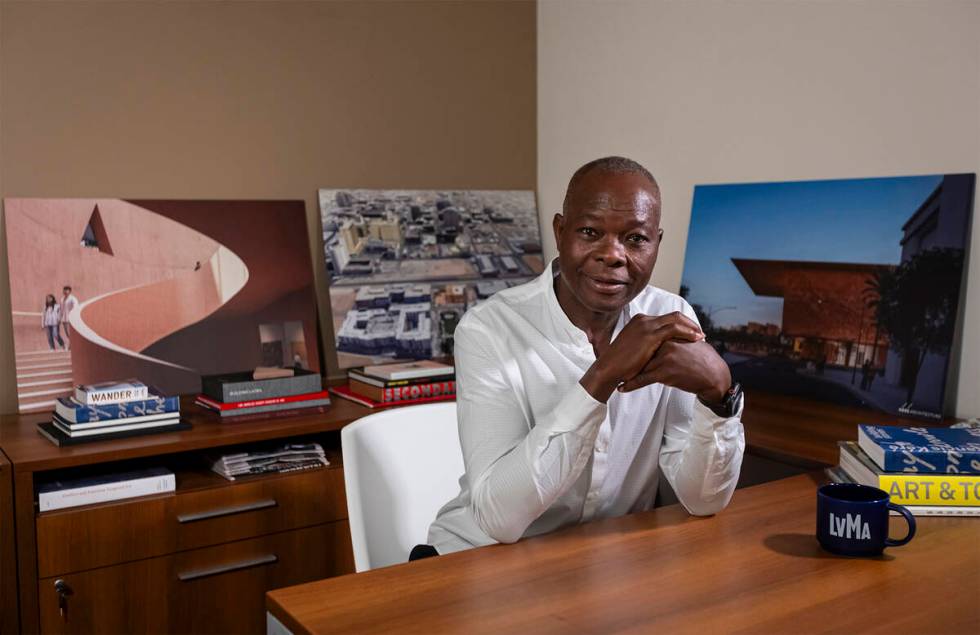
Like pretty much every career in architecture, Francis Kéré’s began in a classroom.
His was darker and hotter than most, though — a stuffy concrete box where even breathing could feel laborious.
“How could it be so blindingly bright outside and yet so lightless, so airless inside?”
At 7, Kéré didn’t yet have the answer — that would come much later, earning him the highest accolades in his profession and world renown as a paragon of sustainable architecture.
Back then, he was trying to become the first member of his family, of his entire village of Gando in the West African nation of Burkina Faso, to learn how to read and write.

His father, a chieftain, sent him to the city because there were no schools where they lived — or electricity or access to clean drinking water.
“When he sent me, it was not a privilege; it was a sacrifice,” Kéré recalls. “He has been mocked. Some people call him stupid. ‘Why is he sending his first son to school instead of letting him work in the fields? He may not come back.’”
Burkina Faso is the world’s hottest country (average daily temperature, 86 degrees Fahrenheit). It’s also among its least educated, with a literacy rate under 25 percent, and poorest, its gross domestic product a scant $32 billion in 2025. (By comparison, Nevada’s 2025 GDP was $210 billion.)
After earning a carpentry scholarship in Germany as a teenager and another in architecture at the Technical University of Berlin, Kéré did come back.
His first major project: to design and construct an elementary school in Gando, created by his own hands, financed through a foundation he established while still in college.
Kéré didn’t just want to build a school for his people, he wanted to build a school with his people, involve the community, utilize — and maximize — what limited resources they had.
He taught the villagers how to create earthen bricks from a composite mix of cement and readily available, locally sourced clay, forming walls that buttressed an innovative double-roof design composed of those bricks and corrugated metal that provided maximum ventilation, significantly reducing classroom temperatures.
It was forward-thinking and functional, cost-efficient and sustainable, a work of art and of utility, all at once.
“I wanted to raise the horizon of my people, to create a place where the kids will stay within the community and attend education,” Kéré explains, “to make sure no one experiences my childhood, sitting in the space that is dark and very hot.
“So I created it,” he continues. “And it grows.”

After the opening of the Gando Primary School, enrollment increased nearly sixfold, from 120 to more than 700, and two neighboring villages followed suit, erecting community-built schools of their own.
The project earned Kéré the prestigious 2004 Aga Award for Architecture; in 2012 The New York Times’ T Magazine named it one of the 25 most significant buildings created post-World War II.
A decade later, Kéré became the first native African to earn the Pritzker Prize, architecture’s highest international honor and widely referred to as the “Nobel Prize” of the field.
Now, after visiting professorships at Harvard and Yale and working around the globe, from Spain to Italy, the United Kingdom to Mozambique, the 61-year-old has come to Southern Nevada to design the long-gestating, $200 million Las Vegas Museum of Art.
Set to open downtown in Symphony Park in 2029, the 60,000-square-foot building will be the city’s first free-standing art museum and is expected to draw more than 2.4 million Vegas residents among millions of other visitors every year. (The museum also plans to break ground this month on its Grand Central Galleries, a nearby temporary exhibition space and media lab scheduled to open next year.)
At first blush, it might seem an unlikely pairing: a man from a land of intense scarcity, who creates works born of necessity, of survival, decamping to a city of opulence and conspicuous consumption to help bring to life a cultural milestone decades in the making.
But there are ties between the two — some geographical.
“Of all the Pritzker laureates, he is the only one who was born and raised in a desert climate just like ours,” says Roger Thomas, an LVMA board member and one of the driving forces behind the museum. “It’s as hot. It’s as dry. Water is as precious. Shade is as precious. This man makes magic out of mud, literally.”
As Kéré sees it, there’s a deeper connection as well.
“Behind all of these societies, there is a community,” he says, “and that’s what I have been given the chance to discover.
“A group of people dreaming to create a place of art, a place of encounter for their community,” he continues. “And then you start to say, ‘Who is this community?’”

The man from the desert meets Vegas
On a weekday afternoon in August, the head of the Las Vegas Museum of Art stands by the altar of the Guardian Angel Cathedral, eyeing a gorgeous, ornately wrought stained glass image of the Virgin Mary ascending over the Stardust casino, among other Vegas signatures of the past and present.
“I don’t think there’s any other church in the universe that depicts the Stations of the Cross with someone throwing dice,” Heather Harmon notes. “I love that we can do something very traditional, but still do it with our own style and our own way.”
Harmon, a fourth-generation Las Vegan and longtime local arts advocate, has long cherished the A-frame structure designed by pioneering African American architect Paul Revere Williams, and often brings visitors looking for a special perspective of the city.
She knew she wanted Kéré to see the space when he came to Las Vegas for the first time, after Elaine Wynn proposed hiring him for the project. Before her death in 2025, Wynn orchestrated the museum’s creation as a partnership with the Los Angeles Museum of Art and pledged financial support to get it started.
“For us, it was so important that the project was grounded in community,” Harmon says. “And really, the best way to know the community was to show the community, to share the community.

To do that, Harmon and other museum board members took Kéré to several iconic locations around the valley, including Valley of Fire State Park, Hoover Dam, the city’s Historic Westside, and the east valley’s Ward 3.
“We wanted him to be able to have a range of experiences,” she said. “If we took the time to visit places that were very dear to us and often shaped those that live and work here, then the building itself could be shaped with that same intention.”
The cathedral, a hidden sanctuary tucked just off the Strip, left a particularly impactful impression.
“It was like a quiet place in the middle of a noisy city,” Kéré recalls. “It was really impressive — it was really even overwhelming. You just drive, and then all of a sudden you turn and you have this place, and I start to say, ‘Wow.’”
His visit directly informed his thinking about the kind of atmosphere he wanted to create at the museum, the purpose it would serve.
“We have to design it to be like a place of calm, that it’s quiet,” he explains. “Where the people can go and be grounded again with the reality surrounding the city.”
‘Why do they want me?’
Kéré’s very first sketch of the Las Vegas Museum of Art was done on a napkin over breakfast in Berlin a little more than two years ago.
He titled it “A Dream for Las Vegas.”
The drawing features a lighthearted flourish: a smiley-faced, anthropomorphic sun looming above the building.
“I think that we could use this sunny boy,” he grins during an interview at the LVMA offices in late July when asked if he was sure that the Vegas sun was so happy, considering the blistering heat outside. “Let’s put it this way: We have to positively deal with it, we from the desert.
“We need to really accept the reality that this playboy is there,” he continues, pointing at his drawing. “We have to make sure we protect ourselves against it.”
Kéré’s playfulness aside, it turns out that the sun — and this idea of providing shelter from it, which has been at the heart of his work since he was a boy toiling in those hot, dark classrooms — was key in unlocking the museum’s design concept.

Upon returning home to Germany from his initial Vegas trip, Kéré was struggling to find an entry point to the project.
“After having absorbed all of the information, I was digesting, I was thinking, and all of a sudden my daughter came and said, ‘Papa, what have you seen there?’” he recalls. “‘What does this lady and her team want you to do? Do you have an idea what it is?’”
Not quite; not yet.
“I really keep thinking, ‘What can I do? What can I do?’” he remembers. “And then, ‘Why do they want me?’
And then the desert native considered where he was from.
“At that moment, I just thought of my own country, and say, ‘I want to create shade,’” he recalls. “I realized, ‘That is it. I have the idea. That is what we have to do.’”
Then he got to work on that napkin.
The design takes shape
Where Kéré comes from, the baobab tree is colloquially known as the “tree of life,” not just because of its capacity for storing tens of thousands of gallons of water in its massive trunk, but because its chaotic tussle of branches provides a rare refuge from the unrelenting sun.
“If you are in my place and you just walk, it’s so hard,” he says. “You’re automatically looking for a canopy, for a tree where you’re gonna rest a little moment before you continue your journey — shade to protect himself. And then, this is where you meet others from the community.”
As Kéré envisioned a gathering place for art in the Mojave Desert, he thought of the desert he grew up in — and the baobab, which became his creative touchstone for the museum’s design.
“I saw this as a metaphor to say, ‘I’m creating a place of shade,’” he says. “‘I’m creating a place of calm for the people coming from the bustling, noisy, daily activities in the casinos, in the resorts. They will come there and refill their batteries and sharpen their senses to go again and keep this city alive.’”
Like his seminal design for the Gando school, the LVMA’s most prominent feature is a large, elevated, overhanging roof.
“In a very naive way, I just said, ‘A community needs a big roof,’” he explains.
And true to Kéré’s penchant for incorporating elements of the native landscape into his work, the facade of the museum will be layered in locally sourced quartzite panels shaded in the rich reds and oranges evocative of the American Southwest.

“The color, the material, the layers of this rock, I start to say, ‘I want to bring part of this nature, this rock, back for the community,’” he says.
Kéré’s trip to the Guardian Angel Cathedral is reflected in the many triangles integrated into the building’s design and the prominent usage of natural light in the second-floor gallery space.
His concept for the LVMA squarely matched Harmon’s vision: a museum that is of Las Vegas, not just in Las Vegas.
“He saw the community,” she says. “And without even having as many extensive conversations as we’ve had now, that initial reaction of caring for and shading our community was a perfect exemplification of what we had hoped to give to our community. It could not have been more synergistic and aligned with how we were thinking about the building and the project.”

A gathering place
For Kéré, growing up in Gando, story time began when the day ended.
He remembers the enveloping darkness of the African twilight when he was a boy, the only source of light being a homemade lantern that was little more than a piece of fabric soaked in shea nut oil.
“We would gather every night to listen to grandfather, grandmother — even the mother and the father,” he recalls. “No one could read and write in my village, so it was oral retransmission.
“You will be sitting, and the story is dramatic,” he continues. “We were squeezing next to each other, and it was for me, like, building a space of safety, where you have our bodies creating this kind of shelter for ourselves, to protect ourselves from the dangers that may emerge (in the stories).”
Certainly, the technical side of Kéré’s work traces back to his youth — the emphasis on practicality, making do with what’s available, countering challenging circumstances with creative problem-solving.
Another intangible quality also informs his designs, a feeling of inclusivity that he’s continually attempting to conjure, which originates in those nightly story sessions.
“I think this is my access to architecture,” he explains. “This is how I may be what I am today, to be able — even with less — to create a sort of atmosphere of protection. Every time, when I have a chance to work, that childhood momentum — How do you create a space where people really feel comfortable or safe? — is always part of what I’m doing.’”
This extends to his design for the LVMA as well.

Among its central elements: The Plaza, “a gathering place for the community,” which is meant to serve as an easily approachable, communal entry point to the museum, and The Canyon, a large, curving staircase visible through floor-to-ceiling glass near the center of the building.
“We designed it to be open, really welcoming,” Kéré says. “It’s where the community will really stay.”
Speaking of which, Kéré has been getting to know this community for a couple of years now.
When he recalls stepping off the plane to Las Vegas for the first time, he speaks of experiencing a palpable sense of wonderment.
“The first thing at the airport, you start to look around, and I start going with my mouth widely open, ‘What is here?’” he says. “Like, ‘I am finally in the land of fantasy.’ You have to just see this bubble of happiness.”
Then he pivots to the people behind that wonderment.
“What you don’t see, until you arrive and you realize, ‘Wow, there’s a real community,’” he says. “You discover those who have imagined and created this place of fantasy where human beings’ hopes and dreams can be real.
“You meet these people that are making sure that these dreams keep going — I’m talking about those working in hospitality and the casinos,” he continues. “You go around, and all of a sudden, you realize the many, many layers of this community — not just the tourists. And they’re here to make Las Vegas be what it is, you know?”
And so like those schoolkids in Gando, he created something just for them.
“It is very different economically, a different community,” he says, contrasting his home village with Las Vegas. “But in terms of a desire to have a place where everyone could come, a place that is for everyone, it is the same.
“I want it to be an address that people can just say, ‘Let’s go!’” he exclaims. “‘Let’s meet at the Las Vegas Museum of Art.’”
Where there’s shade. ◆