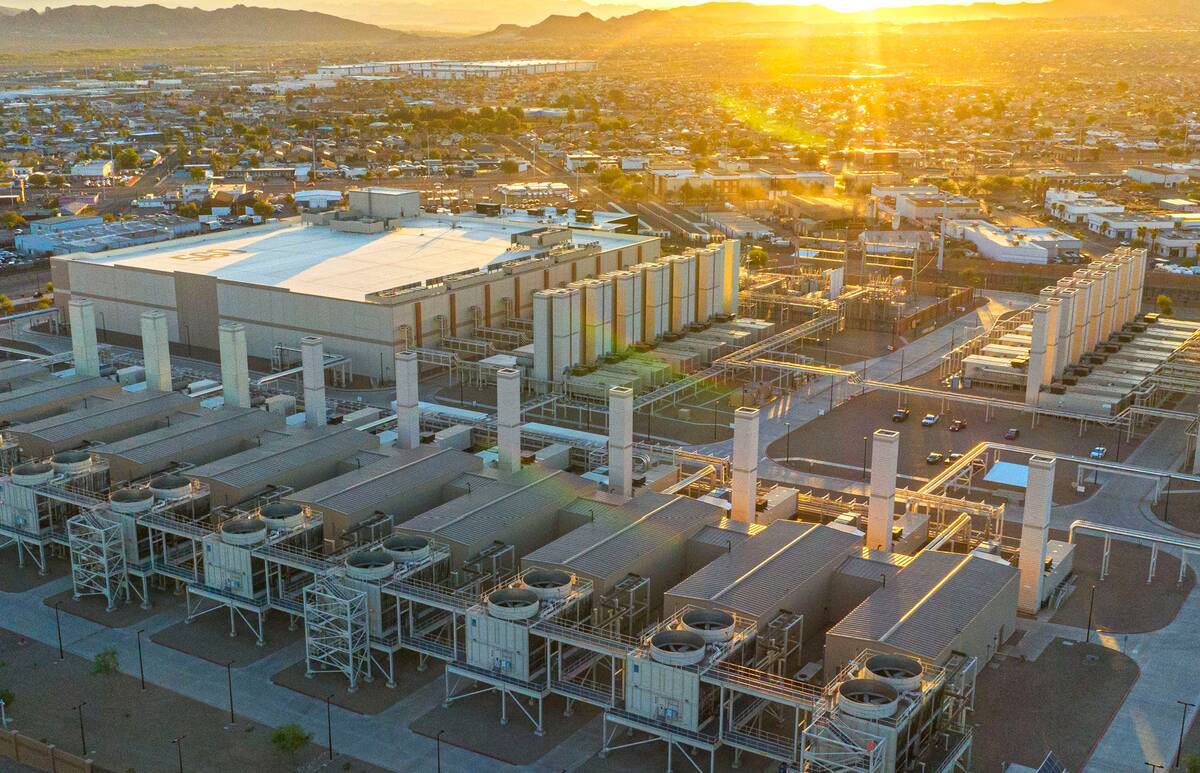
Nevada has become one of the nation’s hotspots for data center development over the past two decades, sparking questions about how the industry affects the energy grid, water resources and more.
As of May 2026, the Nevada Legislative Counsel Bureau reported that about 70 data centers were planned, under construction or operational in Clark, Washoe, Elko, Lyon and Storey counties. Those are mostly clustered in Storey County’s Tahoe-Reno Industrial Center near Reno, though Switch and other companies have a significant Southern Nevada footprint.
Data centers remain wildly unpopular — one poll conducted by the University of Massachusetts Amherst in September says only one in nine Americans support the construction of one in their community — and are a divisive issue in the 2026 midterm elections. It’s a sure bet that the state Legislature will revisit the issue, with several bill draft proposals underway.
Here’s what Nevadans should know about data centers as the Las Vegas Review-Journal continues to report on the issue.
What are data centers, anyway?
Data centers are rooms, buildings or facilities that house IT infrastructure that powers online applications or services and store and transmit data. They provide the backbone of a modern digital economy.
The fast pace of artificial intelligence development has meant that tech companies need more data centers to keep up with the demand for AI computing capacity.
Where are data centers located in Nevada?
Concerns over data centers have largely been viewed as a Northern Nevada issue.
The Tahoe-Reno Industrial Center in Storey County was one of the top 3 fastest-growing markets for data centers in 2025, according to the Desert Research Institute, due to its proximity to Silicon Valley in the San Francisco Bay Area and no state income tax. The 167-square-mile industrial park is three times the size of San Francisco and hosts companies including Google, Switch, Microsoft, Tract, EdgeCore, Novva, Vantage and PowerHouse.
Southern Nevada is home to Switch’s corporate headquarters and several of its data centers in southwest Las Vegas was well as a Google data center in east Henderson. Tech developers have identified plots of land within the Apex Industrial Complex in North Las Vegas for development, as well.
How much electricity do Nevada data centers use?
While data centers only account for 5 percent of NV Energy’s electricity sales now, the utility that serves 90 percent of the state including Las Vegas and Reno is forecasting that number could grow to 64 percent of its electricity sales by 2046.
NV Energy’s existing and approved systemwide generating capacity through 2050 is roughly 10 gigawatts. If projected data center demand materializes, the systemwide generating capacity needed to serve projected demand could exceed gigawatts by 2050, potentially requiring more than twice the utility’s currently existing and approved generating capacity.
Utility leaders have acknowledged that data centers could hamper NV Energy’s ability to reach its state-mandated clean energy goal of sourcing half of its energy from renewable sources by 2030. New natural gas plants — considered a fossil fuel energy source — may be the utility’s solution to growing demand, though plans must be approved by the Public Utilities Commission of Nevada.
How much water do Nevada data centers use?
Data centers are not required to publicly disclose their water usage.
However, a Review-Journal analysis of records obtained through a records request showed that, collectively, data centers used 716 million gallons of water in 2024, enough to supply about 4,395 single-family households.
A Desert Research Institute report estimates that just 12 of Nevada’s facilities are on pace to use about 9,647 acre-feet, or nearly 3.14 billion gallons, of water per year by 2033 — roughly the annual household water needs of 24.1 million people.
Does water used by Southern Nevada data centers return to Lake Mead?
Water usage is now directly tied to the Southern Nevada Water Authority’s ban on evaporative cooling, which prevents new data center development from using Colorado River water for cooling.
Still, some data centers are not subject to the newer restriction, including Google’s Henderson data center, which, according to the company’s 2026 sustainability report, consumed 239.4 million gallons of water in 2025.
Will Nevada data centers increase residents’ electric bills?
This remains to be seen.
Some industry insiders say individual bills could fall if tech companies allow utilities to access its infrastructure, however, no protections currently exist to ensure that ratepayers will not find themselves on the hook for grid improvements needed to handle the extra demand.
To ensure the costs needed to upgrade infrastructure are not shifted to existing customers, NV Energy has proposed agreements that would require large customers to make long-term service commitments and fund or support the infrastructure and generation needed to serve their load.
Those large-load agreements are subject to the approval of the Public Utilities Commission of Nevada.
What tax breaks do Nevada data centers receive?
Nevada’s tax abatement structure of data centers has been the subject of scrutiny as of late.
In 2015, a bipartisan bill passed by the Legislature and signed by then-Gov. Brian Sandoval, a Republican, created a program where data centers can receive breaks of up to 75 percent of personal property taxes for 10 or 20 years.
The Governor’s Office of Economic Development Board, by two-thirds vote, can reduce sales and use taxes to 2 percent from the state’s base rate of 6.85 percent, as well.
For the 10-year abatement, companies must employ 10 full-time Nevada residents within 5 years, pay at least 100 percent of the statewide average wage and spend at least $25 million over half a decade. For the 20-year abatement, the number rises to 50 full-time employees and at least $100 million in spending.
What is Switch building in Nevada?
Switch’s corporate headquarters are in southwest Las Vegas with several data centers on a campus it calls “The Core.”
Its data centers run off 1 gigawatt of solar energy that it built and third-party suppliers, according to the Associated Press, and the company is in the process of constructing more solar fields. It only uses NV Energy’s grid for electricity delivery.
In late August, Switch bought 176.5 acres in North Las Vegas’ Apex Industrial Park for $196 million. Since late last year, Switch purchased roughly 546 acres in Southern Nevada, mostly in Apex, for about $463 million combined through several transactions, property records show.
What are Nevada politicians proposing for data centers?
Data centers have become an election issue, with Democratic gubernatorial candidate Aaron Ford saying he wants to pause their tax breaks, impose a statewide ban on evaporative cooling, conduct public hearings on proposed data centers, support community benefit agreements and work on stronger labor standards.
Incumbent Gov. Joe Lombardo, a Republican, has said data centers present a economic opportunity, but added that his administration will only accept data centers if they have responsible plans in place for water usage, energy generation and infrastructure demands.
Republicans and political advertisements have been highlighting the fact that Ford co-sponsored the bill in 2015 that created the tax abatement program for data centers when he was minority leader of the Nevada Senate before changing his position more recently.
An interim committee of the Legislature, led by Sen. Dina Neal, D-North Las Vegas, voted to draft a bill to pause data centers throughout the state and repeal their tax breaks. Two Republicans voted against it.
So far, Nye County is the only Southern Nevada county to pass an outright ban on data centers, which extends to the over-stressed water basin that serves Pahrump. The Henderson City Council considered a moratorium but opted to require its staff to negotiate development agreements on a case-by-case basis.
The Clark County Education Association, the largest teachers union in Nevada that has endorsed Lombardo, says the sales tax abatements for data centers have cost K-12 schools roughly $357 million since 2015. Its leaders are seeking a bill sponsor to make tech companies pay that tax going forward.
Are companies building data centers on public land?
They might be. One Texas-based company is moving forward with its plans to build a data center on Bureau of Land Management-managed land in Boulder City. However, an administrative judge granted city officials and environmentalists a stay, halting construction while their joint appeal is considered.
Previously, the data center developer sought a city lease — one that the Boulder City Planning Commission recommended the City Council reject. That plan was abandoned once the federal permits came through.
The case is the first of its kind in the nation, the BLM approved converting its approval of the solar-project permit for the data center without further environmental review. It is a direct response to President Donald Trump’s 2025 executive order that directed agencies to speed up permitting for data centers on public land.
Contact Alan Halaly at ahalaly@reviewjournal.com. Follow @AlanHalaly on X. Review-Journal staff writers Emerson Drewes and Eli Segall contributed to this report.