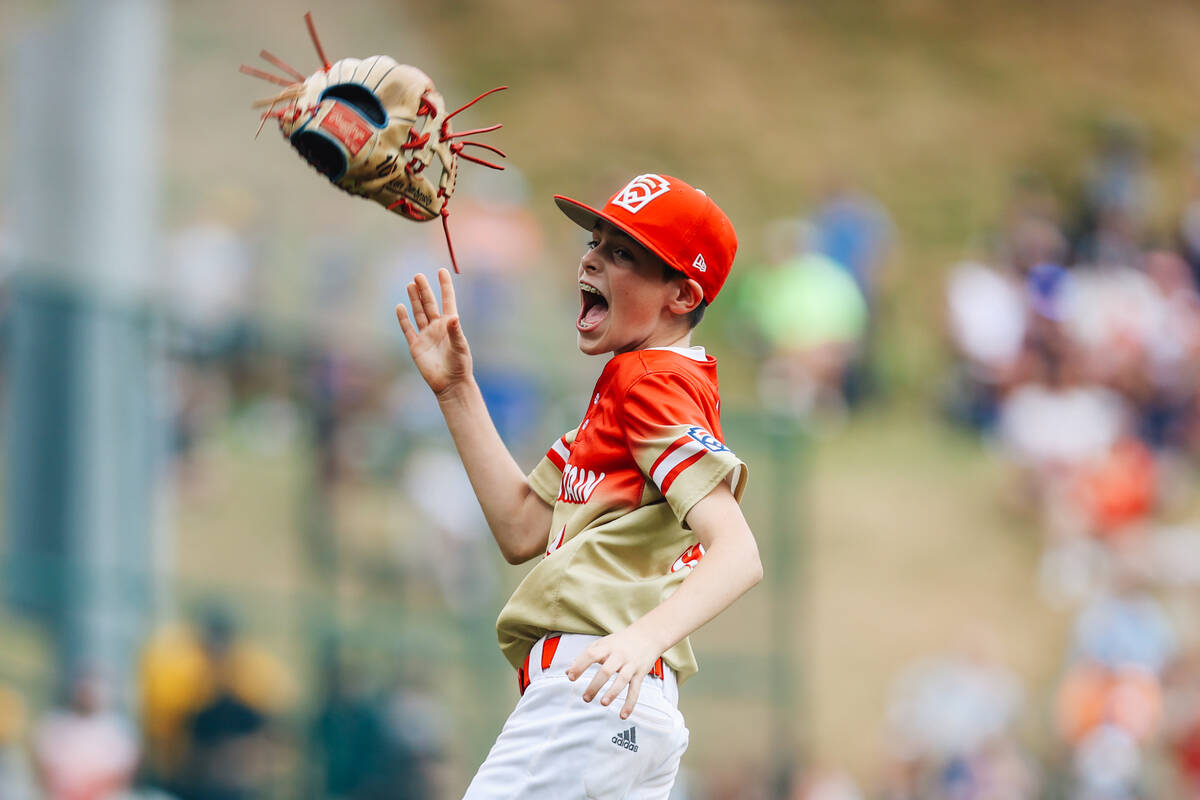
Three U.S. championships in five trips to the Little League World Series.
For Nevada, that is the reality of a run that has transformed the state from a perennial outsider in South Williamsport, Pa., into one of the tournament’s most consistent participants.
Nevada has reached the Little League World Series five times since 2014, with three of those teams winning the U.S. championship. The past two — Summerlin South in 2025 and Paseo Verde this year — have gone back to back.
The state’s most recent run has made it just the second U.S. league to win consecutive U.S. championships, joining Long Beach, California, which won consecutive titles in 1992 and 1993.
For those who have watched the game develop in Southern Nevada, including Mountain Ridge coach Ashton Cave, who guided the first Nevada team to reach the Little League World Series in 2014, the rise has been years in the making.
“There were many Las Vegas teams from prior to us who got so close, came up a few runs short,” Cave said. “We were given an opportunity, and it was just the perfect storm, and we were able to capitalize.”
Mountain Ridge emerged from the old West Region at a time when Nevada’s path to Williamsport included some of the country’s traditional Little League powers, including California and Hawaii.
California has won eight Little League World Series titles and 15 U.S. championships, while Hawaii is tied with Connecticut, New Jersey and Pennsylvania with four titles each.
However, when Little League expanded the World Series field from 16 to 20 teams in 2022, it created new U.S. regions, including the Mountain Region, where Nevada was moved away from California and Hawaii.
Since 2023, Nevada has won the Mountain Region four consecutive years, sending a team to Williamsport each time.
“They’ve kind of broken up the two regions and put Nevada in a different region, which is nice because it allows us to have more opportunity,” Cave said. “But even though California and Hawaii were almost impossible in the past, something’s changed.
“There is something in the air, and because of that, we have been opportunistic over the last few years, and surrounded by great coaching, great community, and great parents and players, we’re kind of seeing the proof in the pudding.”
Cave has watched the Las Vegas Valley grow during the same period that baseball has become increasingly entrenched in the community. More children are playing, and they are playing more often.
Las Vegas’ weather allows young players to train throughout the year, while travel baseball has provided another avenue for players to gain experience outside of Little League.
The Valley has also attracted people with extensive baseball backgrounds, from former college players to minor leaguers and major leaguers who have settled in Southern Nevada. Some have become coaches or instructors, passing their knowledge to younger players.
“You have kids playing year-round baseball and year-round travel ball, and (Las Vegas) has become a center for retirement, bringing in talent from Division I levels to minor league levels and finally to major league levels,” Cave said.
“When everybody is getting exposed to that great talent and mentorship, that is going to create better athletes. You get more repetitions and you get better coaching.”
An aspiring baseball player in Las Vegas no longer has to imagine what it would be like to play in Williamsport. He can look at another kid from his community who already did it.
“Sometimes it becomes contagious,” Cave said. “It just takes the one and then that mentorship and that exposure for those young kids. They see something that was never thought possible to be accomplished by this guy, and then they gravitate to that.
“It just shows you that sometimes you just gotta create a belief, and once that becomes a reality, then the sky’s the limit.”