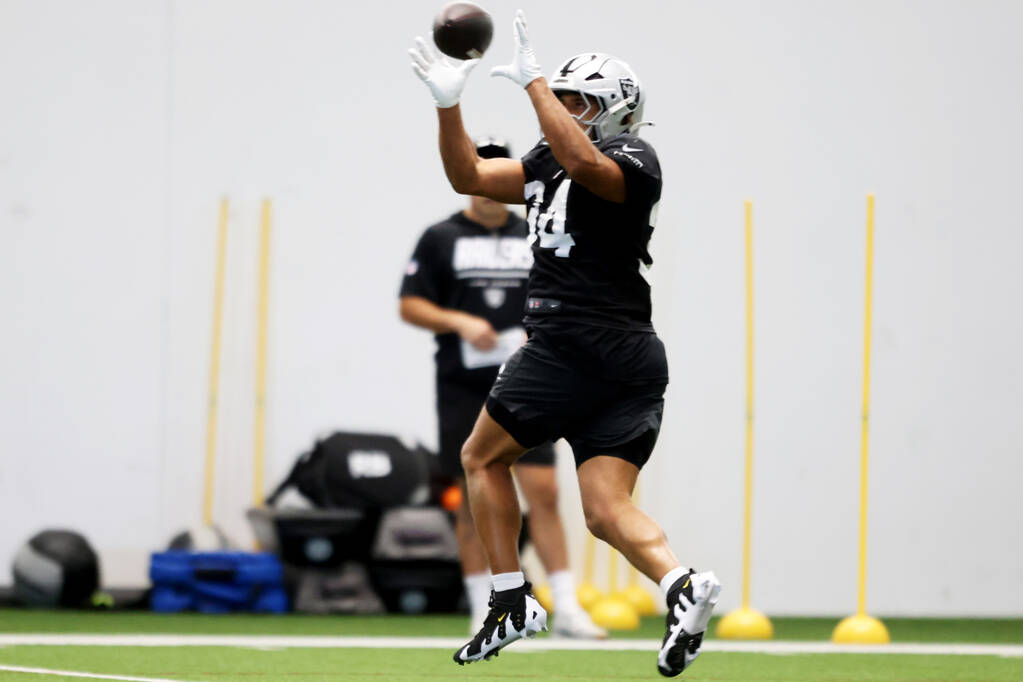
Las Vegas Raiders running back Dylan Laube hadn’t played in an offense with a fullback before this season, the first with the franchise for coach Klint Kubiak.
Not that he’s had much adjusting to do.
“To be honest with you, they basically make the hole and I just follow,” he said after practice recently.
Simple enough.
The Raiders employ a fullback again after two seasons without one at the behest of Kubiak, whose zone-run, play-action offensive scheme makes use of the overlooked backfield position. In 2025 among 32 teams, 13 featured a fullback on the roster — including nine of the 14 playoff teams, namely Kubiak’s Super Bowl champion Seattle Seahawks, for whom he was the offensive coordinator.
Kubiak had a fullback on the field for 261 of their 1,064 offensive snaps in 2025. Its presence is vital to the physicality and optionality with which he intends for the Raiders to run. To fit his vision this offseason, they signed fullback Connor Heyward away from the AFC North champion Pittsburgh Steelers.
“In our scheme, it’s a very versatile player,” Kubiak said. “Guy that plays tight end. That plays fullback. That can pass (protect). That has to be a core-four special teams player. He’s got to be one of the smartest players on your team. We’re going to keep (Heyward) getting better.”
Modern offenses tend to eschew the fullback, formerly a fixture on NFL rosters, for tight ends or running backs as passing evolved. Fullbacks can set a physical tone, serving as junior linemen in a sense, but tend to lack the speed or quickness of other offensive skill positions.
Kubiak’s value of the fullback position syncs with his value of effective rushing offense, reflected last season with the third-most attempts (507) in the NFL.
“Running the ball is important,” he said. “I think it’s a huge part of winning football games. Running the ball. Stopping the run on defense.”
A fullback in Kubiak’s offense might block for a running back bursting up the gut or off tackle — setting up leakouts in play-action passes to the flats. He might be called upon to shore up pass protection, stonewalling blitzers attacking the quarterback.
His motion pre-snap might distract a defense. Allow Raiders defensive tackle Adam Butler to explain: “Depends on the scheme. Depends on how they use him. … If they insert a fullback into the line of scrimmage, whether they motion him back out, bring him back in and the insert him between the tackle and the guard or the tackle and tight end or whatever, that can be complicated because it creates an extra gap that you might not account for.”
Touches are few and far between for fullbacks, fostering a “selfless” mentality for Heyward, a tight end and fullback mashup the past four years in Pittsburgh. He said last month the traditional fullback role he’s playing in Kubiak’s offense is more in line with his skill set.
No wonder he’s found a fit in Las Vegas.
“You might get the ball here and there, but that’s not what it’s about,” Heyward said. “It’s about opening up lanes and getting the run game going and having the run game marry up with the pass game and just honestly doing the dirty work in special teams as well. It’s a full day’s work, and it’s never going to stop.”
Contact Sam Gordon at sgordon@reviewjournal.com. Follow @BySamGordon.