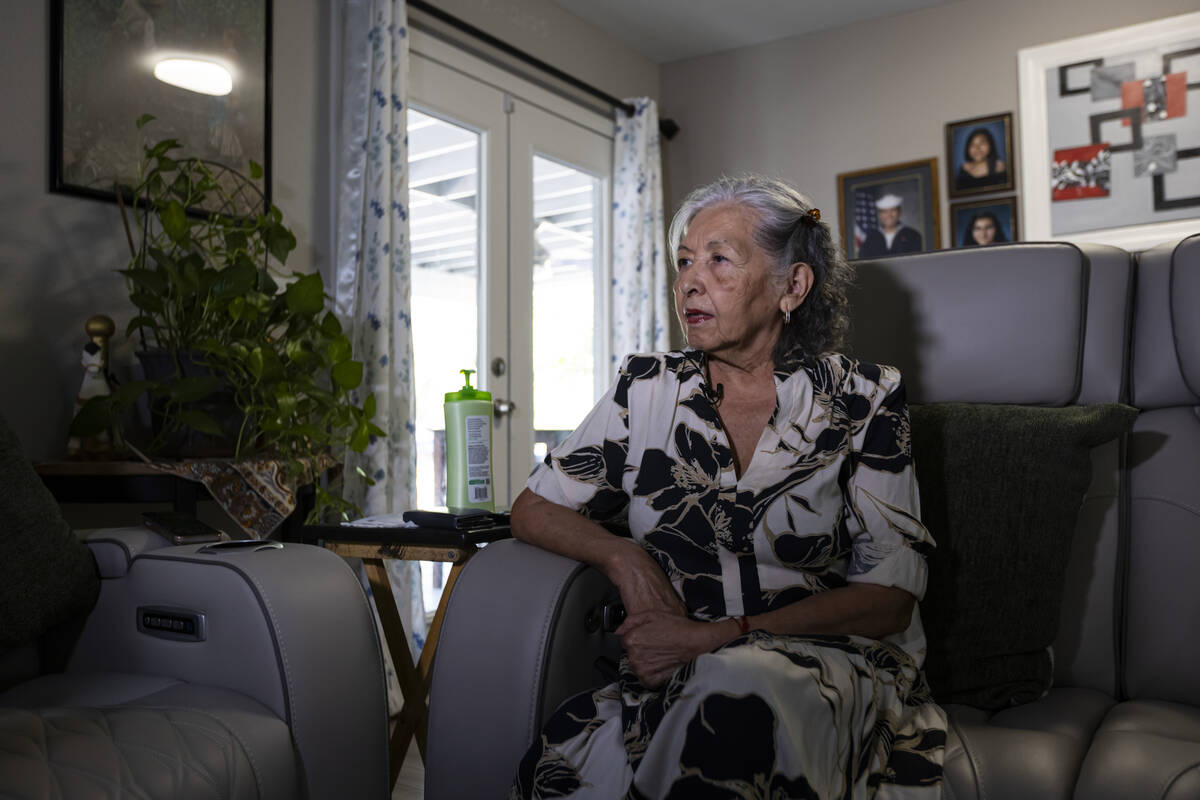
The Gonzalezes struggled to stay cool inside their North Las Vegas home for nearly half a decade.
Small fans and a portable air conditioner proved no match for the desert heat of the summer, causing Antonia and Armando Gonzalez, 76 and 82 respectively, to seek refuge with relatives in Canada or Colorado for months at a time.
“We decided to go,” Antonia Gonzalez said in an interview, “and let the heat pass.”
No matter what their adult daughter, Erica Sanchez, did to try and save her parents’ nearly 30-year-old air conditioner, nothing seemed to work. Wrapping tin foil around it didn’t stop the freon from leaking, and despite spending money to modify the downstairs area to become the new master suite, it never quite stayed cool enough.
That’s when the nonprofit Rebuilding Together Southern Nevada came in. Sanchez said she saw a news story about the organization’s services for low-income homeowners and got to Googling.
Sure enough, 28 days after the family applied, a brand-new air conditioner was installed on the patio. During an interview inside the Gonzalez home on Monday, where outside temperatures flirted with the upper 90s, chilly air filled the living room.
“It was unbearable here,” Sanchez said. “They would go stay with me, with cousins. Now, they’re home. It makes a difference.”
Thousands of others may live without AC
What may have mattered most is that the Gonzalezes had a strong social support system with their daughter.
A Las Vegas Review-Journal investigation published in August found that in the past three years alone, a lack of functional air conditioning in extreme heat waves has led more than a dozen Southern Nevadans to their deaths. The true toll may be higher due to gaps in how the Clark County coroner routinely reports the circumstances of heat-related deaths.
Those who die, the investigation found, often lack community and live alone following the death of a spouse or relative. According to first-of-its-kind hyperlocal data from the U.S. Census Bureau, an estimated 6,700 people in Clark County may live without reliable air conditioning.
Bob Cleveland, CEO of Rebuilding Together Southern Nevada, attended the home visit on Monday and lauds the Gonzalezes as a success story. He said air conditioning repairs are given priority over others the organization does, such as roofs.
However, Cleveland said he often finds himself confronted with cultural stigma when asking for more funding from the state and federal governments.
“Nobody cares about our seniors,” Cleveland said. “If you’re not a puppy or a little kid with cancer, nobody cares. It’s so hard, especially when they are homeowners.”
One talking point seemed to resonate with politicians, he said. Assisting homeowners with air conditioning repairs is far less of a financial strain on taxpayers than providing alternative affordable housing.
“The average cost to rehome a senior is $30,000 per person,” Cleveland said. “Per year, for this couple, they’d be $60,000 a year, and they’re going to live 10 more years, easily. That’s $600,000 from taxpayers. … Just replace the air conditioner.”
Leslie Nix, the city of North Las Vegas’ director of grants development and administration, said local governments are increasingly faced with hard decisions as federal dollars dry up.
“We’re making tough choices between adding another home to add to the affordable housing list, so that another person can live there, or if we have money to improve where residents already are,” Nix said. “Aging in place is really, really important, health-wise and psychology-wise. It’s very hard for old people to get to that point where they have to leave their home.”
Assistance could help many others
When the organization approached her about speaking about her experience to the press, Antonia Gonzalez said she agreed in hopes that others could receive the help they desperately need. On Monday, she proudly showed off her original paintings that adorn her dining room — a pastime she can now do comfortably indoors.
Sanchez said she often hears from Spanish-speaking elders in the community who have a hard time trusting government-related services due to fear of immigration enforcement. Many are afraid of scams, as well.
One single-income family she knows of went six months without an air conditioner because they couldn’t afford the repair and didn’t know help was available, she said.
For many families in North Las Vegas and beyond: “It’s either heat or food,” Sanchez said.
Cleveland is hopeful that extreme heat will soon be added to the list of natural disasters that the Federal Emergency Management Agency can provide emergency funding for.
As it stands, Cleveland said even though his budget is about $12 million, his organization runs out of assistance money every year.
The criteria for the distribution of aid changes annually, he said, as inflation increases what’s considered the area median income. That means more people become eligible each June when that metric changes.
To qualify, applicants must submit proof of income, a utility bill in their name, a copy of the county assessor’s page that proves they own the home and government-issued identification. More information is available at rtsnv.org.
“We’re doing this because we want to make a difference,” Cleveland said.
Contact Alan Halaly at ahalaly@reviewjournal.com. Follow @AlanHalaly on X.