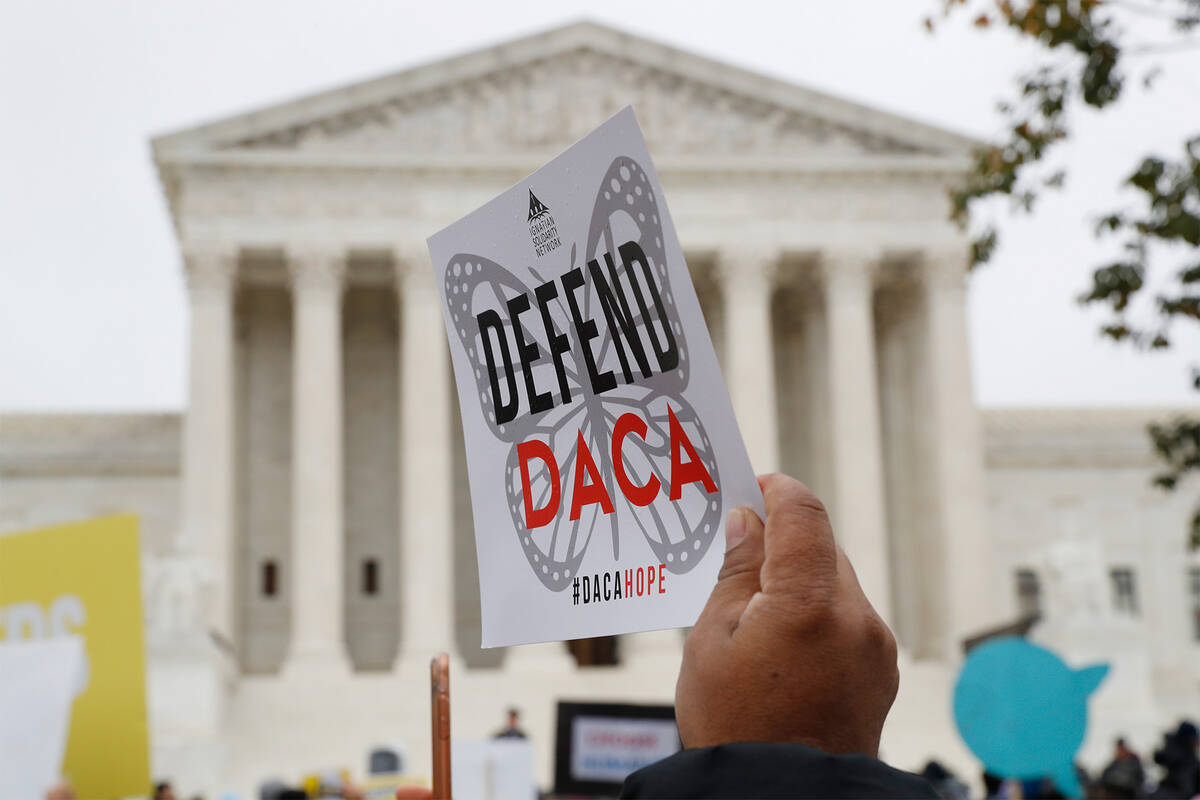
Norma Torres Moreno started to panic in recent weeks.
Her Deferred Action for Childhood Arrivals biennial renewal was coming due in September, and immigration authorities hadn’t approved her applications.
The 34-year-old hotel guest room attendant is dependent on the program’s work permit to raise her four daughters as a single mother, she told the Las Vegas Review-Journal on July 31.
Torres Moreno said she filed her paperwork in March, allowing for a longer processing time than the government recommends, but a U.S. Citizenship and Immigration Services online portal that informs her on each step of the process was not updating as in previous years.
A rule change the Department of Homeland Security proposed in June could see the scenario replicated among the thousands of Nevada DACA recipients who could lose their jobs if their work authorization expires through no fault of their own.
Should Torres Moreno’s DACA status lapse, her employer would immediately be legally mandated to send her home. Her paychecks and then her health insurance plan would subsequently be paused to the possible detriment of one of her girls who requires constant medication, she said.
“Of course I’m getting nervous, and I’m worried,” she said. “I’m a single mom.”
Cutting renewal period
The proposal would — in part — halve the work permit renewal period for certain groups of immigrants with no permanent status like Torres Moreno.
Having to renew her work permit every year would increase uncertainty, she said. “Every day you’re going to be living on the worry of ‘if I’m going to be approved.’”
She said that the roughly $500 fee for the permit would also further stretch her limited finances.
In a statement, the DHS noted that the proposed rule change coincides with President Donald Trump’s “Protecting the American People Against Invasion” executive order, a wide-ranging action he issued on his first day back in the White House.
“President Trump and Secretary (Markwayne) Mullin will continue to put American workers first,” said a DHS spokesperson, also referring to the head of the agency.
The USCIS deferred comment to the DHS.
DACA popularity
DACA was implemented in 2012 through an executive order by then-President Barack Obama as Congress failed to pass a permanent solution.
The program shields recipients — migrants who were brought into the U.S. illegally as children — from deportation and allows them to work without a pathway to permanent residency or citizenship.
To remain eligible, recipients have to pay taxes, stay out of trouble with the law and renew their status on time. The program’s future remains in the hands of the courts after years of litigation. Legislative proposals around DACA have stalled in Congress.
A 2025 Gallup poll revealed that providing a permanent legal status for DACA recipients, also known as Dreamers, was popular among a large swath of Americans.
About 81 percent of survey respondents said they favored or strongly favored allowing Dreamers to become citizens “if they meet certain requirements over a period of time,” Gallup said. Eight percent opposed or strongly opposed.
Nevada was home to 11,279 out of the roughly 580,000 Dreamers in the U.S. as of early 2023, according to USCIS.
Organizations support
The federal government accepted public comments related to the proposed rule change. Nearly 5,000 people or entities submitted comments before the period closed earlier this month.
The Center for Immigration Studies, a think tank that supports lower immigration numbers in the U.S., said it agrees with the proposal.
“Under this scheme, aliens in these categories will be eligible to apply for a renewal,” its letter said. “Neither deferred action nor release under an (order of supervision) confers a lawful immigration status, and neither provides a permanent statutory basis for employment in the United States.”
Yearly renewals, it added, would allow the DHS to regularly review whether employment authorization remains warranted and whether recipients are complying with the rules to maintain their temporary legal status.
The Federation for American Immigration Reform is a similar nonprofit.
In its letter of support for the change in DACA rules, it noted that there was a significant influx of migration into the U.S. under former President Joe Biden’s administration.
“The proposed rule’s economic necessity requirement is a much-needed corrective to the practice of indiscriminately granting work authorization,” FAIR wrote. “By requiring parolees, deferred action recipients, and aliens awaiting deportation on orders of supervision … to establish both economic necessity and discretionary merit, the proposed rule replaces automatic work permits with an individualized review that more fully adheres to our laws.”
Nevada Democrats speak up
The Associated Press reported in May that the DACA renewal process was experiencing long delays not seen in about a decade.
From October 2025 to the end of February 2026, the median wait time for renewals was about 70 days, compared with about 15 days in fiscal year 2025, according to USCIS. This is the longest median wait time since 2016, when it was about 79 days, according to the agency’s data. The data did not include 2020 because of the pandemic.
Nevada’s congressional Democrats have sounded the alarm about changes to the DACA program.
Sen. Catherine Cortez Masto accused the Trump administration of purposely slowing renewals.
“It’s not that they’re just saying we’re gonna ignore the applications,” she said during a May hearing. “They’re actually slow-rolling the applications so that you have a change of circumstance so they can deport you.”
The senator described the delay tactics as nefarious.
“It is a community call to action for everyone to come forward and say, ‘no more, this is not who we are,’” Cortez Masto said. “We have to do right by our families and our community, and it’s time to stand up and take that action.”
Culinary Union safeguards
Torres Moreno works for a hotel whose employees are represented by the Culinary Workers Union Local 226.
Union Secretary-Treasurer Ted Pappageorge told the Review-Journal that the organization has hundreds of DACA recipients within its ranks.
“It’s just another harmful hit from President Trump on our tourist economy,” he said about the proposed change. “The reality is that these are workers that have legal, lawful status. They work hard; they’re necessary for our tourism economy.”
He said that work permit lapses have not been uncommon in recent years but that the situation has worsened under the current administration.
“We’re seeing more and more of these delays that are affecting our members,” Pappageorge said.
The union leader said that the current Culinary contracts require employers to hold the positions and seniority of affected workers, giving them up to a year to get their documents in order.
Pappageorge said that the union is currently negotiating a five-year period.
“Even when the system is gummed up like it is with the Trump White House … our contracts protect (affected members) and protect their jobs,” he said.
Torres Moreno has been in the U.S. since she was 11 years old. While she’s grateful for her DACA status, she said she envisions a future when Congress figures out a way to help Dreamers achieve a permanent legal status.
“It would be great. I’d be thankful. It would be awesome,” Torres Moreno said. “Because now, we’re going to come out of the shadows that we’re living under right now.”
The Associated Press contributed to this report. Contact Ricardo Torres-Cortez at rtorres@reviewjournal.com.