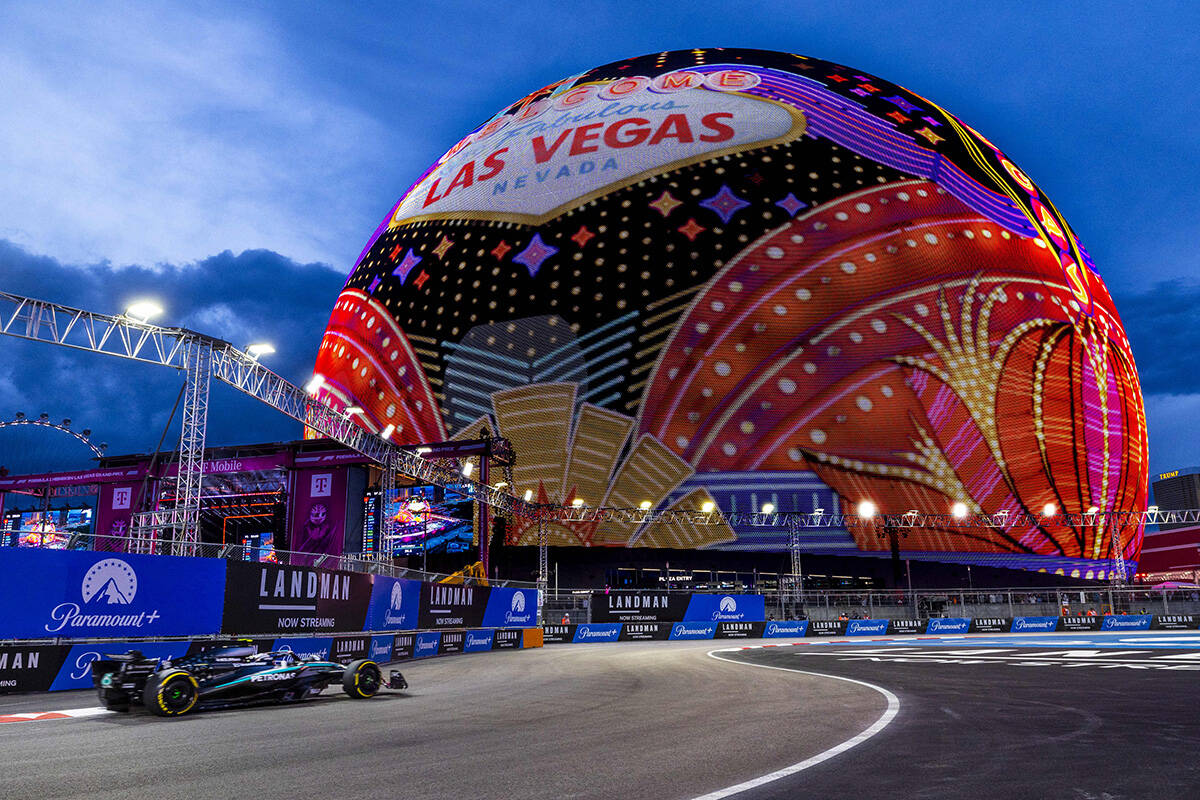
Formula One and the Las Vegas Visitors and Convention Authority have committed to a 10-year extension to host the annual Las Vegas Grand Prix on the Strip through 2037.
With this year’s race, set for Nov. 19-21, that means there are 12 more Las Vegas Grand Prix events under contract; the 10-year deal will kick in after the 2027 race, when the current two-year deal expires, the two groups announced Thursday.
“Since its debut in 2023, the event has been extraordinary, rapidly establishing itself as a premier destination for great racing, world-class entertainment, global business leaders, A-list celebrities and influencers,” Stefano Domenicali, president and CEO of Formula One, said in a statement. “It has delivered a strong and lasting impact on the local economy and community. We always believed that Las Vegas would become a cornerstone of our presence in the United States, and this extension, together with the success of recent years, reinforces our long-term commitment to this important market.”
As part of the new deal, the LVCVA will continue to pay F1 $10 million per year to sponsor the event each year starting with the 2028 race for a total of $100 million, pending LVCVA board approval at a future meeting. The LVCVA is also paying F1 $10 million for this year’s race and the 2027 edition. Las Vegas’ tourism arm previously paid $6.5 million per year to sponsor the race between 2023 and 2025.
The first three years included event hosting costs the LVCVA paid for separately, including parking, transportation and other event-related expenses, but those funds were rolled into the sponsorship costs starting this year to reach the new $10 million total, according to the LVCVA.
The first three Las Vegas Grand Prix races generated $3.2 billion in cumulative economic impact for Southern Nevada between 2023 and 2025, according to race organizers.
Infrastructure improvements
With a long-term contract secured, F1 will invest in adding permanent race infrastructure elements around the circuit, particularly on Las Vegas Boulevard, to help speed up the set up and dismantling of the race.
“We need to make some investments not only on our land, but it’s been quite well talked about that we want to make some investments on Las Vegas Boulevard to be able to improve the infrastructure and therefore reduce the build times — particularly around things like temporary power and lighting, which are the two big reasons why things take a little bit longer to be installed,” Emily Prazer, Las Vegas Grand Prix president and CEO, told the Review-Journal.
LVCVA President and CEO Steve Hill said a good way to describe some of the upgrades is plug-and-play. The upgraded lighting fixtures won’t need temporary supports, instead there will be connections added around the track for the lighting units, which will take less time and not take up a lane of traffic. The track lighting is currently powered by temporary generators, but permanent power sources are being considered as part of the improvements, Hill said.
Hill said F1 could make adjustments to barricades to reduce their impact, as well.
Circuit repave needed?
Leading up to the first Las Vegas Grand Prix in 2023, officials were up against the clock to prepare for the event, which led to nine months of road work, mainly involving paving operations on the 3.8-mile street circuit, which includes portions of Las Vegas Boulevard, Koval Lane and Harmon and Sands avenues, to bring the road up to F1 standards. The setup and tear down time was brought down to about four months total.
In 2023, officials said the track would likely need to be repaved every six to 10 years. Prazer said that plan has changed, and no major repave is yet planned in the coming years.
“One of the things that is quite beneficial of being here year-round is that we obviously can see the asphalt and can test it outside of busy periods and race weekends,” Prazer said. “So we do repairs that people might not see or know about regularly. So at the moment, there isn’t a date, but obviously it’s lasted quite nicely, and there’s no immediate plan to resurface the roads.”
Flamingo bridge status
The future of the temporary bridge built on Flamingo Road over Koval is also being discussed. Hill said last year that the controversial bridge could be moved for future races. Those plans are still in the works, Hill said.
“I think the county will certainly be in the lead in that conversation, and they’ve been doing that all along,” Hill said. “But it’s an opportunity to take a look at that. I think a bridge can be a part of that conversation. The Boring Co. system… will be a part of that plan. So we can look at a holistic plan on how to make sure that the guest experience and our locals’ experience is as good as it could be.”
Conversations regarding the future of the Flamingo bridge remain ongoing, according to Clark County spokeswoman Jennifer Cooper.
“But this year’s race will include the same temporary installation as last year,” Cooper told the Review-Journal in an email.
Race officials will work with Clark County Public Works on the planned infrastructure upgrades in the coming years.
County approval
Increasing the efficiency of building and tearing down race infrastructure was also a clause in the 10-year deal F1 and Clark County entered into last month, recognizing the race as an annual event through 2037. The resolution allows the race to occur on the Strip during times when the county normally wouldn’t allow to be closed to traffic.
The race will continue to be held on the weekend before Thanksgiving in November, which was historically one of the slowest weekends of the year for tourism.
Last year’s race generated $43 million in state and local tax revenue, including $15 million allocated to support local K-12 education, according to race officials.
Strengthen local ties
The long-term deal will also present an opportunity to further strengthen F1’s ties with Southern Nevadans following negative feedback on the inaugural race, especially regarding the nine months of construction needed to prepare the course and ticket prices.
Las Vegas Grand Prix officials have been tweaking ticketing elements each year, with cheaper options geared toward locals, such as a $50 ticket for the first day of practice first sold last year. Race officials have also been working in the community through their nonprofit Las Vegas Grand Prix Foundation and hosting community events at Grand Prix Plaza, F1’s permanent 39-acre multi-use Las Vegas hub.
“So actually taking the time with the Las Vegas Grand Prix Foundation to make sure that we are contributing in the right places, creating accessibility through Grand Prix Plaza has also been quite a big piece of work we’ve done,” Prazer said. “Things like F1 Drive, where we created the kids’ karting camp and opening up F1X as an experience to multiple different locals, have been something that’s given us an opportunity to tell a story all year round, not just for a three-day race weekend.”
The Las Vegas Grand Prix Foundation has contributed over $2 million to local nonprofit organizations, and the LVGP works with the Clark County School District to offer educational experiences at Grand Prix Plaza, including a STEM education event each race week.
Event blueprint
Race officials say they have nailed down a successful blueprint for hosting Grand Prix weekend. Prazer said she expects some minor tweaks here and there, but they are largely focused on keeping Las Vegas’ race as the premier date on F1’s calendar each year.
“One of the big things that we love about the Grand Prix is how unapologetically Las Vegas it is, whether it’s the entertainment or the food and drink offerings and how we turn with the resorts, the whole city becomes the racetrack, the whole destination becomes part of the event,” Prazer said. “That’s really unique to this particular race. You go to other Grand Prix, and even Miami is comparable, like you’re at the racetrack and then you leave and go to South Beach for dinner. The beauty of what we’re doing is that the minute you wake up in the morning, you feel like you’re at the event.”
‘Great value for the city’
Having the Grand Prix locked in through 2037 means there will be a major event happening in Las Vegas each November for the foreseeable future. That ties into the LVCVA’s plan to have a major event in the city during the first half and the second half of the year annually. That has been occurring in most years since the race began in 2023.
In 2024, Super Bowl 58 took place at Allegiant Stadium in February. In 2025, WrestleMania too place in April. Next year, the College Football Playoff national championship will take place in January, the NCAA Men’s Final Four will occur in April 2028 and the Super Bowl will return to Las Vegas in 2029.
“The fact that we are a Formula One city and the eyes of the entire globe are on Las Vegas for a week in November, it is truly the best advertising that we can get,” Hill said. “It comes along with the value of the race and it just multiplies what the value is from Las Vegas. And knowing that we are going to have this for 12 more years now, is it is great for the city and it is only going to get better.”
Contact Mick Akers at makers@reviewjournal.com or 702-387-2920. Follow @mickakers on X.