Working out is essential for building strength and maintaining a healthy, functional body. But did you know that it’s just as important to exercise your mind?
Keeping your brain in top shape improves thinking and memory skills. In fact, regularly challenging your mind through fitness can prevent or put off cognitive decline.
You might have expected the best brain workout to be traditional word games, but we’ve rounded up six unconventional balance exercises that put both your mind and body to work.
Balance naturally declines with age, because of changes in muscle strength, coordination, neural communication and vision — and your brain is a key player.
“The brain plays a central role because balance is a neuromuscular skill that integrates input from the eyes, inner ear and proprioceptors to maintain stability,” explains Mallory Fox, a certified personal trainer and wellness coach. “Cognitive decline and slower processing speed further impact coordination.”
That’s where unconventional balance exercises come into play. These moves typically blend cognitive tasks with physical stability challenges.
“This approach forces the brain to multitask, improving coordination and mental agility,” Fox says. “It’s beneficial because it mimics real-life scenarios where we rarely perform movements in isolation, enhancing both physical and cognitive resilience.”
According to personal trainer Julie Dermer, unconventional balance exercises require proprioceptive, visual and vestibular work that help you feel “mentally sharper.”
Stimulating the mind
Balance exercises call for you to be on your A-game. According to John Oliver, a dynamic stretch specialist, and Isaac Kwarteng, a personal trainer, this means consistent decision-making, tweaking your alignment and being mindful of your senses — in turn, boosting coordination and attention.
Traditional cardio and strength training call for more “automatic movement patterns,” requiring less mental involvement overall.
Balance isn’t just a physical skill — it’s truly a “full-brain workout,” explains Dr. Hayley Nelson, a neuroscientist, professor of psychology and founder of the Academy of Cognitive and Behavioral Neuroscience.
“Maintaining balance requires constant communication between the cerebellum (movement coordination), vestibular system (inner ear and spatial orientation), sensory cortex (body awareness) and prefrontal regions (attention and decision-making),” Nelson says. “As we age, these systems naturally become less efficient, which is one reason balance declines. Balance training helps keep these neural pathways active and adaptable. In neuroscience terms, it supports neuroplasticity, or the brain’s ability to rewire and strengthen connections, which is critical for preserving mobility, reducing fall risk, and maintaining cognitive function later in life.”
Exercises to challenge your brain
1. Single-leg balance with backward alphabet
“(This balance test) combines stability with memory recall for cognitive stimulation,” Fox says.
This type of drill presents a stellar challenge for your executive functions, including cognitive inhibition, attention control and working memory.
According to Nelson, “Reciting the alphabet backward requires mental sequencing and suppression of automatic responses, while balancing demands constant motor adjustments. Together, they tax the brain’s ability to prioritize, shift focus and maintain stability under cognitive load. These are the same skills involved in decision-making, multitasking and adapting under stress.”
Here’s how to do it:
■ Balance on one leg on a flat, solid surface.
■ Keep your gaze focused ahead and your arms at your sides.
■ Begin to recite the alphabet backward.
■ Repeat on the other side.
■ Complete 3 sets on each leg — 30 to 60 seconds each.
2. Ball toss on BOSU ball while naming animals by letter
There’s a lot that’s going on in the brain when you combine a balance exercise with a mental task, such as naming animals by letter.
“The brain has to coordinate multiple networks at once,” Nelson says. “Motor control systems are working to keep the body upright, while cognitive networks (especially in the prefrontal cortex) are managing memory, attention and mental flexibility.”
Your brain is performing “dual-task processing,” an essential skill you constantly rely on in everyday life (i.e., walking while talking).
“(This test) adds unpredictability and verbal recall to balance work,” Fox adds.
Here’s how to do it:
■ Stand on a BOSU ball.
■ Toss a ball with a partner while naming animals starting with “A,” “B,” “C,” “D” and so on.
■ Perform continuous movement for 2 to 3 minutes.
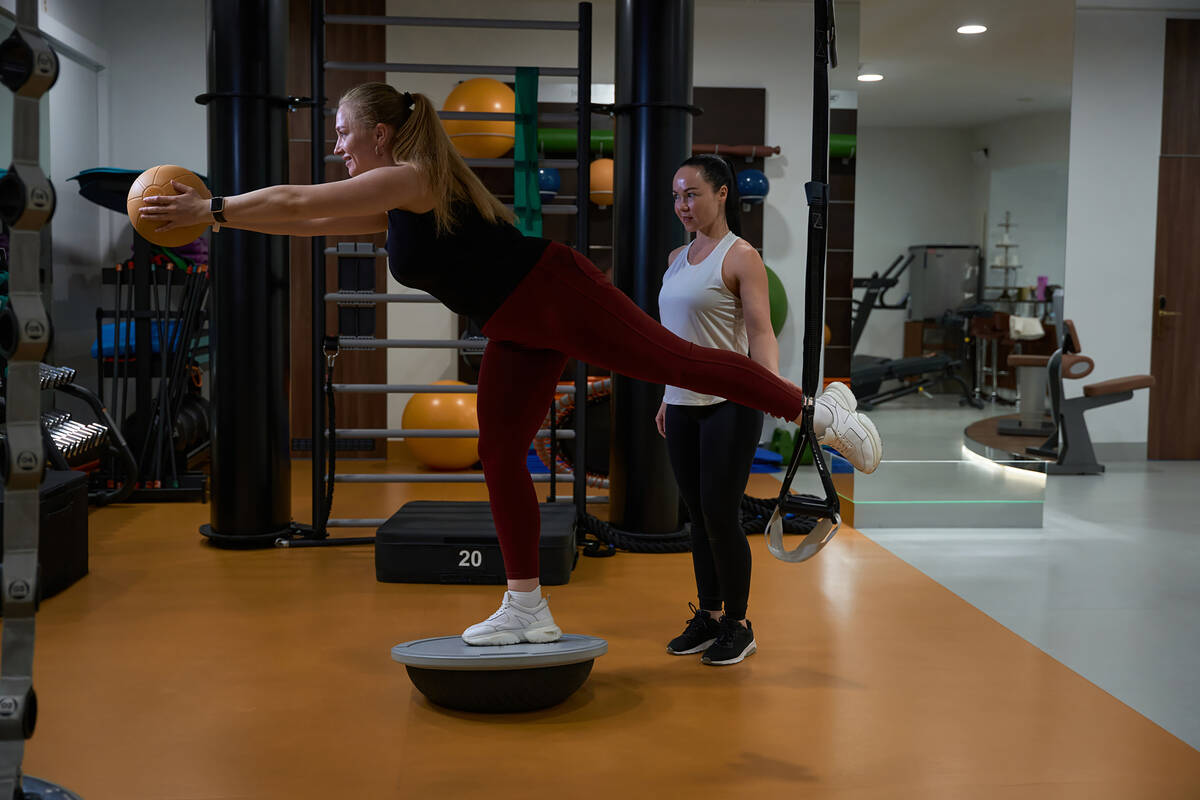
3. Balance + toss (light ball, pillow or rolled towel)
“(This exercise is) playful and dramatically improves reaction time — perfect for aging strong,” Dermer says.
According to Nelson, incorporating the instability aspect enhances the brain’s workload productively.
“The nervous system receives more variable sensory input from muscles, joints and the inner ear, which forces the brain to process information faster and more precisely,” she explains. “Adding a moving object like a ball engages visual tracking, timing and hand-eye coordination, further increasing neural demand.”
Here’s how to do it:
■ Balance on one leg.
■ Toss a light object — ball or small pillow — between your hands at chest level.
■ To progress the exercise, toss the object at a higher height or off to the side.
■ Switch sides.
■ Perform 3 sets, 20 to 30 seconds per leg.
4. Slow-motion lateral walk with pause (controlled instability)
“It looks simple, but slow movement forces your stabilizers and brain to work overtime. (This move is) great for the hips, ankles and fall-proofing,” Dermer says. “The pause requires the brain to constantly adjust tiny shifts (vestibular plus cerebellum plus somatosensory cortex).”
Here’s how to do it:
■ Take a big step out to the right.
■ Pause for 2 to 3 seconds while “midair” before setting your foot down on the ground.
■ Slowly bring the other foot in.
■ Repeat for 8 to 10 steps before stepping to the left.
■ Perform 2 to 3 sets per side.
5. Heel-to-toe walking with patterned counting
“(This exercise) adds a rhythmic cognitive component, enhancing coordination and mental agility,” Kwarteng says.
Verbal tasks engage your language networks — especially in the left hemisphere — while balance works your sensory and motor systems.
“When you combine the two, the brain must rapidly switch, integrate and allocate resources across networks,” Nelson explains. “This supports cognitive flexibility, a core executive function that allows us to adapt, shift strategies and think creatively.”
Here’s how to do it:
■ Start to walk in a straight line, placing your heel directly in front of your toes.
■ While walking, count in a pattern — whether that be Fibonacci sequence or alternating between prime numbers.
■ Walk the full length of a 10-foot line three times, aiming for smooth and controlled movement.
6. Step-and-react drill
Finally, the step-and-react drill is a great exercise for challenging both the brain and your balance.
Here’s how to do it:
■ Stand in the middle of a small yet open space.
■ A partner will call out cues like “forward,” “back,” “left,” or “right,” which you will immediately react to. Quickly take a step in that direction, regain your balance and return to the center.
■ Perform 2 to 3 sets of 12 to 20 reps.
These unconventional exercises provide a stellar challenge for your body and brain. Not only do they channel daily movement, but they also help you continue to lead an active, independent life well into your golden years. Weave them into your routine, and focus on your breath work.