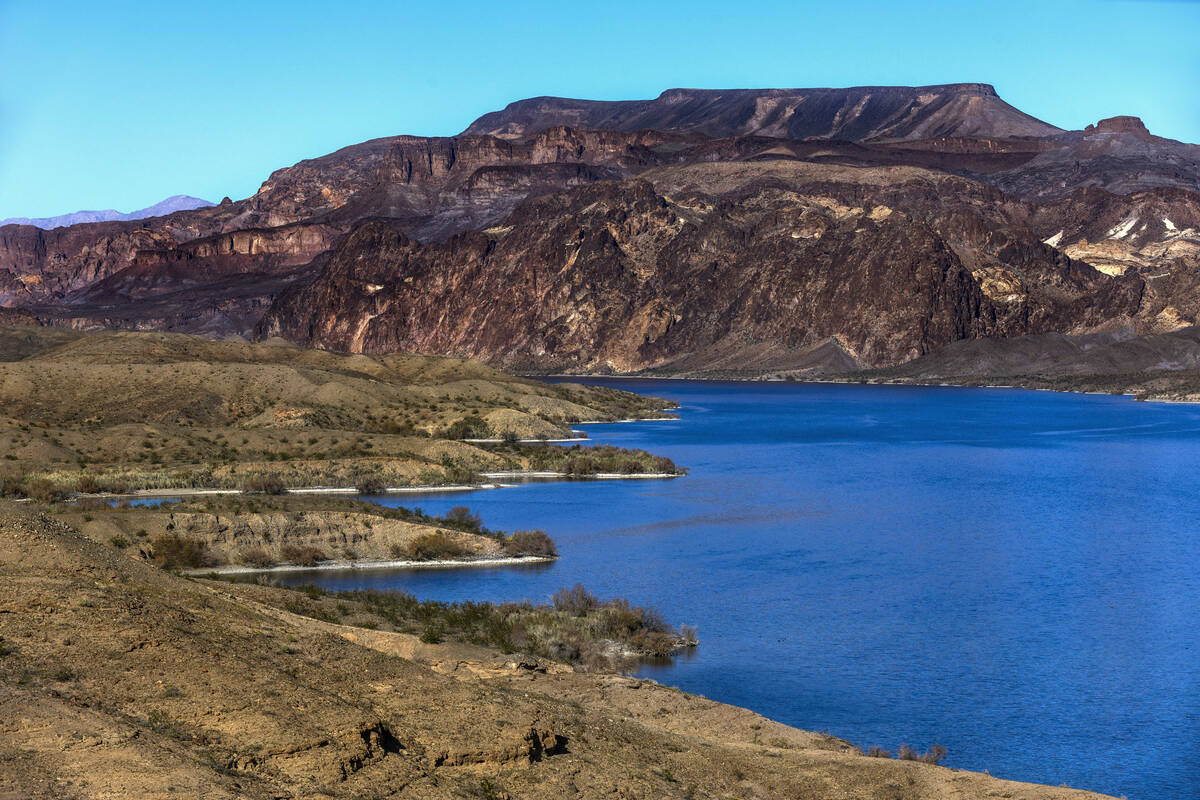
Lake Mead just got told its worst fortune yet, with federal forecasters predicting that over the next two years, the reservoir is likely to drop more than 20 feet below its lowest level on record set in 2022.
The Friday prediction is a reflection of a rapidly changing environment as the Bureau of Reclamation significantly reduces releases from Lake Powell in an effort to keep water flowing in a historically bad snowpack year and the current Colorado River operating agreements are set expire at the end of this year.
As of now, the most probable scenario for Southern Nevada’s main water supply places it at 1020.76 feet above sea level in July 2027. Hoover Dam’s hydropower generating capacity is significantly reduced below 1,035 feet in elevation — something that would happen in April, according to the most recent projection.
Because of the poor snow season and the decision to reduce releases into Lake Mead, the Bureau of Reclamation has previously warned that the hydropower generation capacity at Hoover Dam could be nearly halved by the fall. Utilities across the Lower Basin states of Nevada, California and Arizona, are looking elsewhere to fill gaps in their energy portfolios.
The projection comes after the Lower Basin states proposed a short-term, two-year structure for cuts to each state’s allocation in the face of drought. For Nevada, it will mean a 50,000 acre-foot cut to its 300,000 acre-foot allocation.
That could grow to an 100,000 acre-foot cut should the federal government provide federal funding that state officials say is necessary to see further shortage conditions through. The Lower Basin’s proposal is pending approval from the Arizona Legislature, as well as governing board of water agencies in California and Nevada.
Absent a consensus after a tense, years long negotiation between the Lower Basin and the Upper Basin states of Colorado, Utah, New Mexico and Wyoming, the Trump administration is expected to step in and enforce a plan of its own that will include shortage assignments. A plan must be in place before the start of the next water year on Oct. 1.
Contact Alan Halaly at ahalaly@reviewjournal.com. Follow @AlanHalaly on X.