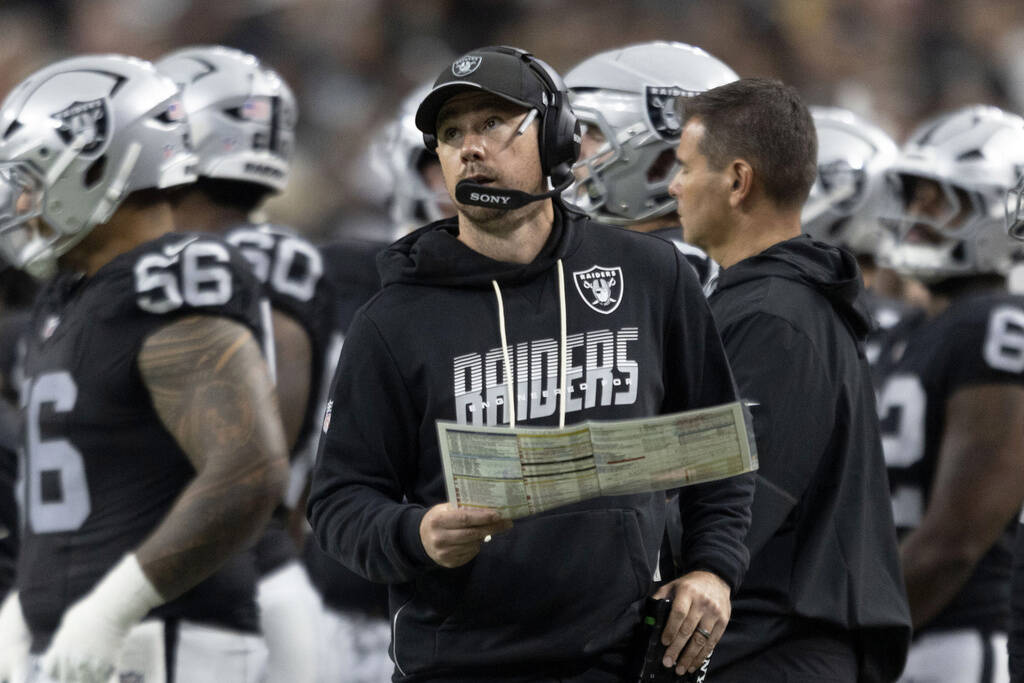
It wasn’t necessarily watching his dad win three Super Bowl titles as an assistant before he reached college that made Klint Kubiak realize how cool coaching could be as a profession.
The younger Kubiak was hooked by a far more subtle experience.
Gary Kubiak, then the head coach of the Houston Texans, allowed his oldest son to sit in on some pre-draft meetings as the staff discussed defensive end prospects.
“I just saw this big room full of guys just talking football and shooting the bull,” Kubiak recalls. “I remember thinking this wasn’t such a bad job. You get to talk football and be around guys that you respect. Even then, I didn’t think I wanted to be a coach, but I remember that day very vividly.”
He may not have known it for sure, but the family business was always beckoning.
Kubiak played four years at Colorado State and then went immediately into coaching as a graduate assistant at Texas A&M. While he took a brief detour when he and his wife were starting a family in search of a more lucrative profession, he returned to the sidelines and never looked back.
His success as one of the sharpest young offensive minds in the game has landed him the head coaching gig with the Las Vegas Raiders, where he is tasked with finding a way to turn around years of ineptitude with a few splashes of mediocrity.
It’s a challenge the 39-year-old Houston-born and Colorado-raised Kubiak is embracing.
“You get the excitement of, ‘Why not us? Why not this staff? Why not this group of players?’” Kubiak said. “To have a chance to be a part of the success here made (this job) even more desirable.”
While he is just getting started on the job, landing it is the culmination of a steady rise through a calling he resisted, even though it was always in his blood.
Head start
Kubiak’s father, Gary, was still playing when he was born, but most of his early memories of his father were as a coach.
While the younger Kubiak loved all sports, there was something about football that was very appealing.
“I always loved the fact that there are so many roles on a football team,” Kubiak said. “There’s just so many different body types and different types of people in football that make up the 11 guys on offense and defense. Just having that team sport with so many different personalities and athletic abilities, I think is pretty unique. It’s not like basketball where it’s just a bunch of tall guys that can run and jump. You’ve got guys on a football team that can’t jump at all, but they can be the best nose tackle in the NFL.”
That bond was only strengthened when he was able to serve as a ballboy and help out around the facility when Gary returned to the Broncos as offensive coordinator in 1995 when Klint was 8.
Whether he was spotting the ball during 7-on-7 drills in training camp or helping clean the locker room after practice, Kubiak just liked being around football.
Especially when larger-than-life figures like John Elway and Terrell Davis are just having casual conversations in your presence.
“You’re going in there to grab their laundry and they’re just having a ball,” Kubiak recalls. “You’re just thinking it’s a cool job these guys have. So just those training camp practices really stand out.”
Kubiak eventually found himself up the road at Colorado State where he played safety.
“My experience there was awesome,” said Kubiak, who played for legendary coach Sonny Lubick before he was replaced by Steve Fairchild for Kubiak’s final two seasons.
“I didn’t have a lot of opportunities, but (Lubick) gave me a chance. I loved being a Ram. I loved playing football there.”
Kubiak joked that he was slow, but Fairchild recalls immediately recognizing the safety’s strengths.
“He was a very good player,” Fairchild said. “But both him and his brother Klay (the team’s quarterback) were outstanding people. He was a returning starter and you could tell right away in the offseason workouts that he was a team leader. He was always there early. When you meet the family, it’s very apparent they were raised that way.”
While Kubiak diminished his own athleticism, he did concede his understanding of the game allowed him to overcome any perceived physical deficit.
No time was that on better display than a 2008 game where Kubiak intercepted Houston’s Case Keenum in the end zone with seconds remaining on the clock to seal a 28-25 Colorado State victory.
“Klint baited him into throwing that ball,” Fairchild said. “He picked it off and we won the game.
“That was a great play and a great memory, but really you just can’t say enough about them as a family. The whole experience of getting to know him and his family was one of those neat things in coaching.”
Fairchild called Kubiak “hard-working and determined, smart and competitive.” He says he would have hired him to his staff, but Kubiak went to Texas A&M to work under Mike Sherman as a graduate assistant.
The plan was to help out on defense. Plans change.
“I was there for two weeks and (Sherman) was like, ‘Hey, we have a guy graduating. We want him to take your job. You have to go to offense,’” Kubiak said. “I was really upset about it. I didn’t want to go to offense. But it ended up being the best thing that ever happened to me. It’s funny how it all worked out.”
Rising through the ranks
Kubiak proved to be a quick study on offense, which was also his father’s specialty. The fact he played safety only helped him better understand how to attack a defense.
But while he has made a steady climb through the profession, Kubiak needed to see the other side of the working world to truly understand his love for the game.
The life of a graduate assistant involves long hours for little pay. He earned his master’s degree in human resource development while coaching, but Kubiak had also married Colorado State volleyball standout Tessa Nelson and felt a responsibility to support the household.
So he took a job doing oil pipe inventory in east Texas. That lasted all of about two weeks.
Kubiak got a call from Texas A&M receiver Uzoma Nwachukwu, a very good player who Kubiak had coached very hard to try to help him reach his full potential. The coach wasn’t sure the pupil appreciated the style, but the conversation reminded him that coaching was what he was supposed to do for a living.
He returned to the job and then moved to the NFL as a quality control coach for the Minnesota Vikings before coaching receivers at Kansas for a year. He realized he missed the NFL and went to work for his dad in Denver, something he had previously insisted he did not want to do.
“I was at Kansas and I realized I could have a chance to go see him do his job,” Kubiak said. “I know he’s one of the best in the world at it. Am I going to really be so stubborn that I’m going to miss out on that opportunity? So the opportunity came up. They won the Super Bowl and Brian Callahan was the assistant quarterback coach and he left and a spot opened up, and I reached out to (my dad). I was like, listen, ‘I told you I never wanted to do this but if there’s a spot, I’ll work my tail off for you.’”
He knew he’d have to put in that kind of effort. Kubiak, whose two brothers also work in the NFL, was always aware of the potential for calls of nepotism so he always wanted to work as hard as he possibly could to justify any opportunities.
He acknowledges all three Kubiak sons are aware of their situation and fortunate to have been born with their parents.
Klint also knows he has a high bar to clear to reach the standard set by his father.
“He’s a way better athlete than me. He played quarterback in the NFL for nine years,” Kubiak said. “My dad is the hardest-working, best guy that I know. So I have a lot of work to do to live up to that.”
He continued that pursuit by moving to the Vikings as quarterbacks coach and then offensive coordinator.
It was there longtime NFL coach Rick Dennison, who played and coached with Gary and had known Klint basically since birth, saw him turn a corner.
“He took control and did a lot of good things,” Dennison said. “Every place he’s been, he’s grabbed a little of what they do and combined it into what he believes. Not just X’s and O’s, but culture. I think each one of those steps. He’s taken some stuff to heart and really done a great job of combining football knowledge and people skills.”
Kubiak returned to the Denver Broncos for a year as passing game coordinator and spent 2023 in the same role for the 49ers.
He has served as offensive coordinator for the New Orleans Saints and Seattle Seahawks the last two years.
Despite all the movement, Kubiak said he was never focused on ascension.
“I just wanted to be the best I was with where I was at,” he said. “When I was a graduate assistant at Texas A&M, I just wanted to not get fired, honestly. Give me a job and I’ll do the best I can at it. And then it was, ‘All right, I’d love to try to coach a position.’
“All those years taught me that you just try to do the best with where you’re at and try to add value to the organization. And I just always felt that those promotions come when you demonstrate that you can do a good job with where you’re at.”
Even after winning the Super Bowl as an offensive coordinator with Seattle last season and becoming one of the hottest names on the head coaching interview circuit, Kubiak wasn’t sure he would leave.
He said he was convinced the Raiders have all the organizational pieces in place from ownership to the front office to facilities to have success and he just wanted to be a part of it.
Now it’s his show to run.
Taking charge
The public perception of Kubiak as being ‘all ball” isn’t necessarily wrong.
“I’ve been around Coach Kubiak a long time, and I love his demeanor,” wide receivers coach Zach Azzanni said. “What you see is what you get. It’s no-nonsense. And I think our team is taking that approach. There’s not a lot of fluff. This is football. It’s ball 24/7 here. And if you’re not a tough guy mentally and physically, if you don’t like to sit through 18 hours of meetings and practice for three hours, this probably isn’t the place for you. And that’s the culture he’s creating.”
It’s one that is appreciated by general manager John Spytek, who hired Kubiak.
“I’ve seen him embracing the challenge of being a head coach and knowing that there’s things that have to get done every day, putting the players in a position to be successful, and demanding a lot out of his staff and the players every day,” Spytek said. “Self-aware, self-critical. There’s a growth mindset to Klint that I think we all really enjoy being around.”
Those who know Kubiak well, however, also point to a dry sense of humor and warm demeanor.
“Oh, he has a personality,” said Raiders lineman Spencer Burford, who also played for Kubiak in San Francisco. “It may not be shown all the time just because of the business we’re in, but at the end of the day he’s human and has personality. It just takes time to see it. He has a sense of humor for sure.”
Burford said one of his favorite parts of seeing Kubiak assume a head coaching role is that it requires him to talk to the team more.”
“He’s a great guy,” Burford said. “It’s just good to see him be a little bit more vocal. He makes it clear what he wants out of his guys and how he wants it done. There’s a clear understanding across the board from staff to players to the guys upstairs to make sure everyone is on the same page. I love Klint.”
Raiders wide receiver Dareke Young, who was part of the Super Bowl team with the Seahawks last year, echoed the sentiment.
“He has to talk more now and lead meetings, but he seems like a natural to me,” Young said. “He’s a leader. A lot of the guys respect him and how he conducts his business. I think he’s made a good transition. And I definitely think he’s funny. I can see why people don’t think he has much personality, but as a coach, you just have to be respected. As long as you handle your business, it doesn’t matter. And that’s what he has done.”
Guiding principles
Just like his core memory of being a coach’s son was in the off-field interactions, the biggest lesson he has taken from his father’s coaching style has nothing to do with route trees or zone run concepts.
“I would say the biggest thing that I learned is that I saw the same guy that I saw it at home,” Kubiak said. “I saw that you can be a leader by being yourself. And so it just kind of gave me confidence seeing you don’t have to change who you are. You have your values and you make those values come to life with the guys that you’re with every day. The coaches and the players. So I think that just gave me confidence knowing I don’t have to all of a sudden change if I become a head coach.
“Just go be yourself.”
Gary won his Super Bowl as a head coach the year before Klint went to work on his staff. But it was never the pats on his dad’s back for raising the trophy that mattered to him.
It was when people would approach him and tell him about the positive way Gary treated them or something he did for their family or a thoughtful Christmas gift that he would draw inspiration.
“I learned at an early age that you treat people the right way, treat people with respect and that means something to people, whether you’re getting fired in Houston like he eventually did, or you’re winning Super Bowls,” Klint said. “I think when people talk about the kind of person you are, you don’t want the first thing to be ‘That guy is a (jerk)’ or he treated me wrong and didn’t care about my family. If the first thing that comes out of their mouth is that I got better as a coach and closer with my family working for that guy, that’s what guys said about my dad and that means something.”
He’s also proud of being a dad himself, notably changing tones when talking about his kids in Little League or getting to take them to shows, sites and national parks since arriving in Las Vegas.
But he also knows he’s here to win. Kubiak’s message to the team has been clear.
He wants his organization to be about “we,” not “I.”
That will also benefit the individual, he believes.
While the modern game and social media machine have put an even greater emphasis on stats, popularity and individualism, Kubiak provides a counter-argument.
“It’s all irrelevant if you don’t win games,” he said. “We tell the players all the time that all these guys that are on the wall here or painted in our team room, you get on this wall by being on a Super Bowl team. It’s really hard to get on this wall as a guy that’s not on a winning team.”
It’s now his job to help make that happen, a gig he’s been working toward his whole life.
Contact Adam Hill at ahill@reviewjournal.com. Follow @AdamHillLVRJ on X.