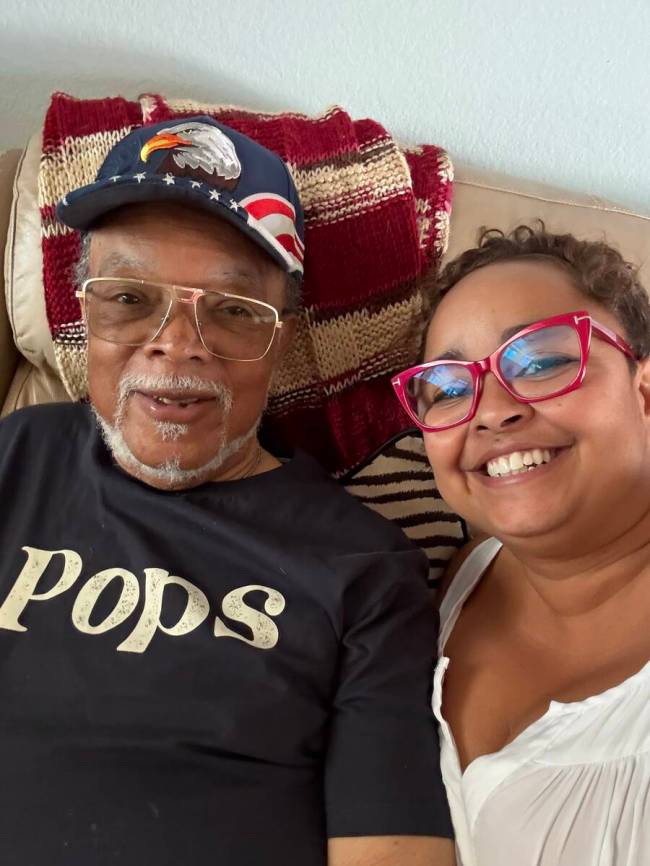
Jazz music hung in the air as the Rev. Leonard Jackson ventured onto the back patio of his east Las Vegas home last September and stepped into the direct sunlight of a 99-degree day.
His neighbor’s shady-but-messy tree that stretched onto his property and kept visitors cool had recently been cut down to his satisfaction.
Inside the house was his granddaughter Leah Almeida who moved from Texas earlier that year to take care of him after he suffered a stroke. Half an hour came and went, and she went outside with an ice-cold water bottle to check on him.
He was dead.
“He made a bunch of phone calls, and he got to talk to some of his closest friends, his daughter and other family from across the country,” Almeida said in an interview. “Then he fell asleep, and that was it.”
Jackson — a lifelong pastor and founder of the Historic Westside’s Faith Organizing Alliance that advocates for clean energy — was one of 712 who died in Clark County because of the heat in 2024 and 2025, according to the county coroner’s office. He was 83.
His official cause of death was cardiovascular disease along with environmental heat stress, though the coroner’s office has yet to provide an autopsy report in response to a public records request.
Jackson’s home sits in ZIP code 89121, a neighborhood east of UNLV that is the fourth-largest hot spot for heat-related deaths, according to a Las Vegas Review-Journal analysis of data from the Clark County coroner’s office.
The official tally of heat deaths in Clark County has grown in recent years, as the coroner’s office has evolved its standards for how to determine when heat plays a factor in someone’s death. The office has released more information to the media in recent years, although data analyzed by the Review-Journal still contained gaps — the exact location where dozens of people were “injured” by the heat was unclear in available public records.

So far in 2026, the coroner’s office has counted 41 heat-related deaths. But the office continues to add to that number throughout the summer and previously has not released final counts until well into the fall.
Over the past few years, extreme heat and its uneven burden on residents has proven to be a multilayered issue that requires willpower and funding to help communities adapt.
Assemblymember Cinthia Zermeño Moore, D-North Las Vegas, lives with her 9-year-old son in ZIP code 89101 — the downtown Las Vegas neighborhood with the most deaths of any geographical area by far, according to the Review-Journal’s analysis.
Moore, who plans on introducing several pieces of legislation related to extreme heat in the 2027 session, said Nevada leaders are only beginning to take extreme heat seriously.
“For many years, I feel like it was an issue that was overlooked,” Moore said. “In the last few years, there’s been more political will to address it.”
Downtown has most deaths, nearby ZIP codes close behind
In Clark County, the deadliest ZIP codes for heat after the downtown core are immediately north and northeast of downtown, as well as east of UNLV and north of Harry Reid International Airport.

Neighborhoods with the most deaths line up with areas that experience heat more intensely than other parts of the valley, or urban “heat islands.” Research shows that where someone lives and works greatly determines their experience during a heat wave at a hyperlocal level.
A landmark 2022 study from the Regional Transportation Commission established that certain parts of the region can feel up to 29.6 degrees hotter than places with more green spaces, tree cover and shade structures.
Ariel Choinard, director of the Desert Research Institute’s Nevada Heat Lab, said existing research underscores how complex of a challenge urban heat is. The context within which people live determines their personal risk factors, she said.
If, for instance, someone is working outdoors all day and comes home to an older home with poor cooling, the impact of extreme heat on that person’s body can compound. Transit riders often can wait hours in the sun to catch a bus to get to work; homeless people often get little relief overnight when temperatures stubbornly stay above 90 degrees; and the rise of the opioid epidemic messes with people’s ability to regulate heat in their bodies.
It’s a systemic issue. It touches everything from housing to healthcare, to affordability and drug use.
“It’s a systemic issue,” Choinard said. “It touches everything from housing to healthcare, to affordability and drug use.”
Choinard’s colleague in the research group, ecologist and tree expert Cheyenne Engel, said the focus of extreme heat planning at the local level is not solutions-based. Rather, response is rooted in adaptation. That is especially true in Las Vegas, which climate scientists consider to be the nation’s second-fastest-warming city.
“We’re not going to solve heat,” Engel said. “It will always be an issue. We’re not going to be able to fix it at the valley-wide level. But a lot of small actions and a lot of little impacts can have wide benefits if we’re doing them wisely.”

Mojave Desert trees bring big benefits in urban settings
The power of shade on a 110-degree day cannot be understated.
According to Engel, studies have shown that the shade of a tree can reduce the temperature of surfaces by up to 50 degrees. The nonprofit American Forests reports that Las Vegas neighborhoods with the most heat-related deaths have anywhere from 3 percent to 12 percent tree canopy cover, per satellite data.
That means life-saving shade can be hard to come by. American Forests recommends 15 percent tree canopy as a baseline target for desert cities.
Hundreds of desert-adapted trees and saplings await their shot to save lives at the city of Las Vegas’ tree nursery, tucked away in a gravel lot next to Doc Romeo Park.
2024 INVESTIGATION
Read the Review-Journal’s previous installment of ‘A Fatal Forecast’
City leaders have an ambitious goal of planting 60,000 trees by 2050, focused on areas with the least tree canopy and the most heat deaths. They regularly give away trees and provide irrigation support to homeowners in targeted ZIP codes using a federal grant.
Las Vegas’ forester, Brad Daseler, said staff members recognize the harsh shade disparities within the city’s boundaries. He notes that the trees that provide dense coverage in areas like Summerlin are often on private property, and they come at a premium price through homeowners association fees.
“Landscaping is kind of a privilege,” Daseler said.
Even the biggest advocates for trees recognize that their full benefits may not be felt for upward of a decade as they reach maturity.
The death of trees that make up the minimal canopy throughout Las Vegas has been a hot topic, as well.
A lawsuit against the Southern Nevada Water Authority alleged its decorative grass removal efforts have killed an estimated 100,000 trees because of newly exposed root systems and a lack of maintenance. The water authority’s hired arborist disputed that claim in later court filings.
Daseler said that in his experience, desert landscape conversions have not led to any significant number of tree deaths. But climate change means a constant game of trial and error to see what species have longevity, he said. Daseler sources trees native to Southwest and Mexican deserts, and has grown a small army owned by the city, waiting to be deployed.
“We assume it’s going to be hotter and drier, and we’re going to continue to have water restrictions,” Daseler said. “We’re trying to put in trees that we think are up for the task.”

Cooling stations offer aid for homeless, others
Aside from tree planting, the most tangible and immediate response to extreme heat deaths in Clark County is its network of cooling stations.
Officials offer libraries and community centers no extra funding or resources other than water, but those facilities agree to become designated, air-conditioned spaces where anyone can come in to cool off.
However, they do not stay open past the facility’s original operating hours and do not offer any other special services that some have called for, such as emergency healthcare.
Half of the six ZIP codes with the highest number of heat-related deaths are not home to a Clark County cooling station in the central valley, though they may be nearby.
This summer, for the first time, Clark County’s social services staff is no longer waiting for official National Weather Service heat warnings to activate the cooling stations, instead relying on its own temperature thresholds.
A Nevada Heat Lab survey of cooling stations published this year revealed that most visitors use the stations at least once a week. Nearly seven in 10 of those surveyed believe the heat puts their health at risk.
The ZIP code with the most total heat deaths includes the bulk of Southern Nevada’s homeless services, near Las Vegas Boulevard North and Main Street.
In Clark County, the coroner’s office data officially identified 30 percent of the people who died of heat deaths as homeless. The Review-Journal determined that at least 41 percent of the deaths originated from outdoors or happened outside.
Having somewhere to direct homeless people to is a major benefit of the cooling station network, said Louis Lacey, director of homeless outreach at HELP of Southern Nevada.
“When we lose people to heat, we know that it isn’t because they didn’t know it was hot outside,” Lacey said. “It’s usually because people run out of safe places to go. They run out of water; they run out of strength or time; or they’re under the influence and they fall out.”
According to coroner’s office data, just over half of all heat deaths from 2024 and 2025 involved drug or alcohol use.
When we lose people to heat, we know that it isn’t because they didn’t know it was hot outside. It’s usually because people run out of safe places to go. They run out of water; they run out of strength or time; or they’re under the influence and they fall out.
When it gets past a certain temperature in the early summer, Lacey said, extreme heat becomes too present a problem to ignore. His staff gives out close to a pallet’s worth of water bottle cases a day to those in need, he said.
One major help has been the ability to pass out comped RTC bus passes that are intended to send people to cooling stations free of charge, Lacey said. But the idea that cooling stations are only for homeless people is a misconception, he said.
In the future, Lacey said, he’d like to see agencies consider bringing cooling resources, such as an air-conditioned bus, into encampment areas to persuade those who are resistant to travel to protect themselves from the heat.

Some eye 2027 for legislative change
Those who research, legislate or organize around the issue of extreme heat interviewed for this article expressed a critical deficiency of Southern Nevada’s response: funding.
Jackie Spicer, coordinator of the Nevada Environmental Justice Coalition, said it’s incumbent on officials to find sources of money for these lifesaving measures.
“It’s not OK to accept the status quo,” Spicer said. “We can’t claim to take this issue seriously if we’re not backing it with funding. To me, that feels like the difference between words on a page and actual action being taken.”
Some recent legislative efforts at the federal level from U.S. Sen. Jacky Rosen, D-Nev., and U.S. Rep. Dina Titus, D-Nev., have focused on allowing the Federal Emergency Management Agency to qualify extreme heat waves as emergencies.
That would allow emergency funds to be applied to heat adaptation.
So far, the most noteworthy piece of extreme heat legislation to come out of Nevada was Assembly Bill 96, which requires the state’s biggest cities and counties to include specific elements of heat mitigation in their master plans. It sparked Clark County to formalize its commitment to operating cooling stations in county documents.
But some, including Spicer, remain unconvinced that language shifts with little enforcement power are enough to see meaningful change.
Moore, the North Las Vegas assemblymember, said she intends to introduce two extreme-heat-focused bills in the 2027 session.
It’s not OK to accept the status quo. We can’t claim to take this issue seriously if we’re not backing it with funding. To me, that feels like the difference between words on a page and actual action being taken.
One is based on a bill that didn’t advance last session to prevent utilities from shutting off electricity between May 1 and Oct. 31. It’s a step past the current administrative code that prevents energy shutoffs when temperatures surpass a threshold.
The other bill would create a statewide extreme heat office, where a designated staff member would oversee adaptation year-round.
Other hot cities throughout the country have similar offices either on a local, regional or statewide level, including Los Angeles, Phoenix and Miami.
“My hope with the statewide office is that it’ll have an outside view of everything that’s going on and help identify gaps — and funding to fill those gaps,” Moore said.

On the ground, community is key
In the meantime, extreme heat will continue to jeopardize the lives of those most at risk.
Almeida, the granddaughter and caretaker of the Rev. Jackson, recalls picking up the phone as a child to an unfamiliar voice. It was Vice President Al Gore’s office looking to speak with Jackson. That was the first time she realized he was a public figure.
Jackson spent his life in service to others, Almeida said, whether that was by helping negotiate peace talks following the Los Angeles riots associated with the police killing of Rodney King or the simple act of lending an ear to a neighbor.
He knew, too, that environmental justice issues ran deep in Las Vegas — evidenced by a 2020 Review-Journal op-ed he penned on the negative health outcomes from climate change issues, such as air pollution.
“He was a man who truly loved people and wanted to see the best for them,” Almeida said.
And that legacy has lived on. Cheryl Peters, Jackson’s mentee who took over the Faith Organizing Alliance as executive director following his death, said her organization is often a one-stop shop for people in the Historic Westside who need assistance.
Peters said she connected a family with a Black church that helped pay the family’s utility bill to prevent it from losing access to air conditioning this summer.
She recalls Jackson making several calls to NV Energy, advocating on behalf of people who could have had their electricity shut off in the dead of summer.
“If he saw you outside hungry, he would just reach in his pocket and give you some money or take you to be fed,” Peters said. “If he could help you, he would help you.”
Contact Alan Halaly at ahalaly@reviewjournal.com and Katelyn Newberg at knewberg@reviewjournal.com.