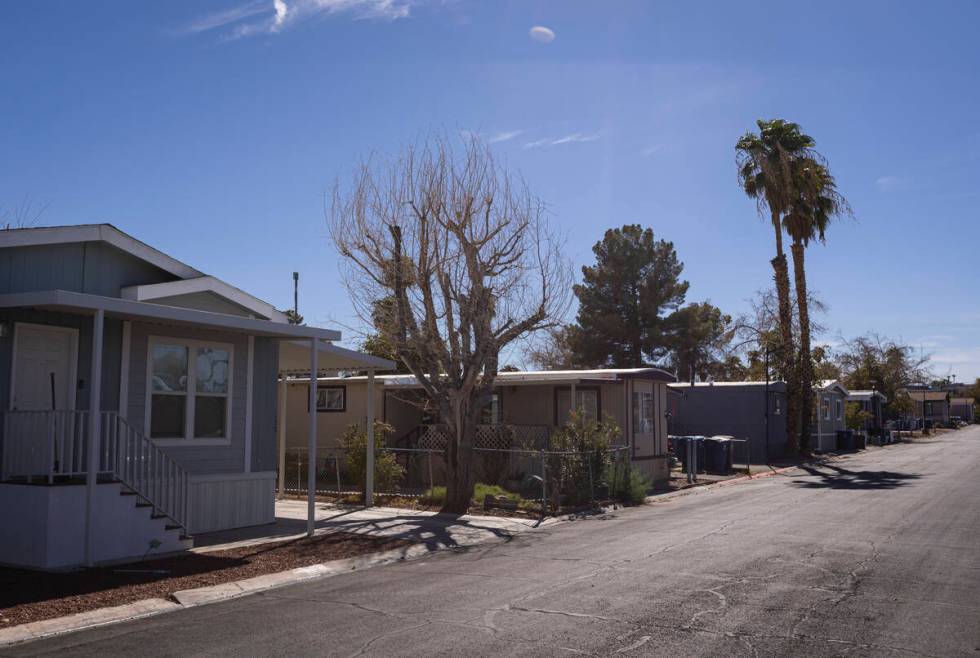
Zena Hanley built a quiet, independent life for herself while trying to escape her family’s ties to organized crime in Las Vegas.
But after a lifetime of association by last name with Sin City’s underbelly, it was the deadliest summer in Las Vegas’ history that ended the 63-year-old woman’s life in 2024.
Hanley died after years of cooling problems in the mobile home where she lived alone in east Las Vegas, making her one of the more than 700 people whose deaths in the summers of 2024 and 2025 have been attributed by the Clark County coroner’s office to heat.

“I couldn’t believe that she was gone,” said 78-year-old Leroy Howell, a friend who found Hanley dead in her home. “I couldn’t understand why she wouldn’t reach out to me. She knew she could.”
According to newly released, first-of-its-kind data from the U.S. Census Bureau, about 6,700 households in Clark County are estimated to be living without air conditioning. The study used an artificial intelligence model to analyze federal population estimates and housing data sets to come up with a prediction as to how households would have answered a survey question asking if they had air conditioning.
Access to reliable cooling in the nation’s hottest desert can mean the difference between life or death.
For Zena Hanley, it did.
Hanley’s was one of nearly a dozen cases identified by the Las Vegas Review-Journal of people whose deaths since 2024 were at least partially caused by not having a working air conditioner in their homes. Routinely released descriptions of heat deaths from the coroner’s office are not standardized, so the true number of deaths involving malfunctioning air conditioners could be higher.
A Review-Journal analysis found that in many cases, those who die without air conditioning appear to lack a robust support system, and renters are left to navigate a confusing network of housing regulations and tenants-rights laws.

New swamp cooler found in backyard
Hanley’s mobile home, where a relative said she lived for about 15 years, is also in one of the top ZIP codes for heat deaths from 2024 and 2025 where someone died in their home or was “injured” by the heat in a residence, according to a Las Vegas Review-Journal analysis of data from the coroner’s office.
The Hanley surname followed her around her whole life.
Hanley’s grandfather and father were Tom and Andrew “Gramby” Hanley, convicted contract killers with ties to organized crime. Reporters at the time wrote that Tom Hanley, a labor union boss, operated an air conditioning company that employed Andrew Hanley as a mechanic.

The Hanley men dominated headlines in Las Vegas during the late 1970s, when Zena was a teenager. Tom Hanley was mentioned in news stories as recently as November, in connection with the remains of a Canadian woman unearthed in the desert outside Henderson.
By the time of her death, Zena Hanley was out of contact with the majority of her family. Her aunt Amy Hanley of Reno was not aware that her niece’s death was included in the coroner’s office totals, or that Zena Hanley died with a broken air conditioner, until she was contacted by a Review-Journal reporter.
“Zena did not have much of a support system,” Amy Hanley acknowledged.
The coroner’s office listed Zena Hanley’s cause of death as cardiovascular disease, with other significant conditions of tobacco use, breast cancer and environmental heat stress.
Amy Hanley, 49, said she last spoke to her niece a few years before her death, but she does remember that Zena Hanley was having difficulties in 2020 fixing her swamp cooler: a type of evaporative air conditioning system viewed as less effective than modern AC.
Howell said Zena Hanley had problems with her swamp cooler for “years and years,” and he would help her make repairs on it nearly every year.
He knew she was planning on buying a new swamp cooler, but she never called to tell him that it had arrived and that she needed it installed. It was sitting in her backyard the day he found her body, he said.
The floor that Zena Hanley was found lying on was 100 degrees, according to her autopsy report. Her skin was 102 degrees.
Data shows cooling disparities
Zena Hanley’s death is an extreme example underscoring a larger issue that plagues Southern Nevada. The hyperlocal U.S. Census Bureau data provides some clues.
The survey’s estimate for Clark County includes areas like Mount Charleston, where an estimated 12.8 percent of homes at the higher elevation don’t have air conditioning.
But in Las Vegas’ urban core, the survey estimates that some neighborhoods have up to 5 percent of households without AC. Those areas can overlap with ZIP codes that have seen higher numbers of heat-related deaths in recent summers, as well as pockets of the valley considered “heat islands,” with hotter afternoon temperatures, according to a 2022 study from the Regional Transportation Commission.
The data also doesn’t indicate how many people in Southern Nevada elect not to turn on a functioning air conditioning unit because of energy costs.
The Energy Equity Project, a research group associated with the University of Michigan, has estimated that about 17 percent of households in Nevada have an unaffordable energy burden, meaning they spend more than 6 percent of their household income on utility bills.
Air conditioning has made modern life in the desert possible for millions of people.
Without it, there are few ways to escape from the blistering summers that can turn deadly. In Clark County, the coroner’s office data officially identified 30 percent of the people who died from heat as homeless. The Review-Journal determined that in 34 percent of Clark County heat deaths, someone died at their home or was “injured” by the heat at a residence, whether indoors or outdoors.
Meanwhile in Europe, where air conditioning is far less prevalent than in the Southwest U.S., estimates show that there were over 10,000 more deaths than expected at the height of a heat wave earlier this summer, according to The Associated Press.
Heat deaths in homes often occur in low-income areas
The Clark County coroner’s office has officially identified nine people who did not have functioning air conditioning when they died from the heat inside a home during the 2024 and 2025 summers. The majority of those people owned the homes they died in, according to county property records.
Death investigators do not use standardized language to describe circumstances when tallying heat deaths in the data the coroner’s office releases publicly. It’s unclear how many more cases are like Zena Hanley’s. The Review-Journal only learned that air conditioning was a factor in her death after obtaining her autopsy report.
Air conditioning access has even underpinned a few wrongful death lawsuits in Southern Nevada, where family members argue that a third party was negligent for not fixing it.
In one case, coroner’s office data indicates that 60-year-old Lisa Borowski died in a group home because of drug use and exposure to high temperatures. Her family has sued the group home, alleging the air conditioner in her room was not functioning.
Although Zena Hanley’s autopsy report makes it clear that she died without a working air conditioner, the coroner’s office data set on heat deaths only indicates that she suffered from “prolonged exposure to elevated environmental conditions.”
2024 INVESTIGATION
Read the Review-Journal’s previous installment of ‘A Fatal Forecast’
The Clark County coroner’s office released Zena Hanley’s autopsy report on Monday but has yet to release over a dozen reports for others who died from the heat. The Review-Journal requested the reports in June.
Zena Hanley had a reputation for independence even as a teenager, when she worked as a “photo girl” taking pictures of tourists in front of the $1 million display at Binion’s Horseshoe casino in downtown Las Vegas, said Lisa Saybrook, an old friend of Zena Hanley’s.
“She was a really tough girl because she had to be,” said Saybrook, who hadn’t heard from her former friend in decades.
Zena Hanley had a variety of jobs over the years, including stints as a cocktail waitress, bartender and construction laborer. She was reserved with strangers but held her few friends close. Howell’s wife, Marilee Howell, said her friend didn’t like to get her picture taken, but she did love gardening and animals. She was known for nursing birds with broken wings back to health.

She lived life on her own terms.
“Zee didn’t like to ask for help,” Marilee Howell said.
Amy Hanley still tears up when talking about her niece. In the midst of her complicated relationship with the Hanley family, Zena was always kind to her, she said.
Las Vegas was a dramatically different town in the 1970s with a much smaller population. Even today, Amy Hanley still meets people in town who know her by her last name. She said being associated with the Hanleys haunted her niece.
“Every time I talked to Zena, I don’t think she could ever forgive Gramby for everything he did,” Amy Hanley said.
The Review-Journal found that, like Zena Hanley, many of the people whose heat deaths were recorded in coroner’s office data do not appear to have had strong support systems.
Many who died in homes because of the heat — whether explicitly from lack of air conditioning or not — lived in low-income areas clustered around the center of the Las Vegas Valley. Property and Family Court records show that many of the people who owned their homes previously had gone through the death of a spouse or relatives and may have been living alone.
So far in 2026, the coroner’s office has recorded one death from someone living with a malfunctioning air conditioner.

Kevin Olson, 67, died in June from cardiovascular disease, but a significant condition of his death was environmental heat exposure. The coroner’s office data indicates that he was “exposed to high temperatures due to malfunctioning air conditioning.”
Olson grew up in St. Louis Park, Minnesota, and moved to Nevada in 1986, according to his online obituary. He lived alone in Boulder City after his parents died.
He was active in the bowling community, previously worked at the American Bowling Congress, and spent years traveling and working at bowling tournaments, often held in Reno or Las Vegas. He loved taking people to dinner at the casinos when they visited, but many of his friends lived in other states, said two of his friends who spoke to the Review-Journal. The rest of his immediate family lived in Minnesota.
Bill Erickson, who was Olson’s friend from high school, said they would talk on the phone about once a month. Olson loved Las Vegas, enjoyed playing poker and was a “gregarious introvert” with his friends.
He also talked about the weather, Erickson said.
“He was not too tolerant of stuff changing in terms of temperature and weather,” he said.
Mark Miller, Olson’s friend and former co-worker, said it crossed his mind that the heat could have played a role in Olson’s death because of some pre-existing health conditions. But neither Erickson nor Miller knew that their friend had a malfunctioning air conditioner until after his death.

Do some Southern Nevadans live without AC?
In the dead, dry desert heat of summer, Southern Nevada nonprofit leaders say the federal data tracks with what they see every day.
Bob Cleveland, CEO of the nonprofit Rebuilding Together Southern Nevada, said he would expect that more than the 6,700 households estimated by the U.S. Census Bureau are without air conditioning in Clark County.
In his experience, virtually all homes have some sort of cooling system available to them, but people can last months or years with a broken air conditioner before asking for help.
Rebuilding Together Southern Nevada helps repair and improve homes for low-income and elderly residents. Every year, the organization replaces over 200 AC units, Cleveland said, and he sees people every day who have gone without air conditioning for an extended period of time.
“We hear it all the time that they don’t know how they would have survived the summer without us coming in and replacing their air conditioner,” Cleveland said.
And as temperatures rise in the nation’s second-fastest-warming metro area, even residents in homes that traditionally didn’t require cooling have started to install air conditioning units. That includes Mount Charleston, typically thought to be the cool mountain respite away from the valley, which is seeing increasingly intense heat waves in the summers.

Jean Perry-Jones, 74, has lived in the Old Town section of Mount Charleston for 50 years as a teacher, probation officer, and now retiree and real estate agent. She didn’t need cooling for decades, and got by with opening windows and turning on fans.
Perry-Jones finally decided to install a split unit early this summer, after a skiing injury kept her inside her home for longer than usual. On really hot days that break into the upper 90s, she said it takes a while for her wall unit downstairs to cool the upstairs bedrooms.
“It’s a frog in the simmering pot,” Perry-Jones said.
But even after installing her air conditioning unit, Perry-Jones and her partner left Mount Charleston in July to wait out the summer heat on the Oregon Coast.

Aid organizations prove to be lifeline
People who can’t afford to escape the heat sometimes postpone asking for help from organizations like Rebuilding Together Southern Nevada, Cleveland said.
He’s seen people go years without applying for a new air conditioning unit because they didn’t know whom to trust to ask for help.
They instead survive with less-efficient, portable air conditioning units, he said. Or they will find somewhere else to go during the heat of the day, such as a senior center or library.
Ashley Gonzalez, the director of HELP of Southern Nevada’s weatherization program, said the organization serves about 10 to 15 households that are in emergency need of a functioning air conditioning unit every summer.
The program uses state and federal grants to install “weatherization measures” in low-income homes, including solar screens, weather stripping, insulation, repaired windows, energy-efficient appliances, or heating and cooling systems.
Gonzalez said the program helps about 200 homes throughout the year, and “almost every single home” needs a repair or replacement air conditioner. In rare instances, Gonzalez said, she’s seen homes that don’t have any air conditioning unit to speak of.
“We don’t know how it started, what came about, if they bought the house that way,” she said. “It’s usually mobile homes that we’ve seen that occurrence.”
Utility shutoffs are common, too. NV Energy routinely cuts power to valley residents who do not pay their bills, though administrative code prevents them from doing so when it gets too hot.
For all customers, the Southern Nevada threshold that prevents shutoffs is 105 degrees. For elderly or disabled people in a standard housing unit, it’s 103 degrees, while it is 100 degrees for elderly or disabled people who live in mobile homes built before Jan. 1, 2000.
According to the U.S. Energy Administration’s data, Nevada saw 185,000 electric disconnections in 2024, the most of any Western state.
Gonzalez said that homes without proper weatherization can reach temperatures 10 to 15 degrees hotter than outside, and that she’s seen houses reach 120 degrees indoors.

Shutoff bill, renter protections could soon hit Carson City
Two bills might provide more protections.
Assemblymember Cinthia Zermeño Moore, D-North Las Vegas, told the Review-Journal that she intends to re-up a bill that gained no traction in 2025 that would have abandoned the temperature threshold for disconnections and instead followed a blanket rule against disconnections in certain months.
As it stands, one vote from the Public Utilities Commission could remake the administrative code that provides the threshold, whereas a state statute created by a bill provides much more certainty, Moore said.
“For people like me that live in the urban heat island, it may be 90 degrees there, but it’s really 100,” Moore said. “If we use the temperature threshold, we’re really not protecting everybody.”
Another law could help fix a common paradox: While homeowners have several options for assistance if their air conditioning stops functioning, renters are left to wait for landlords to fix the problem.
During the 2025 legislative session, Assemblymember Venicia Considine, D-Las Vegas, helped sponsor a bill that would have given tenants more legal remedies when a landlord did not fix a habitability problem in a designated time frame, such as air conditioning units guaranteed in rental agreements.
For people like me that live in the urban heat island, it may be 90 degrees there, but it’s really 100. If we use the temperature threshold, we’re really not protecting everybody.
The bill would have made it easier for renters to withhold rent if an air conditioning unit was not repaired within 48 hours, excluding weekends and holidays. It also would have done away with the “good faith” wording of the current law, meaning a landlord would be required to completely fix a habitability problem within that time frame or risk a tenant withholding rent.
Gov. Joe Lombardo vetoed the bill last year, writing in a memo that the legislation would place too much of a burden on landlords and “destabilize Nevada’s rental market.”
Considine said she plans to reintroduce a modified version of the bill during the next legislative session, but it’s still being worked on. And although the bill was meant to address many different aspects of habitability, Considine said air conditioning is an important component of the legislation.
“It’s inhumane for someone to be living in a place that has no air conditioning when it’s over 105, 110 degrees, day after day, and it’s something that they are paying for,” Considine said.
Contact Katelyn Newberg at knewberg@reviewjournal.com and Alan Halaly at ahalaly@reviewjournal.com.