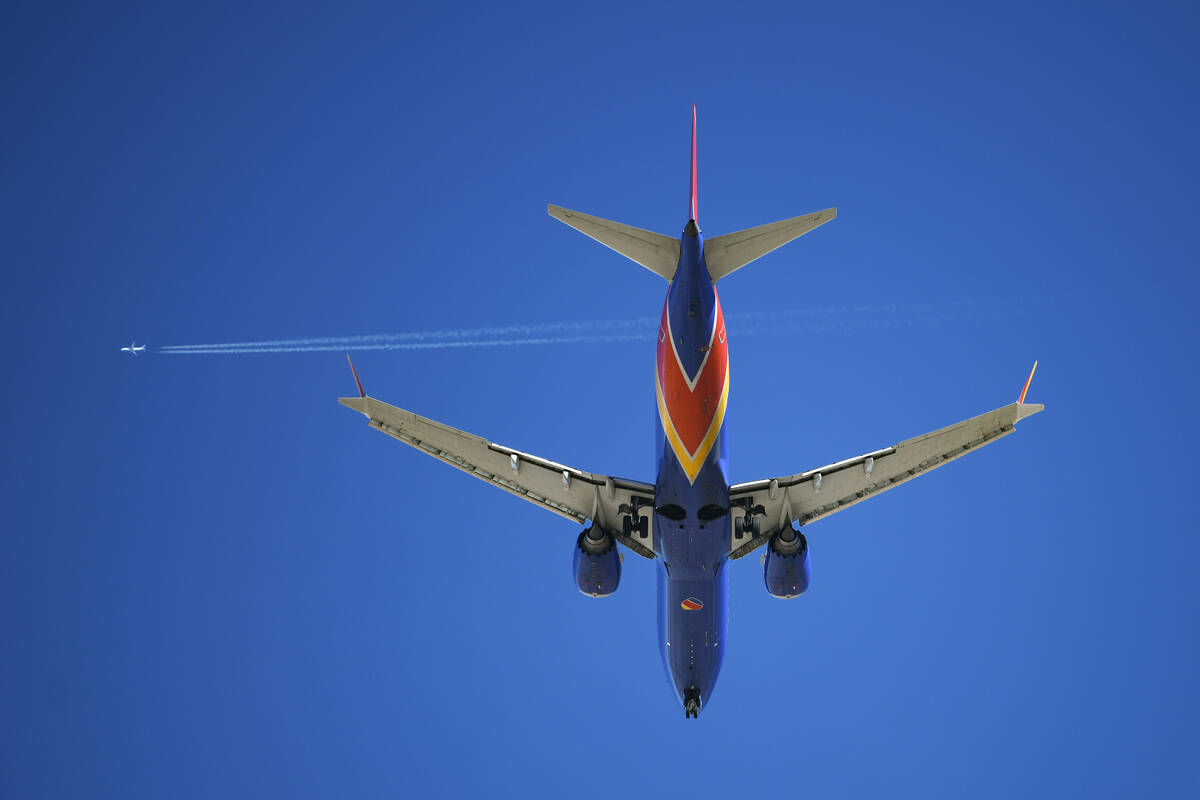
With temperatures expected to soar around 115 degrees over the weekend, air travelers leaving Las Vegas should prepare for possible cancellations and delays — or in even rarer occasions to be bumped by their airline.
Thousands of air travelers last weekend had their flights delayed because high temperatures affected aircraft performance and airlines resorted to removing passengers from planes to reduce departure weight.
There were published reports that airlines offered as much as $2,500 per passenger to get off planes and take a later flight. More often, airlines will offer a free ticket to the destination and, if no one volunteers, up the ante with additional compensation.
Some airlines didn’t seek volunteers and opted instead to wait out a change in conditions, mainly lower temperatures. Others offloaded fuel, assuring that the plane would have to make an unscheduled stop to refuel before continuing on its journey.
Airline plans
Southwest Airlines spokesperson Chris Perry said depending on the location and temperature, Southwest — the busiest commercial airline at Harry Reid International Airport — may lighten the load on airplanes by reducing the number of passengers or limiting the amount of fuel on board.
“Sometimes, this might mean adding an extra fuel stop on longer flights, such as flights from Las Vegas to Hawaii,” Perry said in a Thursday email. “We operate an all-Boeing fleet, and the airplanes are certified to fly safely out of hot, high-altitude airfields as long as the airplane is loaded and configured according to Boeing’s performance charts.”
A representative of Las Vegas-based Allegiant Air said the company has a policy of not bumping passengers unless absolutely necessary, and hasn’t had to do so during the current heat wave.
“As a policy, Allegiant does not bump passengers unless absolutely necessary. Allegiant has not had to involuntarily deny boarding for any passengers at Harry Reid International Airport (LAS) this summer due to aircraft weight restrictions prompted by higher than normal temperatures.
“Safety is our top priority, and we have procedures in place to address a variety of operational scenarios,” the company said in a Thursday email. “In the event a flight requires a reduction in weight, our first step would be to ask for volunteers willing to travel on a later flight in exchange for compensation or accommodations as appropriate. We understand delays can be frustrating and will work to minimize any disruption to our customers while maintaining safe operations.
Mike Boyd of Vail, Colorado-based Boyd Group International, an aviation consulting group, said some airlines randomly remove luggage to reduce weight, reasoning that they can forward suitcases on a later flight if necessary.
Contingency plans
Boyd said each airline has its own contingency plan in place to address an engine performance issue.
“The fact is, it is what it is, and what that means is airlines are going to have to do something about it,” Boyd said. “But they have to look at the economics. If it means we’re going to lose 500 passengers a day out of Las Vegas, do the math on how many people that is as a percentage. It’s really not that many.
“Now, to Grandma and Grandpa who got bumped, it’s a huge deal, but again, it’s an important story, but it’s not like air transportation is dying in Las Vegas.”
Boyd said larger airlines may have a greater advantage when it comes to heat-related bumping because they often have more than one daily flight to a particular destination and many of the larger carriers have invested wisely in customer service personnel that are specifically trained to deal with passengers who are bumped.
Boyd said there’s no way for passengers to prepare for the possibility of getting bumped because soaring temperatures are an unpredictable weather phenomenon.
“What are you going to do, look at the weather and say, ‘In two weeks it’s going to be hot weather, I won’t go?’ People don’t do that,” he said. “This is sort of like a thunderstorm on a big scale. You can’t really predict it. Or a snowstorm, you can’t predict it. And Vegas has had problems also with high winds from time to time.”
Southwest Airlines has a team of dispatchers that addresses high-temperature issues since it offers flights in several high-temperature destinations including Salt Lake City and Phoenix.
“We have a team of highly qualified dispatchers who work in our Network Operations Control center in Dallas,” Perry said. “Their job is to factor in all the challenges — temperature, field elevation, winds, runway length, airplane size, loading, etc… — and develop a flight plan that allows us to operate safely.”
Contact Richard N. Velotta at rvelotta@reviewjournal.com or 702-477-3893. Follow @RickVelotta on X.