Anthony Tyson spent years running a landscaping business in Connecticut before addiction upended his life.
After entering drug rehabilitation in California, his health insurance expired. Without coverage or stable housing, Tyson became homeless and eventually made his way to Las Vegas. He has spent about two years living outside under a park shelter at Siegfried & Roy Park, near Harry Reid International Airport.
“Rehab was extremely successful,” Tyson, 62, said.
Recovery, however, didn’t solve everything. Tyson has lived with high blood pressure for years, and without a car or reliable transportation, getting to a doctor’s office to refill his blood pressure medication isn’t easy.
And now, instead of traveling to a clinic — or going without care — Tyson waits for healthcare to come to him.
Every few weeks, healthcare workers from the Southern Nevada Health District’s newly formed street medicine team find Tyson where he’s staying, check his blood pressure and refill his medication. And during the summer, the team distributes water and other heat mitigation supplies to help patients cope with Southern Nevada’s triple-digit temperatures.
When asked whether he would be able to manage his chronic health condition without the team’s visits, Tyson didn’t hesitate. “Probably not,” he said, adding that the team’s visits have helped him stay on his medication.
Tyson is one of more than 180 people the health district’s street medicine team has treated after launching in November 2025. The four-person team has also completed more than 270 patient visits — including dozens of follow-up visits — bringing primary healthcare directly to people experiencing homelessness who often struggle to reach traditional medical providers.
As Clark County’s homeless population continues to rise, the health district’s street medicine team is preparing to expand using a $490,000 grant approved by the Clark County Board of Commissioners in May. The funding will soon allow the team to add a nurse, medical assistant and a contracted behavioral health provider, broadening healthcare access as another summer of extreme heat places people living outside at heightened risk.
Care for the mobile clinic’s patients is usually covered by Medicare and Medicaid.
Doctor’s office without walls
Mary Butkus, who’s been in and out of homelessness for the past eight years, said the team’s visits have made healthcare accessible in ways that traditional medical clinics often cannot. Butkus lives in east Las Vegas with her dog in a tent on a vacant lot adjacent to Interstate 11.
“They are an excellent team. I’m glad that we have them, because I cannot make it to a doctor,” Butkus said.
Louis Lacey, director of homeless response teams at HELP of Southern Nevada, echoed Butkus.
“When you’re at an encampment, everything you own is there. At any time, the authorities could come and abate that encampment,” Lacey said. “You could exit the hospital, come back to your encampment, and everything you own is gone. If it is not abated, then your so-called friends or other people may show up and rifle through your encampment and steal everything of value.”
He added: “If you have pets — and no one to watch them — and you need medical help, then you have to surrender your pets.”
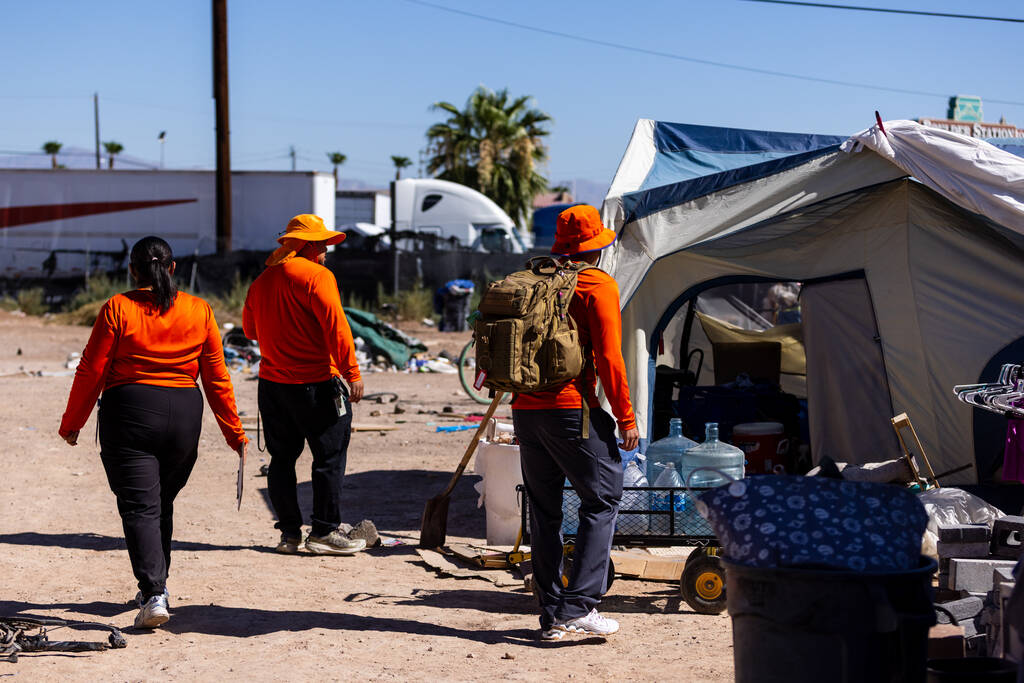
On outreach days, vehicles driven by the street medicine team pull into parks, encampments and vacant lots throughout the Las Vegas Valley. Nurse practitioner Long Tran unloads medical equipment while community health workers greet patients, many of whom they already know by name.
Blood pressure cuffs, stethoscopes, test tubes for sexually transmitted disease testing and backpacks replace examination rooms. Patients receive care wherever they are.
The team treats everything from high blood pressure to diabetes, skin infections and wounds. Tran can prescribe and refill medications, perform testing and transport or connect patients to the Southern Nevada Community Health Center in Las Vegas, where they can establish long-term primary care while the street medicine team continues checking on them in the field.
“We see them for whatever acute need they have,” Tran said. “If they require chronic care for like high blood pressure or diabetes, we can initiate the treatment and then recommend following up with our brick and mortar team” at the health center.
The goal, health district officials say, isn’t to replace traditional healthcare. Instead, the street medicine team serves as a bridge, helping patients begin treatment while connecting them with ongoing medical care they might not otherwise receive.
The program itself grew out of a gap that healthcare professionals and homeless outreach organizations had been discussing for years, according to district officials.
Planning for the program began in early 2025, and the Southern Nevada Health District saw its first street medicine patient that November after months of meeting with community partners to identify unmet medical needs among people experiencing homelessness. It’s the health district’s first such program, team supervisor Shannon Pickering said.
Pickering, a community health manager at the health district, said existing outreach organizations and their unlicensed community health workers were already helping people find food, water, shelter, and housing resources. What many lacked, she said, was licensed medical providers who could diagnose illnesses, prescribe medications and provide treatment in the field.
“There just weren’t enough medical providers that were out on the streets assisting with the medical piece of it,” Pickering said.
Pickering and Lacey, the director of homeless response teams at HELP of Southern Nevada, said that the organization helped the health district identify that gap and that the two organizations are often in the field together. Outreach workers with HELP, Lacey said, regularly encountered people who needed medical help, but because they weren’t licensed clinicians, they couldn’t provide the treatment themselves.
Lacey said that healthcare available through street outreach providers in Clark County was much more limited before the health district launched its street medicine team.
“The health district is bringing a more robust approach to providing medical services in the field to individuals experiencing homelessness,” he said.
Why follow-up matters
One visit rarely ends the relationship between the street medicine team and its patients.
Much of the team’s work revolves around returning to the same people. Mondays are largely dedicated to follow-up visits, Pickering said, allowing healthcare workers to check whether medications are working, wounds are healing or infections are responding to treatment.
Patients recovering from infections are often seen again within days, while those managing chronic conditions such as hypertension or diabetes may receive regular check-ins over several months.
“Sometimes a follow-up could be in a month,” Pickering said. “Sometimes the follow-up could be in a week.”
Consistency, Pickering said, helps build trust with patients who often have little reason to trust healthcare providers.
“We try to be consistent,” she said. “We go where the homeless are.”
The street medicine team also works closely with community partners, including HELP of Southern Nevada, Nevada Homeless Alliance, Clark County Social Services, the Salvation Army, and other homeless outreach organizations and teams.
A spokesperson for Clark County declined to make a representative in the county’s social services department available for an interview.
“Clark County Social Services would not have much to add at this time,” county spokesperson Jennifer Cooper said in an email.
Those partnerships, health district officials say, allow healthcare workers to meet patients who already have established relationships with outreach teams, making it easier to begin treatment and connect people with long-term medical care and housing resources.
“Our goal is to provide the primary care medical services that the homeless people need on the street,” Pickering said. The health district also has “the goal of getting them stably housed and into a long-term, more traditional health care setting.”
Surviving another summer
As temperatures continue to climb well above 100 degrees, the street medicine team’s backpacks have changed with the season.
With blood pressure cuffs and other medical supplies, the team carries water, electrolyte packets, sunscreen, aloe vera, cooling towels, hats, sunglasses and educational materials explaining the warning signs of heat exhaustion and heat stroke.
Jackie Spicer, coalition coordinator at the Nevada Environmental Justice Coalition, said people experiencing homelessness often remain exposed to dangerous temperatures long after most residents have gone indoors. Unlike people with air conditioning, those living outside may spend entire days and nights in the heat, she said.
She added that hot pavement can cause burns and that some may even seek relief inside flood channels because temperatures there are significantly cooler despite the risks.
“If their skin touches the sidewalk, they can get third-degree burns just from the contact,” Spicer said.
Ariel Choinard, who leads the Nevada Heat Lab at the Desert Research Institute, said hot nights can be especially dangerous because they prevent the body from recovering after prolonged heat exposure.
“Those high overnight lows are really troubling because people have less of a chance to cool down and get an actual physical break from the heat,” she said.
She added: “Cooling stations operate on business hours, so if you’re somebody who needs a cooling resource after your library or your rec center closes, that’s limited.”
Contact Lucas Hellberg at lhellberg@reviewjournal.com.