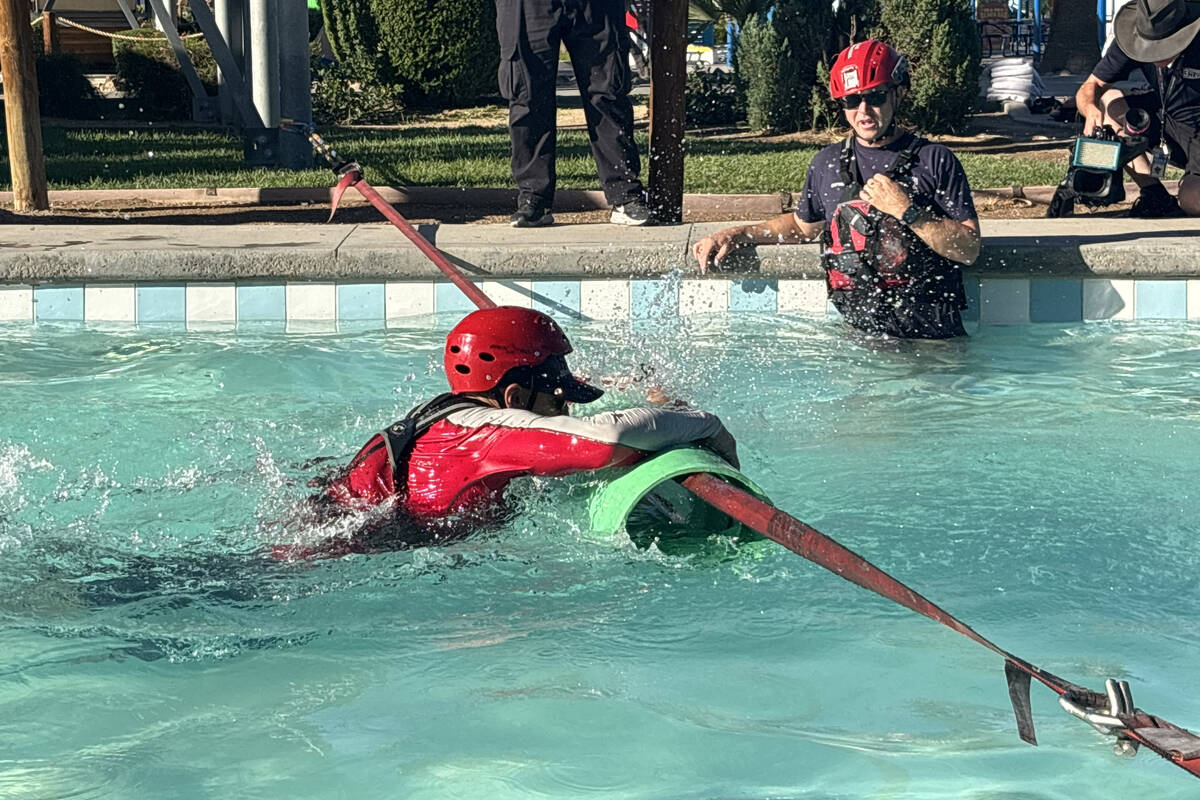
Henderson firefighters spent time Monday practicing swift water rescues as a strengthening El Niño offers up at least the potential for increased monsoonal moisture in Southern Nevada this summer.
Henderson Fire Capt. Colin McTaggart said the fire department’s annual swift water training at Cowabunga Bay Water Park helps firefighters get ready for what is arguably the most dangerous threat Las Vegas Valley residents face when it comes to weather: flash flooding caused by monsoonal thunderstorms.
“This gives us the opportunity to get guys into actual moving water and practice the skills they need for the real world incidents that happen here in this valley,” McTaggart said.
“When we get those rains, and as the body of water gets moving, it’s pretty easy to get swept away — either individuals or vehicles,” McTaggart said.
Firefighters practiced a series of drills including swimming against currents, finding eddies, using ropes and other devices that people can grab onto if swept up in swift waters, and swimming in dangerous conditions in which firefighters need to get over partially submerged obstacles if they themselves end up in the water.
“The biggest message we need to get out to the public is don’t underestimate moving water,” McTaggart said. “It is incredibly strong, and it doesn’t take very much to sweep a human off their feet or pick up a passenger vehicle. The rule of thumb we like to say is six inches (of moving water) can take a human and 12 inches can actually take a vehicle. If you see those waters rising, just make sure you use precaution and don’t cross them. Stay out.”
The summer monsoon season in Southern Nevada generally runs from late June into September. Julie Phillipson, lead meteorologist at the National Weather Service’s Las Vegas office, said it is hard to say whether the region will see an increased number of thunderstorms this summer, but it is possible given the current setup in the atmosphere.
“There is a strengthening El Niño right now, so that could indicate a more active Eastern Pacific tropical storm season, which could give us more opportunities for significant monsoon events, but right now we have to wait and see,” Phillipson said.
The National Oceanic and Atmospheric Administration is forecasting a 40 percent to 50 percent chance of above-normal precipitation in Southern Nevada this month and a slightly lower chance for above-normal precipitation through September. Normal precipitation in Las Vegas averages 0.38 inch of rain in July, 0.32 inch in August and 0.32 inch in September, according to data from NOAA.
The monsoon season has proven deadly in the Las Vegas Valley in the past. In July 1999, the Las Vegas Valley saw 3 inches of rain in an area that typically sees an average of only 4.18 inches of rain a year. Two people were killed, 353 homes were damaged and millions in damage done to public property.
Contact Glenn Puit at gpuit@reviewjournal.com.