The trip was the ultimate test of their bromance, and they passed. But it had a deeper message.
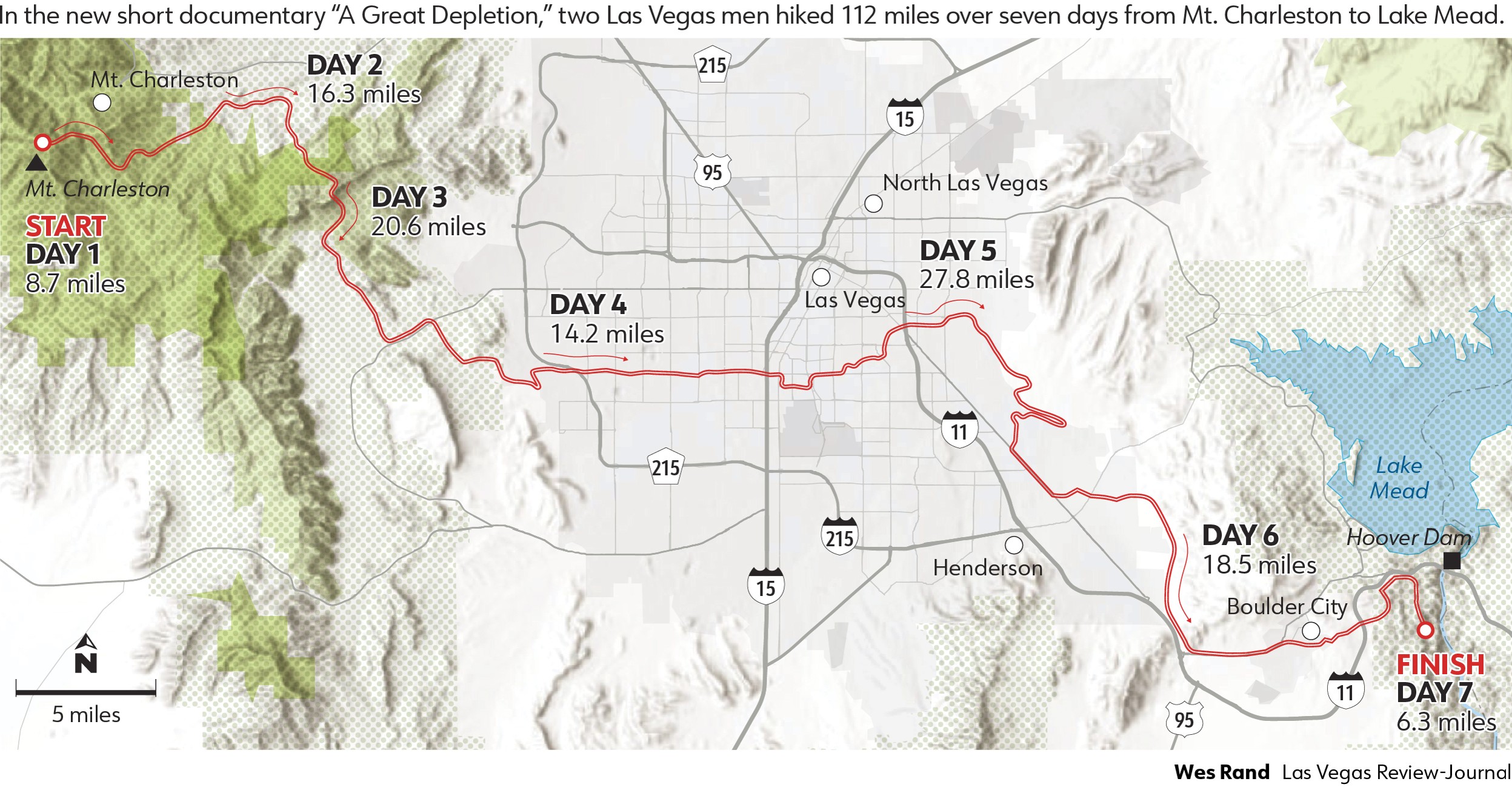
It has been months since Alex Harper, 37, and Austin Williams, 35, began a 112-mile journey from the Spring Mountains to Lake Mead that most rational people might shudder at. Over seven days, they summited Griffith Peak, walked the Las Vegas Strip and made it all the way to the reservoir that makes urban life possible in the Southwest.
The biggest catch? Along the way, the pair agreed to only drink water that was free, whether that was spring water in the mountains or out of a tap at a Las Vegas Strip resort.
Access to water in the Mojave Desert, the pair contended in a recent interview, is life or death for flora and fauna.
“Water is the limiting factor for us, too,” said Harper, a Las Vegas birding guide and naturalist. “On this walk, we can crank out many miles, we can walk through our blisters, we can do all these things that are not life-threatening. If we run out of water, that’s going to be the thing that stops this first. It dictates everything.”
Harper and Williams are the stars and the crew behind a self-produced, short documentary titled “The Great Depletion” that tracks their hike and documents how climate change is contributing to extreme drought and species decline in Southern Nevada. On Tuesday, it debuted on YouTube, with two in-person screenings to come.
The film comes at a time when all seven states in the Colorado River Basin are years into heated debate about how to share the river as federal guidelines are set to expire. Over the next two years, Lake Mead, Southern Nevada’s primary water source, is projected to dip 29 feet below its all-time low set in 2022.
Williams, who works with his wife, Sam Arikawa, as a two-person real estate team, said his idea for the film came from Beau Miles, an Australian YouTuber who often pushes his physical limits in videos to make commentary about nature.
“Springs are going dry — water sources that animals, birds and pollinators have had access to for thousands of years that they no longer have access to,” Williams said. “They can’t just go to 7-Eleven and buy water. We mimicked that aspect of, ‘OK, well, if we don’t have access to go buy water, what does that look like for us?’”
Ambitious hike yields lessons
A few mornings, Arikawa — or “Saint Sam,” as she is nicknamed in the film — met up with Harper and Williams to check in and provide their first meal, a breakfast burrito.
Behind the scenes, Arikawa helped scout locations and map out the route. Arikawa said she wasn’t too keen on coming along for the adventure, but she wasn’t in love with the idea of Williams doing it, either.
“If they have their mind set to something, it’s going to happen no matter what,” Arikawa said.
So they did. The journey began with a grueling hike to the summit of Griffith Peak and, later, a descent into the La Madre Wilderness. They filled all of their water containers at Harris Springs, the only available natural fresh water source until they reached the Colorado River.
Once they reached the Las Vegas Valley, the pair continued the narrative about species lost against the region’s often harsh urban landscape. One night, they opted to stay at a Strip hotel.
Once they hunkered down for the night, Harper weighed in on the façade that Las Vegas and the Strip offers to visitors. A city so acutely affected by climate change doesn’t often center those impacts, he said.
Williams, who grew up in Southern Nevada, said that meeting Harper and learning more about the environment has completely shifted his perception of water-guzzlers like lawns, golf courses and water features.
“I accept Las Vegas for what it is,” Harper says in the film. “It does not hide the fact that it is here to entertain. But I do think we’re living in a little bit of a fantasy land.”
Later, they traverse past the Flamingo Wash, Clark County Wetlands Park and, eventually, through Boulder City to reach the Colorado River.


A film in all seven Colorado River states?
Williams said the success of the hike has widened their ambitions. One day, he would like to create similar films in every state in the Colorado River Basin, illustrating the unique ways that climate change is affecting different parts of the watershed.
Next on the list is New Mexico, with hopes to complete a hike along the Rio Grande over two weeks in April 2027. On their website, helpthewest.org, they have a fundraising goal of $30,000 to support the travel and film production.
For now, though, Williams and Harper want their audience to take the information they gather from the film and turn it into some measurable action, whether a donation or a decision to volunteer. The website suggests organizations for residents of every state in the Colorado River Basin.
“It was a real struggle for me at the end of the hike, because I had more questions than I started with,” Williams said. “This is so monumental, and I felt so tiny … we really want people to get connected to these organizations that are already doing the work for them.”
The best antidote to anxiety about climate change and drought, Harper said, is to get involved.
“Sometimes I have weeks or months where I’m just so down about this, and then you bounce back,” Harper said. “Community is going to hold you together.”
The film is available to stream on YouTube on Williams’ channel, https://www.youtube.com/@austinandsam. It will be screened first on Aug. 23 at 2 p.m. at the Springs Preserve, with another showing at the Winchester Dondero Cultural Center on Aug. 26 at 6 p.m.
Contact Alan Halaly at ahalaly@reviewjournal.com. Follow @AlanHalaly on X.