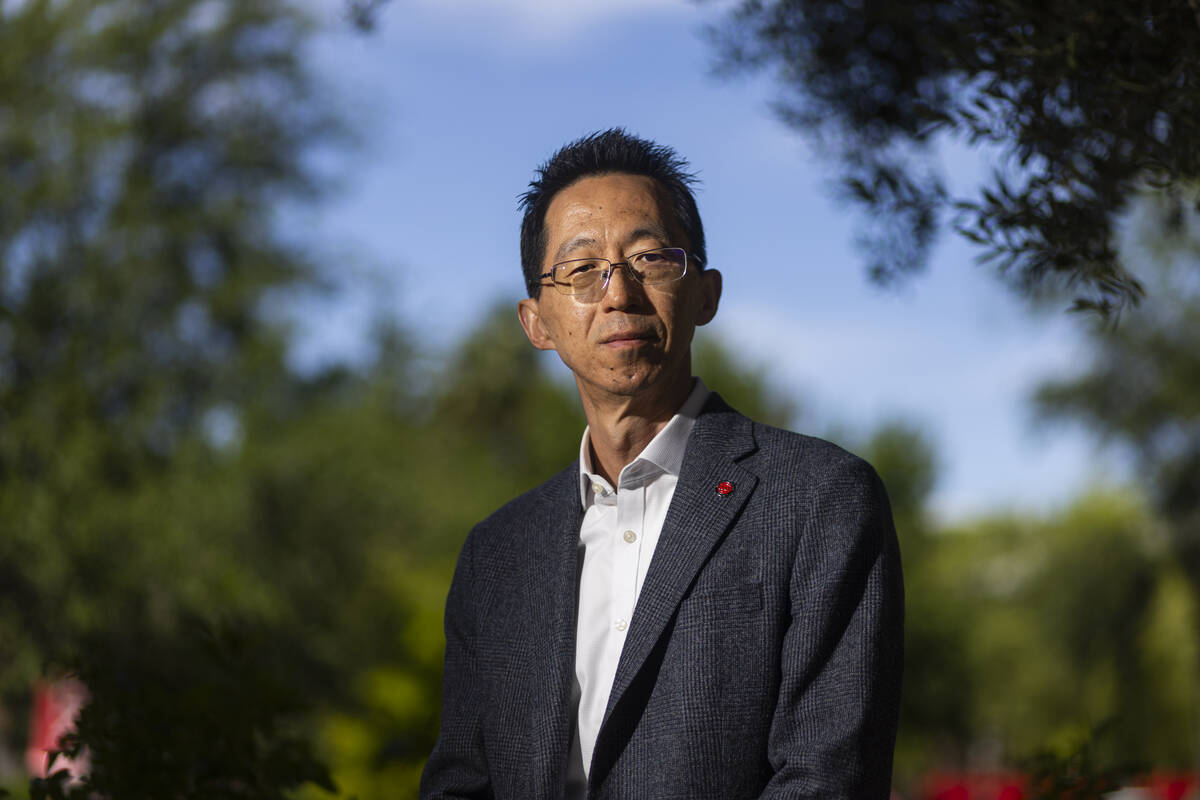
Daniel Chi is on a couple of missions.
One, the chair of the Department of Finance at UNLV’s Lee Business School wants to increase financial literacy across Nevada. A recent study found that Nevada has the highest rate of credit card delinquencies and one of the highest overall debt burdens of any state.
About 3,000 students were taught personal finance through coursework at UNLV, and Chi said they are expanding the courses to the Clark County School District. He was recently appointed by the Nevada System of Higher Education’s chancellor to represent NSHE on the Nevada Advisory Council for Financial Literacy due to his work on increasing financial literacy.
Chi’s second mission is to try and help turn the Las Vegas Valley, long heavily reliant on tourism and gaming to power its economy, into a financial hub. He said this starts with training the next generation of financial talent through UNLV, and, in turn, help cultivate the industry locally. He took some time to speak to the Las Vegas Review-Journal about how the valley can achieve this goal, and what we can do to help expand our economic footprint.
Las Vegans are bad with their money. What are some things they can do right now to change that?
Have a budget and live within one’s means. If one cannot control credit card spending, one should get rid of the credit cards and use a debit card or cash.
For those who do not have a rainy day fund, start building one. The rainy day fund should have enough cash to cover three to six months of cash flow needs. That is, if one becomes employed tomorrow, the rainy day fund should last him or her for three to six months.
Open a money market fund for a higher interest rate. Currently, a reasonable money market fund should offer an annual interest rate of over 3 percent.
Arrange for automatic payroll deduction into this fund. That is, avoid having to manually transfer money into this account — that may peter out very soon. Instead, automate your best behavior.
What is UNLV doing right now to help prepare the next generation of finance sector employees?
A skilled labor force is essential to the successful transformation to a financial center. The Department of Finance at UNLV has been updating its curriculum to prepare students for the fast-changing landscape. For example, we have introduced courses on financial technology and AI in finance. We recently introduced a course that prepares students to obtain financial-industry licenses before they graduate, which is a pioneering idea in the country.
Our new insurance and risk management major is one of the very few in the Western U.S. and is starting very strong, and well received by the industry. We also introduced experiential learning activities such as Rebels on Wall Street, UNLV President’s Investment Challenge, student-run investment funds, and the Kerestesi Insurance Challenge.
How do you both cultivate local talent in this sector and then make sure they don’t fly off to a financial hub like New York or somewhere else and keep them in Vegas?
As we cultivate local talent, the local financial sector will also grow, which will create a positive feedback loop. This is how a robust ecosystem is formed. As of now, many firms in Vegas hire a lot of financial talent from other states. As we train more financial talent, those positions will gradually be filled by Vegas-grown talent.
What is one thing Las Vegas needs to work on right now to cultivate a better financial sector labor force?
More investment in training and education programs. For example, at UNLV, even though the enrollment in finance courses have nearly tripled since 2022, the total faculty count in the Department of Finance have actually declined. Teaching capacity has been stretched to a breaking point. We need to significantly increase the teaching capacity to meet the demand.
What are some of the challenges out there right now regarding Las Vegas becoming more of a financial center hub?
There is still a misconception from the rest of the country that Las Vegas is not a serious place to do business, that we are not “smart enough” or “serious enough.” This misconception was partly self-inflicted, we branded ourselves as “Sin City” and advertised the slogan, “What happens in Vegas stays in Vegas.” But times have changed, and now we need to change our image and build a new reputation: We are serious about business, including financial business.
Another challenge is the lack of awareness and advocacy for the financial sector. The financial sector is environmentally friendly, does not require much water, electricity or land, provides stable and high-paying jobs, and is essential to support the other sectors. We need to build an alliance to advocate for the financial sector.
Contact Patrick Blennerhassett at pblennerhassett@reviewjournal.com.