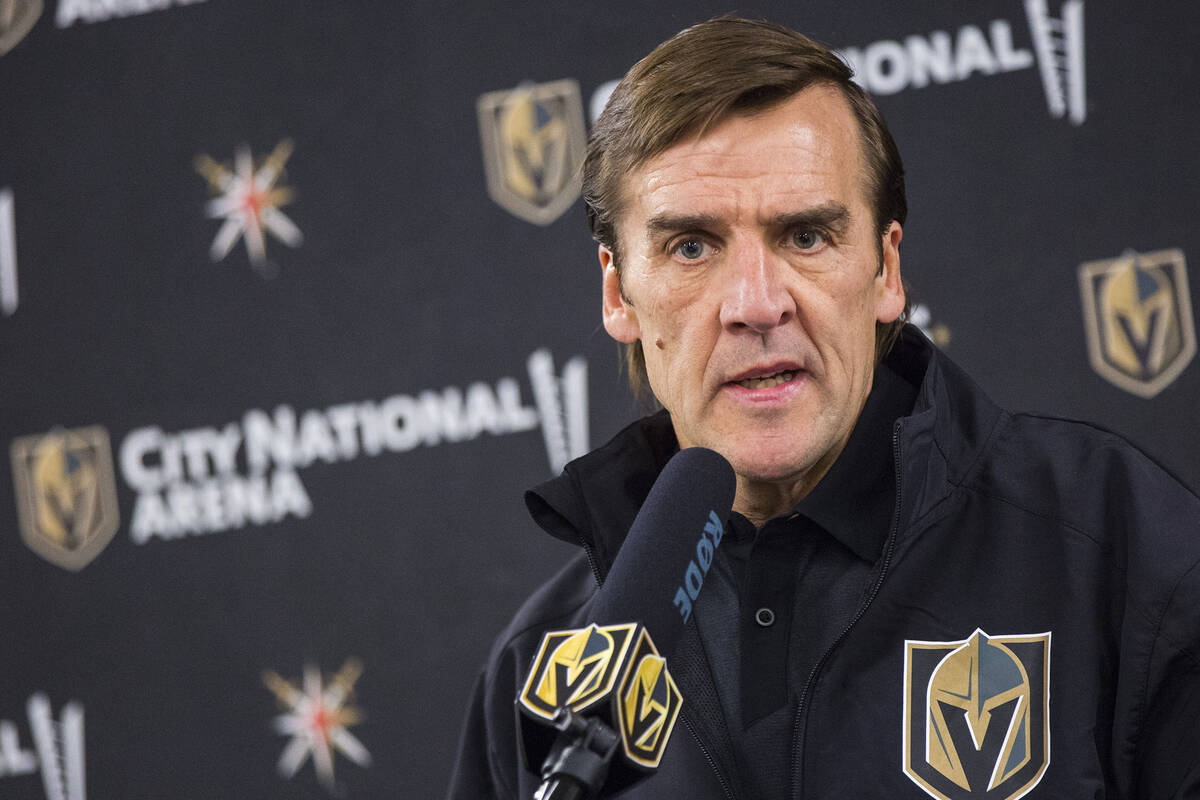
Not even Kelly McCrimmon, one of the chief architects of what has become one of the most successful franchises in the NHL, could have envisioned just how consistently good the Golden Knights would be in their first decade.
It simply had never been done before.
“It’s unprecedented in the league, so you wouldn’t expect it would happen,” McCrimmon said on a phone call before leaving for Raleigh, N.C., where the Knights will begin their third Stanley Cup Final in nine years since entering the NHL as an expansion team. “But it’s been a tremendous journey, and we sure don’t think we’re done yet.”
The Knights, and McCrimmon as general manager, could soon lift their second Stanley Cup, and there is no reason to believe they are headed for the long-predicted fall with most of the core pieces signed through next year and beyond.
They have become the envy of the league and drawn the ire of opposing fanbases by getting good immediately and contending just about every season of their existence through a series of aggressive trades and signings, shrewd salary cap management and an almost cutthroat mentality.
“This is one of the best organizations in the league with (owner Bill Foley), George (McPhee) and Kelly running it,” coach John Tortorella said.
While the Knights have taken a lot of big swings, they make contact more often than not and have plenty of home runs on their résumé.
“It takes bold decisions, but more importantly, it takes good decisions,” McCrimmon said earlier in the postseason. “Because it’s easy to trade draft picks away, (but) if you don’t convert those to real serviceable players on your team, now you’ve created two holes, right? You don’t have the draft picks to add people into your organization, and you don’t have a player that you traded for.”
McCrimmon and the Knights have developed a reputation for their pursuit of star players at the expense of future assets and developmental pieces, but that wasn’t always the plan.
The historic first season made the organization rethink everything.
“Bill (Foley) and his people have done everything that you would want to do in Las Vegas for the creation of the first major league team there,” NHL Commissioner Gary Bettman said during a news conference in Utah earlier in the postseason. “I think it’s given Las Vegas an identity beyond the Strip. And while there’s other franchises coming, I don’t worry for a second because they’ve got a loyal, firm fan base that started on Day 1.
“It’s been very gratifying to see a market that some were critical or skeptical about when we announced expansion.”
‘Changed the Calculus’
There is no doubt the Knights crushed the expansion draft in June 2017, laying the foundation for all of their success.
Sure, the expansion rules were favorable. And yes, several teams made massive blunders by handing over additional assets in an effort to get the Knights to stay away from some of their top players.
But the Knights, led by McPhee, then the general manager and now president of hockey operations, and McCrimmon, his assistant GM, had a plan and executed it.
They knew they would have a competitive team. They didn’t know they had a team that would reach the Stanley Cup Final.
But once Thanksgiving came around and they were still near the top of the standings, it started to become clear something special was happening.
“Everyone was waiting for the bottom to fall out on us, but we just continued to have a great year,” McCrimmon said “We got to the playoffs and were kind of hoping to win a round to validate just how good our year was.”
After winning two rounds, the Knights ran into a juggernaut Winnipeg team that was expected to write an ugly ending to the Cinderella story.
McCrimmon remembered the Knights falling behind 3-0 just a few minutes into Game 1. The obituaries on the season were being prepared until the Knights steadied the ship over the final two periods. While they still lost the opener, they won the next four straight and were on to the Final.
Even though the Capitals would win the Cup in five games, the stage had been set.
“We expected we would be a team that would draft and develop and try to build our team that way,” McCrimmon said. “When we got through that experience, it changed the calculus of our entire organization.”
The Knights signed Paul Stastny and traded for Max Pacioretty that offseason, adding a pair of veteran stars to the young core.
“We tried to improve our team and really that’s been our objective every single year of our existence is trying to win it,” McCrimmon said.
Then came what McCrimmon believes is the organization’s most important deal to date.
Game-changer
There have been so many major moves made by the Knights from signings to trades to coaching changes.
But McCrimmon doesn’t hesitate when asked if he believes there is one defining move that has been most important in the organization’s sustained success.
“Yes I do,” he said. “Mark Stone.”
The Knights acquired their captain in a trade with Ottawa at the deadline in their second season.
He signed a long-term deal the following year and has been the team’s leader through all of the roster changes and coaching regimes.
“When we got Mark Stone, we went from a good team to a real contender,” McCrimmon said. “That’s the trade that really solidified what we were. That would be the one trade that would stand out, but there have been a lot that have been impactful.”
It was only the beginning.
The Knights traded for Chandler Stephenson and Alec Martinez the next season, who became integral parts of their first championship.
By that time, McCrimmon had become general manager with McPhee bumping up to his current executive job while still maintaining a strong voice in the decision-making process.
He saw how other championship teams were constructed and realized there was a glaring need for a No. 1 defenseman, so he signed Alex Pietrangelo in free agency before a 2020-21 season that ended with a semifinal loss to the Montreal Canadiens.
That series helped the organization make another realization.
“After we played Montreal, we liked our centers, but we realized we needed a No. 1 center,” McCrimmon said.
So they started working on a deal that took more than a month into the next season to complete, but was worth the wait as they eventually landed Jack Eichel.
Trades for Tomas Hertl and Noah Hanifin at the 2024 deadline were followed by the sign-and-trade for Mitch Marner last offseason. Those moves were supplemented by in-season deals for Rasmus Andersson, Nic Dowd and Cole Smith, among others.
When all was said and done, the Knights had traded for three of the top five picks from the 2015 draft, which happened two years before the Knights had even played a game.
“We didn’t have a team in 2015, but we’ve done pretty well by that draft,” McCrimmon joked.
McCrimmon, however, bristles at the notion the Knights pursue every single big-name player that becomes available.
He believes the organization has an understanding of what a championship roster looks like in terms of ability and character and trusts in their process for identifying the right players and aggressively acquiring them.
“We’re confident in the people in this organization and our hockey operation,” he said. “We’ve got great resources and great analytics people. So our decisions are made through a very thorough process.”
Forward Keegan Kolesar, who was acquired from Columbus in a draft day trade before the inaugural season, has been in the organization since before they ever played a game.
“I think management, scouting staff and everyone who works in the organization has a keen eye for what a championship pedigree roster looks like from the NHL level all the way down to the minor league affiliates,” he said. “They do a good job of bringing in character people first and foremost, then we have guys who have every high-end skill you can think of in hockey and then guys who lean into their roles really well.
“It’s been a perfect formula.”
‘Great culture’
The Knights have a reputation for operating in a ruthless manner, which may be deserved.
They fired coach Bruce Cassidy, who had won them the Stanley Cup, with just eight games remaining in the regular season this year, and have cut ties with popular players against fans’ wishes. They signed goaltender Carter Hart with a controversial history few teams were willing to touch, and he’s starring for them on the postseason run.
But they also earn high marks for how they treat players while they are part of the organization.
Nic Dowd, who was acquired in a trade at the deadline in March and has been a key piece of the playoff run as a fourth-line center, believes that’s a factor in all of the winning.
“I didn’t really keep tabs on these guys being in the (Eastern Conference) for so long,” he said. “Being inside, it makes sense that they’ve had a winning organization and a great culture because the organization is full of great people and when you surround yourself with people like that, it’s a lot easier to have success. And they’ve had a lot of success. From the GM down to the players and the other people you spend time with every day, there are just a lot of great people.”
McCrimmon said that’s another part of the organizational philosophy. It’s no secret the players are treated well, and it’s at least part of why the Knights have been able to bring in so many big-name talents who want to experience it.
“We try to take away all the excuses from our players,” he said. “We give them every resource to be their best. And we try to build good teams. That’s what we’ve done.”
Over and over again.
“I think we’ve made a lot of really good decisions, but we’re not going to pump our chest and brag about it,” McCrimmon said. “We just work really hard to keep making more and maintaining the standard.”
It’s one that will be tough for any other organization to match. The Knights have been to the Final three times in their nine years of existence and only missed the playoffs once, and that was in a year they went 43-31-8.
Each time they make a big trade, their eventual downfall is projected. Yet they haven’t paid the price for shipping off prospects and draft picks.
McCrimmon credits the scouting department for finding and developing young players who can be parts of trades, but admits their approach isn’t a traditional one.
“Tampa and Florida have used similar strategies. Colorado, too.” McCrimmon said. “But it’s really a break from what the norm has been for a long, long time. And to that other avenue of building a team, there are some teams that are really coming into their own having used that. It’s a lot of customer pain along the way and again, you have to make good decisions. You have to draft the right players if that’s the strategy you adopt. I always feel you manage the team in front of you, and that’s what we’ve done.”
No time for reflection
McCrimmon, McPhee and Foley have every right to shout their own accolades from the rooftops.
They could even build statues to themselves in Toshiba Plaza, and few would bat an eye.
Their success — the Knights have the most postseason wins of any team since their inception — truly is that remarkable.
But there’s little time for that.
“To be really honest, we don’t reflect or reminisce that often,” McCrimmon said. “We’re always focused on the here and now and the upcoming season. The ultimate prize is the Stanley Cup, so in 2023 when we won, I think there was a period of time when we really reflected not just on the time with the Knights but the entire journey. For a lot of us, it’s our 10th year with the Golden Knights. Friendships have been formed and the trust developed over the years has grown and I think a big reason why we’ve had success.
“But sitting around talking about it is not how anyone in our organization is wired.”
They are more about action. It seems to be working for them.
Contact Adam Hill at ahill@reviewjournal.com. Follow @AdamHillLVRJ on X.