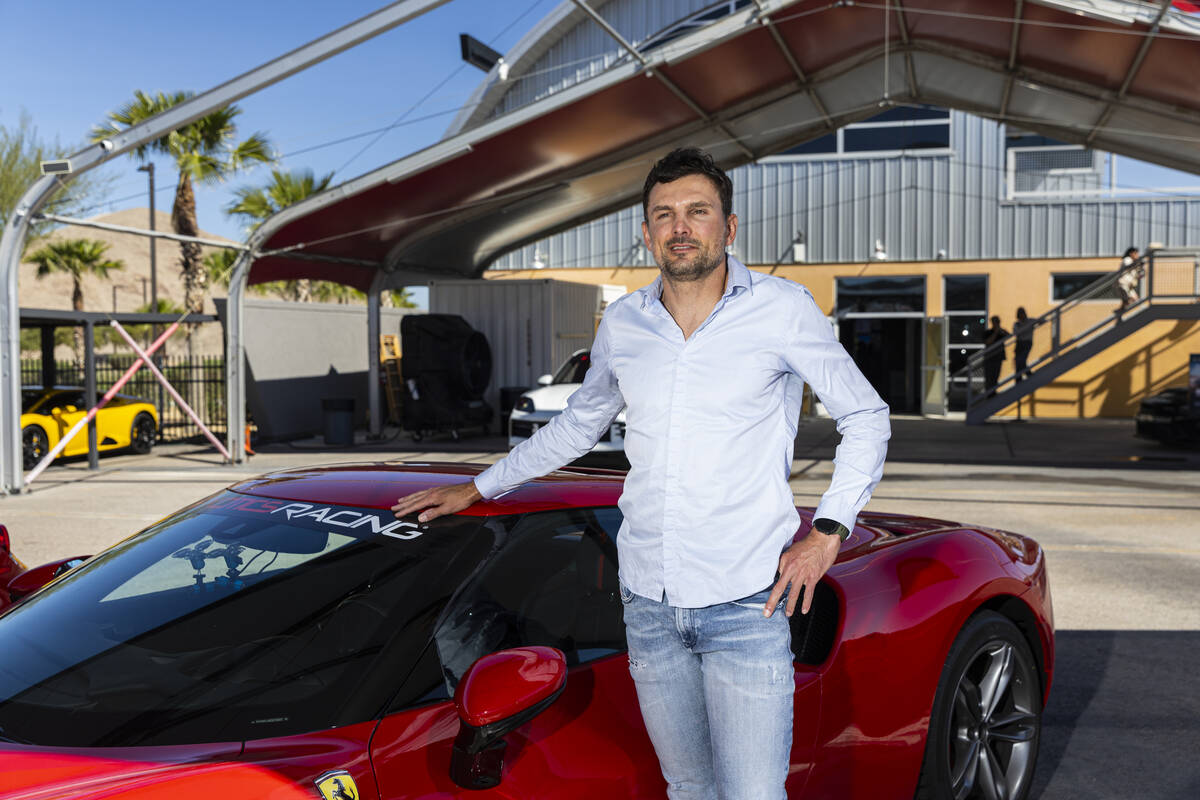
When Eric Houle decided to take his family to Las Vegas for the first time in years, his son Carson had his sights set on one thing — driving fast cars at Speed Vegas.
“I knew I had to take him here,” Houle, who hails from Atlanta said with a smile. “That’s basically what brought us to Vegas, his enthusiasm for cars.”
Tourists coming to Las Vegas solely to drive fast cars such as Lamborghinis and Ferraris signals an emerging industry buoyed by Speed Vegas’ record expansion since a new ownership group took over Exotics Racing and merged the company in 2021.
Carson Houle, 20, is a huge fan of the popular Netflix series “Formula 1: Drive to Survive.” He represents a new generation of fans who got hooked on racing via the television series that launched in 2019.
Located in south Las Vegas on South Las Vegas Boulevard about a 20-minute drive from the Strip, Speed Vegas, owned by Romain Thievin, attracts upward of 200,000 people annually to drive one of their very fast cars, drive the off-road circuit or race go-karts. Last year was the most successful in company history, with executives handing out $350,000 in bonuses of up to $10,000 to all 120 employees. Plus, four of the company’s top executives come from race track-operation backgrounds with decades of experience.
No signs of slowing
Industry experts credit the success of Speed Vegas and other experiential retail companies, amid declining tourism, to drawing younger visitors who prefer novel experiences over traditional entertainment. In the case of Speed Vegas, this “fun economy” is fueled by social media, the popular Netflix show and the blockbuster 2025 film “F1.”
In fact, the spending power of Gen Z is expected to hit $12 trillion by 2030, and those born roughly between 1997 and 2012 are more into buying experiences than stuff, said Bo Bernhard, a professor at UNLV’s Harrah College of Hospitality.
“The places that truly understand the fun economy, and Las Vegas chief among them … are positioning themselves to win the broader economy in the generation to come,” he said.
Speed Vegas is part of the rise of experiential retail, which ranges from escape rooms and ax-throwing venues to large-scale attractions such as Area15, said Frank Volk, executive vice president with commerical real estate brokerage CBRE Group in Las Vegas.
“Residents and tourists are just as excited about high-adrenaline attractions, immersive art and social gaming as they are about slots and shows,” he said. “Competitive socializing, eatertainment and immersive attractions have all taken off, and projects like Area15 and Meow Wolf, which is now pulling in around a million visitors a year, still do well off the Strip. … These experiences broaden our economic base while keeping the city’s identity rooted in excitement and play.”
Evens Stievenart, Speed Vegas’ chief operating officer and a former race car driver from France, said business is booming, or more accurately, picking up speed.
Speed Vegas continues to evolve, with new vehicles and facility upgrades. The focus remains on delivering authentic, premium motorsport experiences while expanding the reach of the brand globally.
This year the venue is adding to its stable of 70 cars, valued at about $15 million, a Ferrari 296 Challenge, Ferrari 296 Pista, Ford Mustang GTD, Ford Mustang Dark Horse SC and Lamborghini Temerario.
Stievenart credits the popularity of F1 from the Netflix show, the blockbuster movie starring Brad Pitt and Las Vegas hosting an annual grand prix with putting a spotlight on racing and Speed Vegas.
“It brought in new demographics, this group that are very into motorsports, so that definitely helped,” he said.
High in rankings
Stievenart said a big part of their business hinges on getting ranked highly in Google searches and on artificial intelligence chatbots.
“A lot of our marketing now is centered around this aspect,” he said. “Someone will type in to ChatGPT ‘I am coming to Vegas for the weekend, I want to go to a restaurant, see a show and do something fun.’ ”
Large corporate groups from companies such as Google and CrowdStrike have also been a big hit lately, Stievenart added, noting big conventions are bringing in people who want to break away and drive a fast car for an afternoon.
Celebrities have also helped with exposure. Movie star Jamie Foxx, basketball superstar LeBron James and Michelle Rodriguez, one of the mainstays of the “Fast and Furious” franchise, have spent time at Speed Vegas. Also, a slew of race car drivers hold a lot of the lap records at the course, including Charles Leclerc, Lewis Hamilton and Juan Pablo Montoya.
“We even had this lady come who was 100 years old,” said Stievenart, “and she told us that she wanted to drive a car at 100 miles an hour, so we helped her with that.”
Safety first, foremost
Stievenart said safety is of the utmost importance to Speed Vegas.
Under previous ownership, a double fatal crash occured there in 2017 that resulted in lawsuits and major changes to the racetrack. It filed for Chapter 11 bankruptcy in 2017.
Stievenart said the only thing Speed Vegas has in common with that former company, Exotics Racing, is the ZIP code.
Stievenart said substantial changes to the track and overall safety environment have been made to Speed Vegas.
“We redesigned the track layout and shortened the main straight(away),” he said. “The objective was to keep the experience exciting for guests while ensuring speeds are more manageable and fully aligned with the safety systems now in place. We removed the concrete walls that had been installed by the previous ownership at the end of high-speed sections. We created significantly larger run-off areas. We added gravel traps to help slow cars substantially in the event of an off-track situation.”
They also installed TecPro barriers, which Stievenart said is the highest standard of energy-absorbing barriers used in motorsport, including all or most of the Formula 1 tracks, including the Las Vegas Grand Prix. Speed Vegas also made major improvements to the vehicle and operating side, he added.
“We use endurance-grade braking systems on the cars to maximize reliability and significantly reduce the risk of overheating or brake-related issues under track use,” Stievenart said. “Our team of more than 10 mechanics performs daily inspections and safety checks on the fleet. Our racing instructors go through ongoing training. We continually review onboard video to ensure safety procedures and operating standards are being followed consistently.”
In the end many young and old enjoy the rush of driving an exotic car.
Bernhard, the UNLV professor, said he recently took his 78-year-old father-in-law, a racing car fan from Mexico City, to Speed Vegas. He couldn’t stop talking about the experience for days, he said.
And this key element, experience, is where the future is headed when it comes to where tourists are going to be willing to spend their hard-earned cash.
“The next 50 years look like fun,” Bernhard said. “A rising global middle class is pouring money into experience-driven spending in the fun economy, pushing this sector ever upward from where it already stands today.”
Contact Patrick Blennerhassett at pblennerhassett@reviewjournal.com.