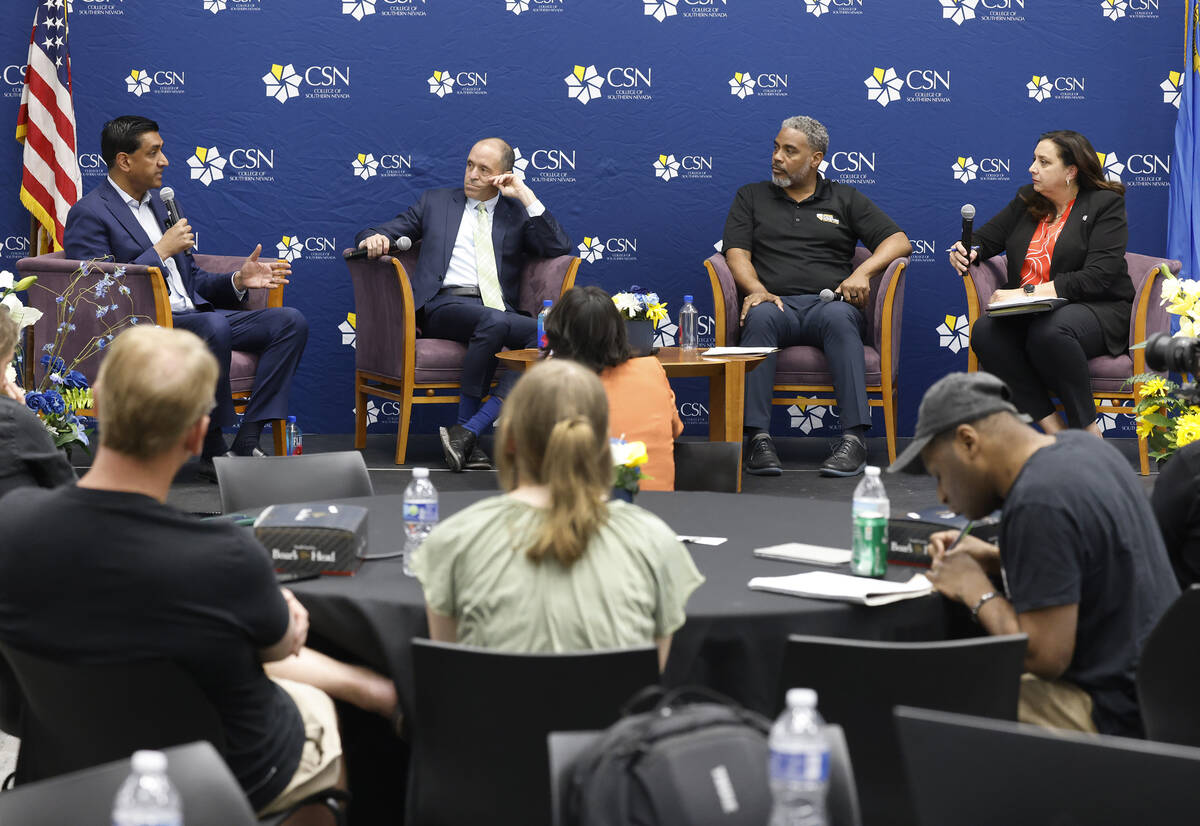
Artificial intelligence is on a path to become as revolutionary a technology as the wheel, the printing press and the gasoline engine, an OpenAI executive said in Southern Nevada Friday.
“When you get these economic transformations of that scale, they drive enormous economic opportunity,” said Chris Lehane, the tech company’s chief global affairs officer.
Lehane joined Rep. Steven Horsford, D-Nev., and Rep. Ro Khanna, D-Calif., at the College of Southern Nevada’s North Las Vegas campus. The conversation was moderated by Clarissa Cota, CSN’s vice president of external relations and campus operations.
It centered around democratizing AI, or getting the technology into people’s hands early in its adoption.
Lehane said that nearly 1 million Nevadans regularly use OpenAI’s ChatGPT, which has almost 1 billion users worldwide. CSN’s event included workshops for faculty and students on how to use the technology.
“This technology in particular scales how humans think, how they learn, how they create, how they build,” he said. “Right now, we are in a moment of transition.”
“We need to democratize access to this,” he added. “We need to get these tools into all of your hands, and we need to work to teach you how to use it, because it lowers barriers to entry and produces incredible economic opportunity.”
He gave an example of a local resident who told him Friday that he uses AI to help him advertise and market his business.
A national NBC News survey conducted last month found that 46 percent of 1,000 registered voters surveyed rated AI negatively. About 26 percent answered the opposite.
Job displacement, surveillance and the effects of the data centers that power the technology are at the center of the debate over AI.
Khanna told the Las Vegas Review-Journal that there needs to be a tech social contract where the technology helps people, not just the tech billionaires.
“My focus is on making sure that we’re not just the consumers of technology but that we’re the owners of it and that every community, regardless of background and regardless of zip code, benefits,” Horsford told reporters. “Yes, we will have to grapple with other impacts the technology will have in the workforce and entrepreneurship,” he added.
Horsford expanded on the point in his public remarks.
He said the U.S. had to close its wealth gap. “We talk a lot about diversifying our economy here in Nevada,” he added. “Well, tech is not a sector; tech is across every sector.”
AI is already making its way into every sector and the workforce can’t afford to be left behind, Horsford said.
“So yes, we’re going to grapple with the tough policy issues about the displacement that tech has in the workforce. We’re going to talk about civil liberties and civil rights issues within tech,” he said. “We’re going to talk about who owns the data and how do we protect people’s data. Those are very important and tough policy issues that Representative Khanna and I will work on at the federal level.”
He said local and state governments need to do the same.
Contact Ricardo Torres-Cortez at rtorres@reviewjournal.com.