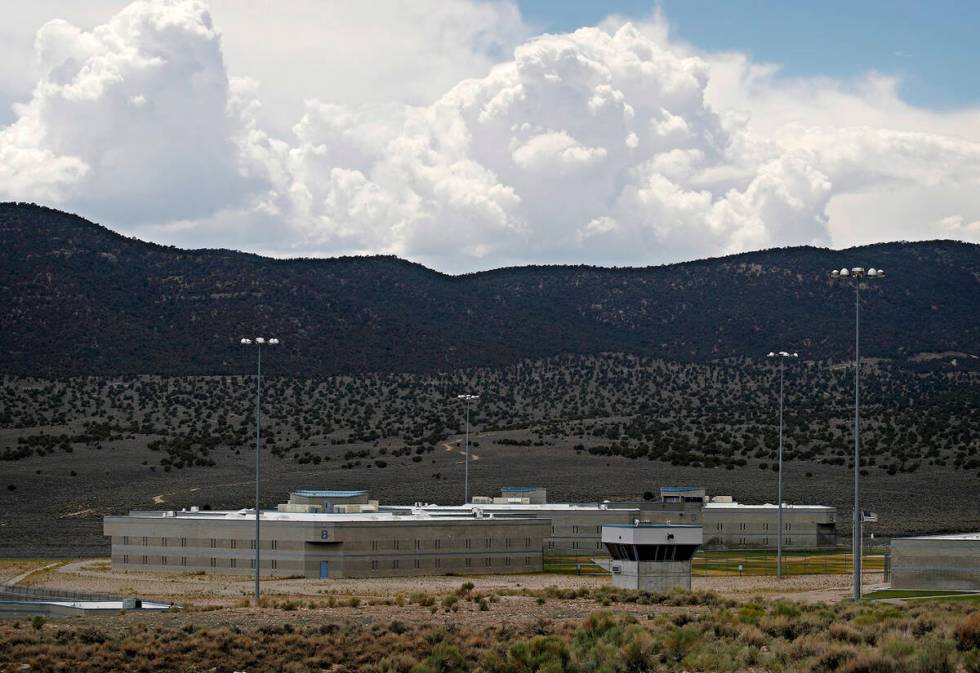
Clark County prosecutors have frequently sought capital punishment over the last 20 years. But the cases rarely result in death sentences.
No one has been executed in Nevada since April 26, 2006. Since then, prosecutors have pursued the death penalty against more than 220 people.
Less than one in ten of those defendants were actually sentenced to die in Clark County, records show.
Clark County District Attorney Steve Wolfson recently rekindled the effort to follow through with an execution. Last week, he announced his office plans to seek execution warrants for three longtime death row inmates.

In the modern era, almost all of the prisoners executed in the state were “volunteers” who relinquished their appeals and agreed to have the state to kill them.
Some legal experts question why prosecutors still devote resources to seeking death when it is unlikely a given case will result in a death sentence or execution, at least in the near future. Death penalty cases also come with a high price tag, requiring the investigation of mitigating evidence and often resulting in decades of expensive appellate litigation if a jury orders death.
“It doesn’t make any fiscal sense to do this,” said retired Nevada Supreme Court Justice Bill Maupin. “It not only doesn’t save money, it costs a huge amount of money with no result.”
Others, like Wolfson and his predecessor David Roger, believe the death penalty still has merit.
Wolfson said polling he has seen from a few years ago indicates that a “small majority” of Nevadans favor the death penalty.
“As long as the law provides for the option, I think it’s my responsibility in a certain number of very, very special cases to give the jury that option,” he said.
Wolfson has said he makes the final call whether to pursue the death penalty against a defendant, after the case has been evaluated by a death penalty review committee made up of prosecutors.
There is virtually no public data comparing how different jurisdictions pursue the death penalty. But local defense attorneys, like former public defender Scott Coffee, believe Clark County seeks the death penalty more than most other jurisdictions in the United States.
“We are an extreme outlier,” said Coffee, who has spent years litigating and tracking death penalty cases in Clark County.
Whether Wolfson’s announcement about death warrants for killers Zane Floyd, 50, Donald Sherman, 62, and Sterling Atkins, 52, will result in executions remains to be seen. All of those defendants were sentenced to die over 20 years ago.
The district attorney acknowledged that trying to move forward with capital punishment for those men would likely result in additional legal fighting.
Some who fight against the death penalty are still concerned.
“I tell clients all the time, ‘Just because they haven’t done it in 20 years doesn’t mean they won’t start up tomorrow’ and here we are,” said Ryan Bashor, one of the two attorneys in the Clark County public defender’s office qualified to handle capital cases.

Nevada death sentences by the numbers
The Review-Journal analyzed records from the Department of Corrections, District Court, Clark County district attorney’s office, and data compiled by Coffee.
Prosecutors file a notice in a defendant’s case in order to start the process of pursuing the death penalty. In the last 20 years, prosecutors have filed notices to pursue the death penalty against at least 225 defendants, records show.
Twenty of those people were sentenced to die in Clark County. Only nine of them remain on death row today, either because the other defendants died before the state could execute them, or had their sentence overturned.
Records show that four of those defendants sentenced to death in the last two decades died on death row. One additional defendant died after their sentence was overturned, but before he was re-sentenced.
Coffee said death penalty cases are wasteful, and are unlikely to result in executions.
“If you look historically, at least one of those is going to get overturned,” he said.” It’s a waste of resources. It is a spot on the horizon that we can’t reach.”
Although defendants are rarely sentenced to death, prosecutors have continued to pursue about 10 cases on average each year.
Wolfson has pursued the death penalty against 121 defendants since he became Clark County district attorney in 2012.
His office has pursued capital punishment less frequently in recent years. During the first seven years in office, he pursued the death penalty against an average of 10 defendants a year. That dropped to an average of six defendants annually in the latter half of his time in office.
Wolfson said that over his 14 years in office, defendants’ mental illnesses have become a more significant mitigating factor. He also attributed the length of time in Nevada without an execution to defense litigation.
“Our defense is very active,” Wolfson said. “They do a good job at challenging convictions and causing incredible amounts of delay.”

Capital punishment enthusiasm waning
The last time a jury in Clark County sentenced a defendant to death was in 2024, when jurors ordered capital punishment for Robert Brown, who had broken into his girlfriend’s apartment, killed her, injured her mother and shot at a 3-year-old girl in the apartment.
Nationally, enthusiasm for the death penalty has declined since the ‘tough on crime’ years of the 1990s, Gallup polling shows.
In 1994, 80 percent of Americans supported capital punishment for a person convicted of murder. Just 52 percent did in 2025.
Both Wolfson and Roger, the former district attorney, said they considered the likelihood a jury would sentence a defendant to die as part of their office’s death penalty review committee process.
However, Wolfson said jurors today appear less likely to impose the death penalty. He also attributes public dissatisfaction with Nevada’s death penalty policies to the lengthy court process.
“I think that Nevadans are more frustrated with the length of delay more so than the actual act of execution,” he said.
Retired Nevada Federal Public Defender Franny Forsman believes the lengthiness of death penalty cases can be attributed to litigation from lawyers uncovering trial issues originating decades earlier.
“But I also think that the attitude of the citizenry is not as intent on killing people as it was,” she said.

Unlimited litigation
Maupin, the retired state Supreme Court justice, said death penalty cases are an “agonizingly long” process with seeminly endless issues for lawyers to litigate.
Mary Lou Walton experienced that process firsthand.
Her husband, Las Vegas dentist George Monahan, was murdered in 1980 by Samuel Howard, a Vietnam veteran who claimed to be interested in a van Monahan was selling.
Howard was sentenced to death in 1983, but the Nevada Supreme Court deemed him ineligible for capital punishment in 2021, after he had spent decades on death row.
At the time of his original sentence, Walton said she wanted Howard executed. She also believed the execution would eventually happen, though she knew it “wouldn’t be anytime soon.”
She did not realize that litigation in the case would last 40 years. She said following Howard’s appeals closely was an upsetting process.
“As the years went on, I just eventually tuned it out,” Walton said. “After a while, it wasn’t that important to me anymore that he be put to death, as long as I knew that he was in prison for the rest of his life.”
Walton is now ambivalent about the death penalty.
“In a way, I don’t think it’s human, but I also did not think of him as being totally human,” said Walton.
District Judge Jacqueline Bluth resentenced Howard, now 77, to life without parole in November.
Court records show that Howard is in the process of challenging his life without parole sentence in the Nevada Supreme Court.

How prosecutors weigh the facts
Under state law, there must be at least one aggravating circumstance to consider a case for capital punishment, Wolfson said, and cases with aggravators are almost always presented to the death penalty review committee.
Aggravating factors include murders involving financial gain, torture, sexual assault or killings committed at random. Factors prosecutors consider in favor of the defense include age, mental health and circumstances of the crime.
Defense attorneys also attend death penalty review committee meetings and try to convince prosecutors not to seek the death penalty against their clients.
Roger said he thinks there has been an unfair focus on the prosecution as a decision maker in death penalty cases. He noted that police who investigate a crime, victim’s relatives who provide input, jurors who make a sentencing decision and judges who can take the death penalty off the table also play a role.
“It is really a shared responsibility,” he said.
Mark Bettencourt, director of the Nevada Coalition Against the Death Penalty, argued that prosecutors have too much discretion.
He pointed out that many murder cases have aggravating circumstances.
“It’s a little bit challenging to see or understand the science of when is this being sought versus when is this not,” he said.

‘Politics don’t play into my decision’
Some question the motivations behind seeking death and the practical value of doing so.
Forsman attributed Clark County’s frequent use of the death penalty to politics.
“When you have all judges elected and all DAs elected, I just think it creates an atmosphere where seeking death gives you some publicity,” she said.
Wolfson said he believes asking for capital punishment is only appropriate in cases that represent “the worst of the worst.”
“Politics don’t play into my decision whether or not to seek the death penalty,” he said.
Robert Langford, who sought the death penalty as a prosecutor and has also defended clients in capital cases, said capital punishment satisfies none of the legitimate functions of sentencing.
“A lot of people believe, myself included, it’s a much worse punishment to make someone sit in a prison cell the rest of their life than it is to strap them to a gurney and put poison in their veins,” said Langford.
Walton said she has felt peace after Howard received a life without parole sentence.
She thinks it doesn’t make sense to pursue the death penalty considering the delays in performing an execution.
“I think it would be better all around if they just went for life in prison without parole because that’s what they’re going to get anyway,” she said.
Contact Noble Brigham at nbrigham@reviewjournal.com. Contact Katelyn Newberg at knewberg@reviewjournal.com or 702-383-0240.