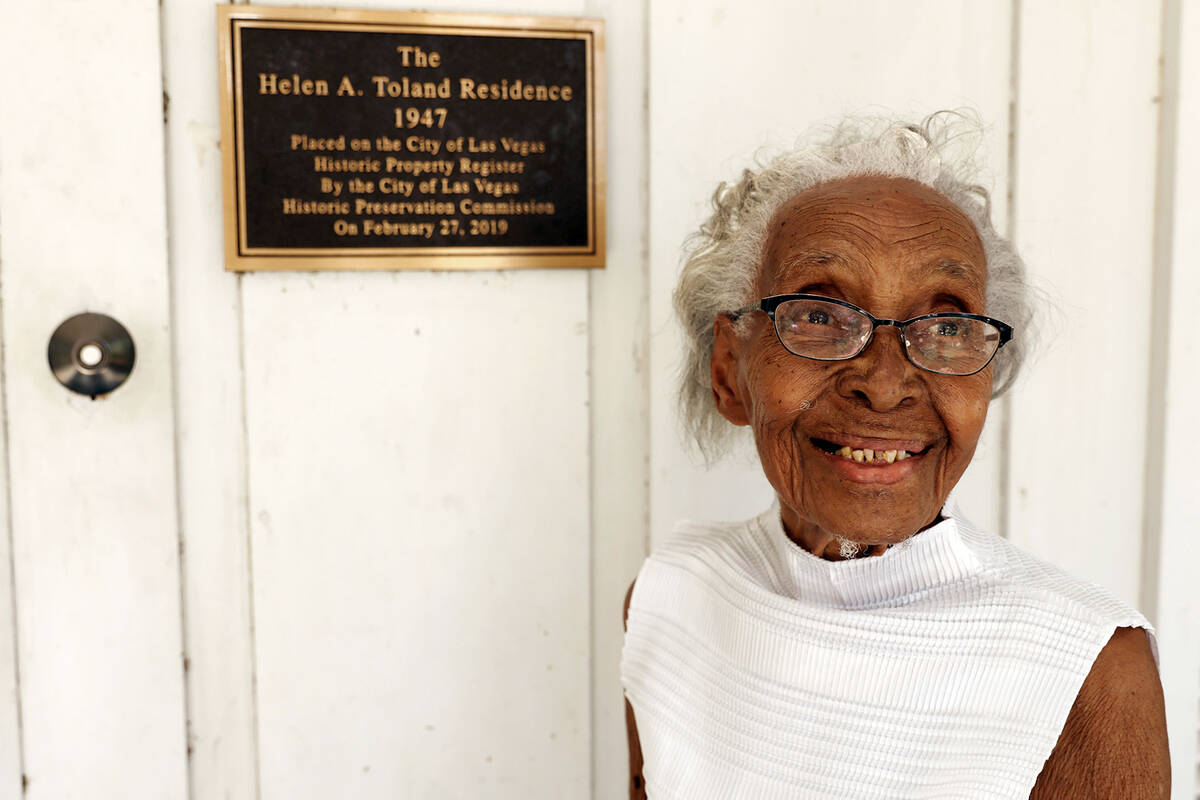
Helen A. Toland raises cotton in her front garden.
The crop is among the first things Toland shows visitors, whether it be service-learning students from UNLV or curious passersby.
During the presentation, she poses a simple question: “What do you think of that?”
Toland also parades her collection of African artwork — busts and artifacts from Senegal, Ghana, and Zimbabwe — with hundreds of pieces decorating both the inside and outside of the home.
Lastly, she shows her library, a nook at the east end of the home that has become too small, as large stacks of novels spill into the dining room.
Weeks shy of her 100th birthday, Toland’s motto remained the same as when she became the first Black woman principal in the Clark County School District in 1965.
“There are many ways to beauty, and there are many ways to educate,” Toland said toward the end of a tour, settling into a couch in the living room of her home on Comstock Road.
The single-story house — on the City of Las Vegas Historic Property Registry — is located in the Historic Westside. It is the neighborhood where Toland and her late husband, Jim Anderson, a notable civil rights leader in Nevada, settled when they started their life together in Las Vegas.
How she got to Vegas
Toland was born on May 3, 1926, in Marceline, Missouri, where she noted that the Black population never exceeded 100, and social facilities like churches and schools were segregated. She later received a full scholarship to the University of Illinois at Urbana-Champaign.
After earning an A in her first public speaking class, she decided to major in speech correction, now called speech pathology. Following graduation, she worked in Louisville, Kentucky, and later in Los Angeles, where she earned her master’s degree and became involved with the NAACP.
In Los Angeles, she also met Anderson, who, during her Easter holiday visit to the valley in 1964, convinced her to move to Las Vegas and marry him.
“Jim was living in Las Vegas said to me, ‘You ought to go out and see about getting a job here,” Toland said, grinning.
Toland said when she asked why, Anderson replied, “Well, we’re going to get married, aren’t we?”
“That was my proposal, so that’s how I got to Las Vegas,” Toland added. She started as a speech therapist for CCSD, working with Black and sometimes white children.
In the 1960s, few Black professionals worked in predominantly white schools, and finding employment in white social spaces was often a challenge
Toland once told a UNLV archivist that she and Anderson would walk through Las Vegas casinos, counting how many Black dealers and other employees they saw.
The couple’s advocacy would help change that reality. Wayne Smith, president of Toland’s nonprofit, described their partnership as a “Westside powerhouse.”
The 1971 Consent Decree
Anderson, a prominent advocate and lobbyist for jobs, housing, and equal opportunity for Black residents in the Westside, volunteered as a union representative for the NAACP.
Working alongside attorney Charles Kellar and fellow NAACP leaders, Anderson helped secure a landmark 1971 Consent Decree.
Following years of protests and legal efforts by Black residents and local leaders, the Justice Department filed a complaint alleging that the gaming industry violated the Civil Rights Act of 1964, which bans employment discrimination.
Under the decree, all parties in the lawsuit agreed about the violations. Casinos and unions were required to end discrimination in hiring and to employ Black workers in at least 12 percent of all jobs — including visible, customer-facing roles that had long been closed to them.
Anderson died shortly after the decree, though his work marked a significant step toward a more integrated Las Vegas.
Smith said Toland would translate Anderson’s legal victories into tangible student success when she pioneered the “Outdoor School” program first at Kit Carson and later at the integrated Robert E. Lake Elementary School, where she also served as principal.
The program blended nature, science, the arts, and practical life skills and was an early precursor to modern STEM education models.
‘Gave us the confidence to move on’
Toland became principal at Kit Carson after only a year as a speech therapist.
Toland said that during her early career, she took students at Kit Carson Elementary, then an all-Black school, on overnight trips to Mount Charleston and Disneyland.
When the Checkmates, Sammy David Jr., and Cassius Clay visited town, Toland arranged for them to speak to and perform for the students. This was so that, by the time would be bused out of the neighborhood to the desegregated middle school, they would develop positive views of their heritage and culture.
“It was important for the kids to know that they were important,” Toland said.
Afterward, she said, the children also had to write about the experiences.
One of Toland’s former students, Swayzine Fields, 70, said Toland’s leadership gave her confidence. Fields later worked as an Assistant Special Agent in Charge for the FBI in Los Angeles before retiring.
“She gave us the confidence to move on, because we knew that Black people played a major role in society, whether anybody thought it or not,” Fields said. “And so a lot of us ended up pretty successful in our careers coming from Kit Carson.”
Fields, who has since moved back to Vegas and now lives on the same street as Toland, regularly visits to check in and hang out. Most refer to the lifelong educator as “Mother Toland,” and Toland, who has only one biological son, calls all whom she teaches her children.
“She’s still trying to help kids who have problems with reading or speech or people who have had strokes or aphasia, even at this point in her life,” Fields said.
At 99, Toland is still an avid reader herself, her most recent reading interest being “Washington Gone Crazy, about former Nevada Senator Pat McCarran, and a collection of poetic essays called “The Prophet.”
She also spends a lot of time outdoors, walking, weeding her garden, and feeding the neighborhood cat. Sometimes she does seated yoga at the West Las Vegas Arts Center.
‘She would say push’
Right before Anderson’s death, the couple took their first trip to West Africa, visiting seven countries, including Nigeria, Senegal, and Ghana.
“All it took was one or two people to show us how much we didn’t know,” Toland said. “So it created a desire to travel there.”
She said she has since traveled to Africa more times than she can remember.
In addition to the artifacts and artwork she brought back, Toland shares what she has learned with children across the valley, aiming to instill an understanding that, contrary to harmful stereotypes, African people are neither primitive nor uncivilized.
“It is important to teach Black children about their heritage in Africa, so they know that they are of value,” Toland said. “We have to tell the truth.”
The Helen A. Toland Foundation continues to advance this mission by providing resources and scholarships to support education, health, and families in the community.
The foundation is launching the Centennial Legacy Initiative and hosting a number of events in celebration of Toland’s 100th Birthday, including a “Living Museum” walkthrough at her home on Sunday; a literary-focused school assembly at Helen A. Toland International Academy on May 1; and a Centennial Tribute at the West Las Vegas Theater on May 3.
The Centennial Legacy Initiative will focus on creating an endowment to sustain and expand scholarship opportunities.
Toland said that when students reflect on her legacy, she hopes they’ll remember her persistence.
She said: “I want my kids to remember me and say, well, she would say ‘push and push and push.’”
Contact Akiya Dillon at adillon@reviewjournal.com.