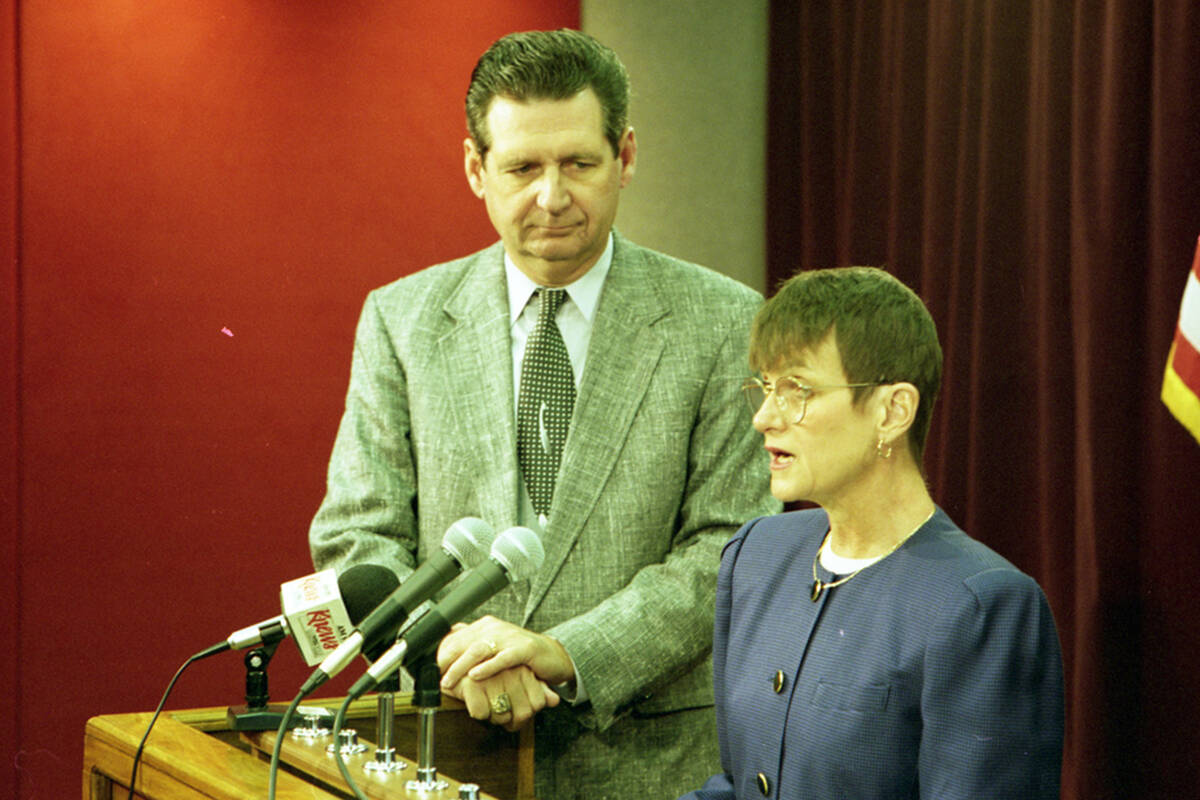
Sue Wagner, the first woman elected lieutenant governor of Nevada, has died.
She was 86. She died Tuesday in Reno, where she lived much of her life.
Wagner served in the Nevada Assembly from 1975-1980 and in the Nevada Senate from 1981-1989. She served as elected lieutenant governor from 1990-1995.
“She fought a very long, good fight,” said longtime friend and former state Sen. Helen Foley.
Both women served in the Nevada Legislature together in the early 1980s, and were the only female members of the Senate, she said.
“She was a Republican, I was a Democrat, and yet we co-sponsored many pieces of legislation and worked very collaboratively,” Foley told the Review-Journal on Tuesday.
Foley noted Wagner’s work promoting young professionals, particularly women.
Serving in the political science department at the University of Reno, Nevada, Wagner did the same for interns.
“Nevada is better off because Sue Wagner served us in the Legislature and as our lieutenant governor,” Foley said.
U.S. Rep. Steven Horsford, D-Nev., said he was saddened by Wagner’s death, describing her as a true leader and public servant. He said he was one of the interns she championed.
“Not only did she lead our state in service, she was the director of the college internship program that provided the next generation of leaders, including me, to the state legislative process,” he wrote on social media.
Sen. Jacky Rosen called Wagner a trailblazer who left a lasting mark on Nevada.
“She was a steadfast champion for women’s rights, and her advocacy was instrumental in codifying the right to reproductive freedom in Nevada law,” Rosen wrote on X. “I’m honored to have learned from her, and to have called her a friend.”
Wagner was born Jan. 6, 1940, in South Portland, Maine. Her father, who worked as a pharmacist, was involved in Maine’s Republican politics. Her father’s battle with rheumatic fever prompted the family to move to Tucson, Arizona.
She received her bachelor’s degree in political science from the University of Arizona and a master’s degree in history at Northwestern in Chicago. Later, she became assistant dean of women at Ohio State University.
Door-knocking from a young age
She married Peter Wagner, an atmospheric physicist, who would later become a Desert Research Institute scientist and associate research professor, and moved back to Arizona in 1964. She worked as a newspaper reporter and then as a teacher before her family, which had added two children, moved to Reno in 1969.
There she got involved in politics, campaigning for Pat Lewis Hardy, who won a seat on the Reno City Council.
In “Through the Glass Ceiling: A Life in Politics,” a University of Nevada, Reno, oral history project, tells of how a childhood punishment helped prepare her for a political career’s requirement for door knocking. Without permission, she’d taken her older sister’s bicycle, which was expensive for the time, and left it where a car could crush it. To make amends and earn the money to replace the bike, she was sent out by her parents to sell candy bars door to door.
“So that was the end of that,” Wagner said in the oral history, “but when I think back on it, and I wonder why I like going door to door campaigning, hey, they sent me out on my first door-to-door campaign at 7 or 8 years old.”
‘Dynamic and powerful’
Planes twice yielded tragedy for her. In 1980, as she was entering the state Assembly, her husband Peter Wagner and three other Desert Research Scientists were killed in a crash. During her run for lieutenant governor in 1990, she was seriously injured in a Labor Day plane crash after campaigning in Fallon.
The small plane was flown by Bob Seale, then a Republican candidate for state treasurer. Seale’s wife was killed. Two others onboard suffered less serious injuries.
Wagner suffered a broken neck and back but went on to win the election, becoming the first woman elected lieutenant governor. But her injuries wore on her health and she never again ran for office.
“It changed my life, that plane crash,” Wagner said. “I was not physically able to run for office.”
Foley said that the physical repercussions from the crash cut her political potential short.
The friend said she had envisioned Wagner as a future U.S. senator.
“She was really the first woman in the Legislature that actively promoted women and supported legislation on behalf of women and children,” Foley said. “She dared to stand up to the big boys and a lot of times that wasn’t easy.”
She added: But she was dynamic and powerful, and very influential in the state of Nevada.”
Political legacy
During her political career, she helped institute a marriage license fee that supported domestic violence shelters, pushed for the creation of an ethics commission and measures to boost education funding, and backed protections for at-risk children.
In 1997, she was appointed by then Gov. Bob Miller, a Democrat, to the Nevada Gaming Commission, a position she held until her retirement in 2009.
Political observers said Wagner might have achieved the governorship if she’d run, because she was well respected and could work across the partisan aisle. She was a moderate Republican who was socially liberal, especially when protecting women’s right to choose abortion.
In 1990, she worked to pass a referendum that prohibits Nevada from amending abortion laws without first winning approval in a referendum. Those laws adopt the tenets of Roe v. Wade, the 1973 U.S. Supreme Court decision that said a woman has a right to have an abortion in the early stages of her pregnancy.
Wagner operated at the Republican Party’s left edges. She stunned the GOP in 2014 when she quit the party and registered as a nonpartisan voter.
She said she was fed up with Tea Party conservatives pushing the party to the right — and out of her comfort zone.
The political move may have been telegraphed in 2010, when Wagner wouldn’t back Republican Sharron Angle, a Tea Party conservative, in her race against U.S. Sen. Harry Reid, D-Nev.
“The reason I quit is I’ve just had it up to here with many different issues,” Wagner said told the Review-Journal. “Republicans want to get rid of the EPA (Environmental Protection Agency). And they just hate Planned Parenthood. Planned Parenthood does so much for women’s health — mammograms, birth control.”
Wagner said the party left her before she left it. She blamed the highly partisan politics of today on the caucus system, where each party’s members get together to strategize, often leading to battles and gridlock.
Nevertheless, in “Through the Glass Ceiling,” Wagner said shared experience left her feeling collegial about all of her colleagues, whatever their stances.
“I have to say … I do like everybody, because I do think we went through all of these difficult times together,” she said. “Once you’ve been through a legislative session or sessions … and you go through this time, and … you work with are the same people day in and day out, and you’re up all night at the end of the session, you’ve got to have this feeling that we have shared an experience that very few people have ever shared.
“And that’s how I look back on my whole political career.”