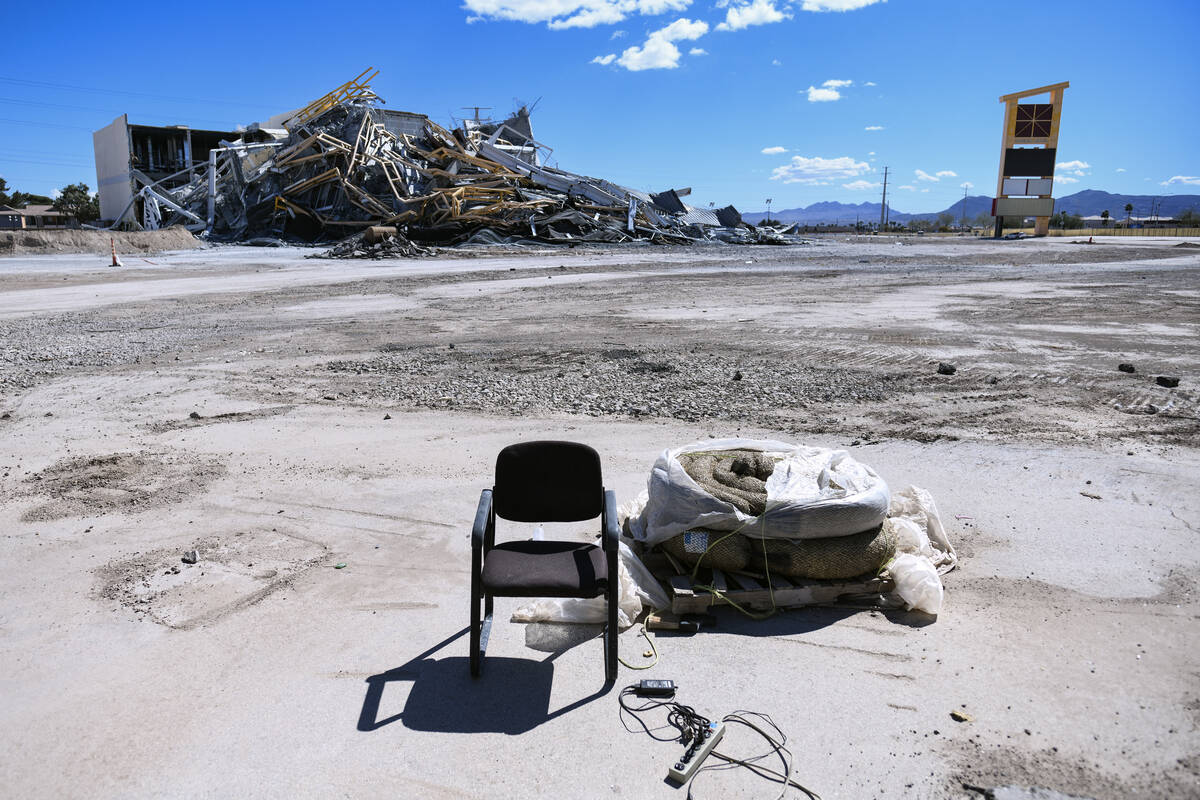
When the Eastside Cannery debuted in summer 2008, hundreds of people waited outside to get in Las Vegas’ newest hotel-casino on opening night.
Some waited a few hours to explore the $250 million project on Boulder Highway.
“We think it brings a new dimension to the east side of town,” developer Bill Wortman said at the time. “We’re extremely proud of what we’ve done here.”
Less than 20 years later, the current owners have imploded the hotel and want to sell the land for housing. And while Las Vegas has a long history of casino implosions, Eastside Cannery met its demise much sooner than other hotels that were also emptied out, laced with explosives and, in a matter of seconds, reduced to rubble.
“This (was) a lot newer,” said UNLV history professor Michael Green.
In America’s casino capital, hotel implosions are a spectacle: They are often early-morning parties, with fireworks and masses of people gathering to watch and cheer the destruction.
There were no designated public viewing areas for the Eastside Cannery implosion, or any fireworks. But several people were outside at a neighboring RV park to watch the building get toppled, and the Longhorn casino across the street tried to cash in on the event.
“Join us for our implosion party!” its sign out front declared.
The implosion that started it all
Eastside Cannery, on Boulder Highway at Harmon Avenue, had been closed since the onset of the COVID-19 pandemic in 2020. Work crews tore down portions of the property lately, but the 16-story hotel tower stood until demolition crews imploded it at 2 a.m. on March 5.
Overall, Eastside Cannery featured 300-plus hotel rooms, a 64,000-square-foot casino, several bars and restaurants, a 250-seat entertainment lounge and 20,000 square feet of meeting and ballroom space.
Its footprint spans about 29.5 acres, and owner Boyd Gaming Corp. has said there was not sufficient market demand to reopen the place and that it intends to sell the site for residential use.
Hotels in Las Vegas have often been imploded to clear space for bigger, flashier resorts. For instance, the Dunes, which opened in 1955, was imploded in 1993 and replaced by the Bellagio.
More than 200,000 people showed up to watch the elaborate destruction of the Dunes.
Casino developer Steve Wynn ordered a pirate ship at his newly opened Treasure Island to “fire” at the neighboring hotel, which, having been wired with dynamite and explosive charges, then collapsed into a heap of rubble, as recounted by the Neon Museum.
The contractor even used black rifle powder to create a brighter flash, according to the museum, which says the Dunes was one of the oldest casinos on the Strip and was the first hotel in the corridor to be toppled with the use of explosives.
‘Nature of the industry’
Green, of UNLV, said that many Las Vegas hotels built in the 1950s were considered state-of-the-art for their time. But standards and attitudes can change, he added.
He said that while it pains him, as a historian, to see resorts torn down, he understands that it’s the “nature of the industry.”
He also agreed that imploded hotels in Las Vegas were usually older than Eastside Cannery when it came crumbling down.
Altogether, Las Vegas hotels were often at least three decades old by the time they were imploded.
Not everyone in Southern Nevada decides to implode a hotel when they want to demolish it. And in one high-profile case, as Green pointed out, a hotel was taken down before it was even completed.
The never-finished Harmon hotel — a structurally flawed project that sparked massive litigation — was supposed to be part of the multi-tower CityCenter project on the Las Vegas Strip.
But work crews started dismantling the Harmon around 2014, and developers purchased the plot in 2021 to build a retail project.
Brian Gordon, a principal with Las Vegas consulting firm Applied Analysis, noted that Eastside Cannery wasn’t the only hotel-casino in Southern Nevada that never reopened from the pandemic shutdowns.
These properties were nowhere near the Strip, and, Gordon pointed out, the owners opted to make money off them another way.
Station Casinos never reopened Fiesta Henderson, Fiesta Rancho and Texas Station after the statewide, mandated casino closures were lifted. The company ultimately demolished them and sold the three sites for about $90 million combined.
Gordon said that the pandemic shutdowns allowed casino operators to rethink their entire business model and that some properties didn’t make the cut.
‘Much more modern’
In spring 2007, Cannery Casino Resorts held a ceremonial groundbreaking for Eastside Cannery.
Wortman, co-founder of the Cannery company, said the project marked a “new paradigm” for Boulder Highway and would be a “much more modern facility.”
Eastside Cannery replaced the 1970s-era Nevada Palace and opened amid a struggling economy that only worsened. The month before its debut, Wortman said it was hard to judge how customers would respond to a new hotel-casino in the middle of an economic downturn.
But his team figured the new place would create excitement on the east side of town, the Las Vegas Review-Journal reported.
“There hasn’t been anything new down here for many years,” he said.
In 2016, Boyd Gaming acquired the Cannery hotel-casino in North Las Vegas and Eastside Cannery from Wortman’s company for $230 million in cash.
Boyd President and CEO Keith Smith said the deal expanded its presence in the locals casino market “at an attractive price.”
He also cited Eastside Cannery’s proximity to the neighboring Sam’s Town hotel-casino, also owned by Boyd.
‘Plenty of excess capacity’
In March 2020, then-Gov. Steve Sisolak ordered casinos and other businesses in Nevada closed to help contain the coronavirus outbreak. Nevada’s casinos were allowed to reopen in June 2020, but Eastside Cannery never did.
Michelle Rasmusson, Boyd’s chief compliance officer, told Clark County officials in a letter in spring 2024 that the company had “plenty of excess capacity” at Sam’s Town and that market conditions did not support reopening its neighbor.
Early last year, Boyd purchased the land under Eastside Cannery from Wortman for $45 million. The company had been leasing the footprint but declined to say why it bought the land.
Then, in October, Boyd announced plans to demolish the shuttered hotel-casino and sell the site. And last month, it said the hotel tower itself would be imploded.
Wyatt Diaz-Gomez, who lives near UNLV, watched the early-morning event from a neighboring RV park.
“It was pretty cool,” he said.
Contact Eli Segall at esegall@reviewjournal.com or 702-383-0342.