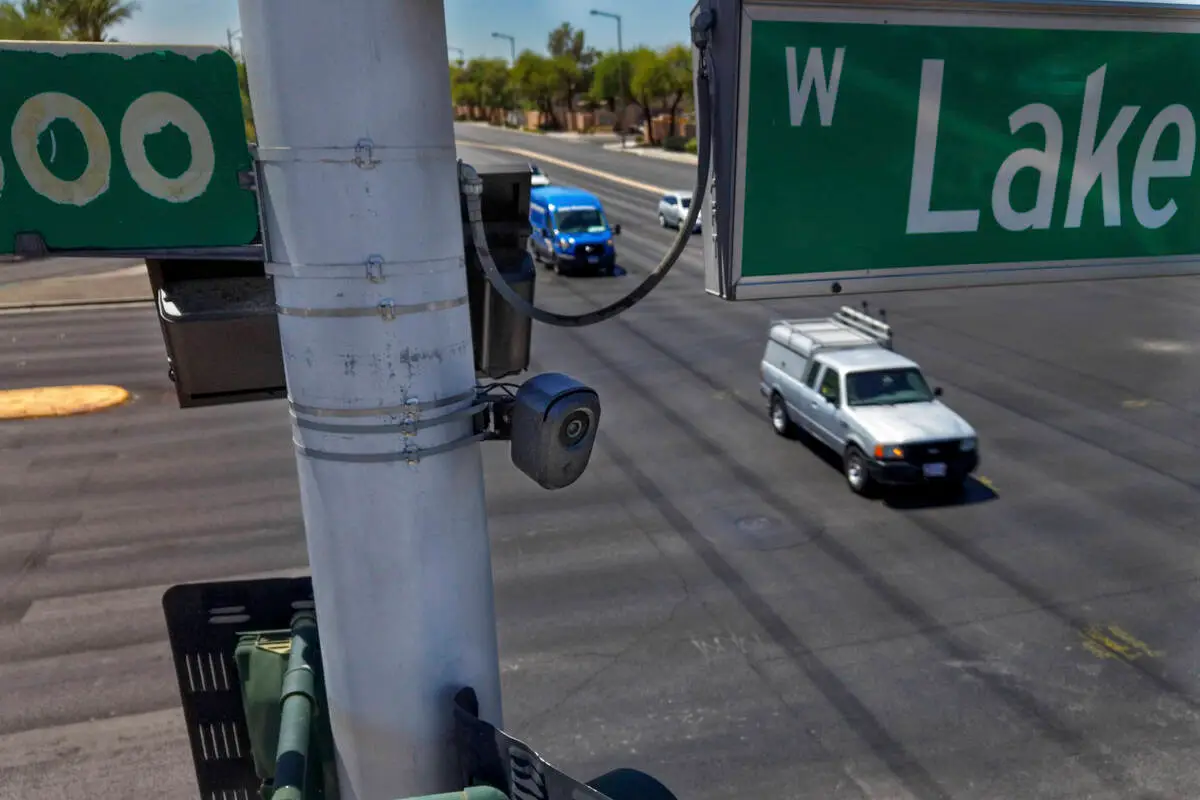
Proposed legislation that would regulate Flock Safety and other automated license plate readers would not go far enough to ensure the privacy of Nevadans, according to Assemblymember Selena La Rue Hatch, who wants the state to ban their use outright.
The Northern Nevada Democrat submitted a bill draft request for the 2027 Legislature that — if signed into law — would ban the use of automated license plate readers and their associated networks, according to the American Civil Liberties Union of Nevada, which backs the proposal.
Under the legislative process, lawmakers submit proposed bills to the Legislative Counsel Bureau, which then drafts the language. The wording of the bill was not available Thursday. La Rue Hatch couldn’t be reached to discuss her proposal but shared her position in an ACLU press release.
“No one living in the United States of America should be the subject of widespread government surveillance, period,” she wrote. “Flock and other ALPR networks are being used to track the movements of everyone. They can see your daily routines, what friends or family you visit in your free time, where you go to church, what political groups you support, everything.”
Flock did not address La Rue Hatch’s proposal directly, but a company spokesperson told the Las Vegas Review-Journal that it supports regulations. Flock Safety is not the only company with automatic license plate readers, but it’s among the most prominent.
“Flock’s technology is an important public safety tool for law enforcement agencies across America, helping officers solve serious crimes and find missing people,” the spokesperson wrote in a statement this week. “We support thoughtful, bipartisan legislation that puts strong privacy, transparency, and accountability guardrails in place while preserving law enforcement’s ability to use technology responsibly to keep people safe.”
Nevada considering regulations
Last month, the Nevada Legislature’s Joint Interim Standing Committee on the Judiciary requested draft legislation to place guardrails on the technology, which is not currently regulated in the state.
If signed into law, the bill would require agencies that use the technology to adopt written policies and train personnel on the cameras’ legal use and data protection. The proposed law would also mandate annual reports about the cameras’ use, policies and audits.
La Rue Hatch’s Sept. 9 announcement landed amid rising national scrutiny and pushback over privacy concerns and inappropriate use of the technology.
“This technology is in direct violation of our basic constitutional rights, is far too easily abused, and it does not match our Nevada values,” La Rue Hatch said. “This is the Silver State, not the Surveillance State, and I’m proud to sponsor this bill to ban Flock and ALPR surveillance networks.”
U.S. media have reported on cases of dozens of police officers accused across the country of using the technology outside their law enforcement capacity, some of whom were arrested on stalking allegations.
Unpopularity of license plate readers
A late-August YouGov poll of about 20,000 U.S. adults found that 46 percent of respondents somewhat or strongly opposed the use of license plate readers for law enforcement purposes, while 38 percent of them somewhat or strongly favored their use.
Seventeen percent of those surveyed said they weren’t sure, according to the findings.
License plate readers are designed to capture images or video of vehicles passing through their field of view, documenting their plate numbers, descriptors and location, noted the Legislative Analysis and Public Policy Association.
Flock Safety highlights built-in privacy controls and transparency tools on its systems, adding that its cameras don’t identify people in vehicles, nor do they track them.
The company says the technology’s users do not have access to live feeds, that searches are logged and images auto-delete after a week.
“Flock does not replace investigators or human judgment,” the company said.
Both sides of the argument
ACLU of Nevada Athar Haseebullah classified the technology as indiscriminate and invasive.
“The government should not have access to everyone’s freedom of movement, and neither should a big tech company like Flock,” he told the Review-Journal.
Haseebullah said that the proposal emerged after monthslong conversations with La Rue Hatch, which intensified when legislators started to discuss regulating the technology.
State-imposed guardrails would be difficult to enforce through official oversight because of the Legislature’s limited gatherings, he said.
“It’s a misnomer to think that a part-time Nevada Legislature that is only in office for four months every other year is going to be able to keep up with the regulatory oversight of this technology and its misuse,” Haseebullah added.
Automatic license plate readers have defenders.
During a congressional hearing this week, FBI Director Kash Patel defended the use of the technology, saying that the agency only uses it in a case-by-case basis and not as regularly as police departments.
“We have to use it lawfully, but we, the FBI, don’t continue to access them on a rolling basis,” he said.
Patel credited the technology for helping law enforcement track the whereabouts of a man accused of a fatal shooting at Brown University in 2025, who later was found dead. He also said the FBI has been able to find kidnapping and child trafficking suspects.
“We have continuously utilized this when people kidnap children and cross state lines,” he told Congress. “We have saved children over and over again from these child predators,” he added.
Metro’s use of license plate readers
The Metropolitan Police Department has installed 180 Flock cameras across the jurisdiction, as well as 130 Motorola automated license plate reader cameras, Sheriff Kevin McMahill told the Review-Journal earlier this year.
He said the technology helps his officers fight crime.
“We also limit our Flock usage to law enforcement purposes, and we also only share our Flock data with legitimate law enforcement organizations for the purpose of conducting those criminal investigations,” McMahill said.
An online Flock Safety portal about its network’s use by Metro said that it has access to 207 cameras in the company’s network. Over the last month, the cameras documented more than 2.4 million vehicles. At least 3,692 searches had been conducted during the same period.
Metro did not respond to a message seeking comment about its position on the legislative proposals.
Haseebullah said he expects La Rue Hatch’s bill to at least receive a hearing, and theorized that there would be public pushback if not.
“I would hope that our Legislature takes into account that public support for our position in terms of prohibiting ALPR technology is actually quite popular, and in fact, guardrail bills are not going to be,” he said.
Contact Ricardo Torres-Cortez at rtorres@reviewjournal.com.