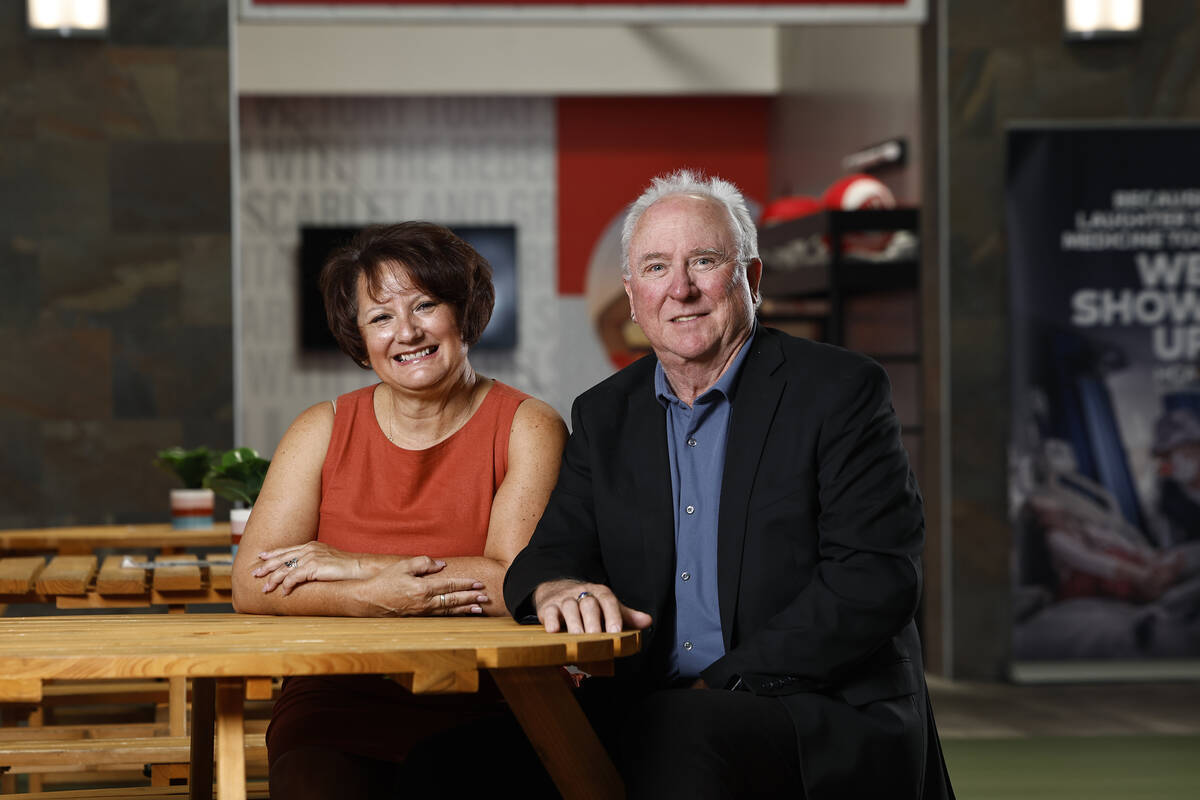
When the founders of Purdue Marion & Associates began thinking about stepping back, they ran into a problem: They couldn’t quite find a succession plan that felt right.
So they came up with an unconventional solution — they gave the company to their employees.
Purdue Marion & Associates, now The PMA Agency, is a boutique public relations agency in Las Vegas founded by Bill Marion and Lynn Purdue in 2002. After 24 years of building the company through the aftermath of 9/11, the Great Recession and the COVID-19 pandemic, Purdue and Marion were ready to ease into semi-retirement.
But they didn’t want to close the doors or sell the agency.
Instead, in February, the agency transitioned to employee-owned, renaming it to The PMA Agency, with Purdue and Marion becoming “partners” rather than founders. The financial terms of the deal were not disclosed.
“I can’t think of a better reward to give them for their perseverance during the hard times, as well as their incredible work ethic during the good times,” said Purdue. “ They now own the company, and that makes us feel so good that we are able to give back to them.”
The company now consists of five “partners”: Purdue, Marion, Michele Voelkening, Gaby Rodriguez and April Mastroluca, as well as two staff members who do digital marketing and administrative work.
Voelkening, the agency’s first hire, now serves as the president and managing partner, Rodriguez is vice president of public relations and community outreach and Mastroluca, a former Nevada assemblywoman, is vice president of strategy and public policy.
“It’s a huge responsibility,” said Voelkening. “We want to make sure that we’re honoring everything that they did because they sacrificed a lot in the hard times.”
How do employee-owned businesses work?
There are multiple ways for a company to transition to employee ownership, said Wonyong Oh, Lee Professor of Strategy at UNLV’s Lee Business School.
The most common form is an employee stock ownership plan, or ESOP, Oh said. Under an ESOP, shares of a company are held in a trust and transferred to employees from existing owners, most often through retirement benefits.
Other forms of employee ownership, according to the National Center for Employee Ownership, include partnerships, in which a small group of employees become partners and share profits and decision-making; employee trusts; stock options; worker cooperatives; and direct company ownership, in which employees use their own money to purchase the company, either outright or gradually.
The biggest benefit of employee ownership, Oh said, is “incentive alignment.”
“In a traditional business, employees may sometimes think, ‘Even if I work hard, the profits ultimately go to the owner,’ ” Oh said. “Employee ownership can therefore help align employees’ interests with those of the company.”
But employee ownership also comes with potential drawbacks, including the “free-rider problem,” in which some employees may contribute less while still benefiting from the company’s success; slower decision-making; and “risk concentration.”
Under risk concentration, employees can have both their jobs and a portion of their retirement wealth tied to the same company.
“If the company experiences financial difficulties, employees may face not only reduced job security or income, but also a decline in the value of their ownership stake,” Oh said. “In other words, both their employment and part of their retirement wealth may be tied to the performance of the same company.”
The decision to go employee-owned
The PMA Agency was always meant to be small.
“We decided that we never wanted to be measured by the size of the agency,” said Purdue. “It was rather the talent, so we brought in mature practitioners who were really good at what they did.”
And it worked.
Voelkening has been with the agency for 24 years, Rodriguez for about 12 years, and Mastroluca is the newest hire in February.
With practitioners who have stayed with the company for so long, a family-like atmosphere was created. Marion joked, “I think we’re better than family. My family was pretty dysfunctional.”
“Bill and I spent 24 years as partners,” said Purdue. “So to just close the doors one day, that seemed so sad.”
The two had discussed succession plans for about 15 years, but nothing stuck. The idea of employee ownership finally emerged during a staff retreat. As the partners continued talking about it, they realized the people already working at the agency were positioned to take it forward.
“We met with the team on more than one occasion, and finally worked out that they’re already leaders in their field,” said Marion. “Why don’t we create something where they just take over the company, and we stay on as advisors and practitioners, but we take a junior role and let them run the company.”
The transition took over a year, working with their CPA on the details of the ownership, which they did not disclose. Now, Purdue and Marion say the biggest challenge is “giving up that authority and leadership.”
“We actually sat down and talked to each other, and said ‘OK, we are no longer like the head dog, right? So, shut up, let them explore,’ ” said Purdue. “If we feel like they’re taking a left turn somewhere, we’ll speak up, and then we’ll still give them our thoughts and opinions.”
Although, even that does not happen often, with Marion saying the partners have always stepped up to challenges within the company.
As for if they recommend transitioning to employee-owned? It’s case-by-case.
“Employee-owned company is good when you have an employee base that is vested in the long-term future of the company,” said Marion. “If you have an internal structure or atmosphere of constant change, constant turnover, then it’s not going to work.”
Although, in the end, the employees and clients are happy with the transition. All three, Voelkening, Purdue and Marion saying they have received positive feedback internally and externally, two clients even saying “it’s about time,” according to Marion.
“We are family, and then this restructuring was basically the inheritance,” said Marion.
Contact Emerson Drewes at edrewes@reviewjournal.com. Follow @EmersonDrewes on X.