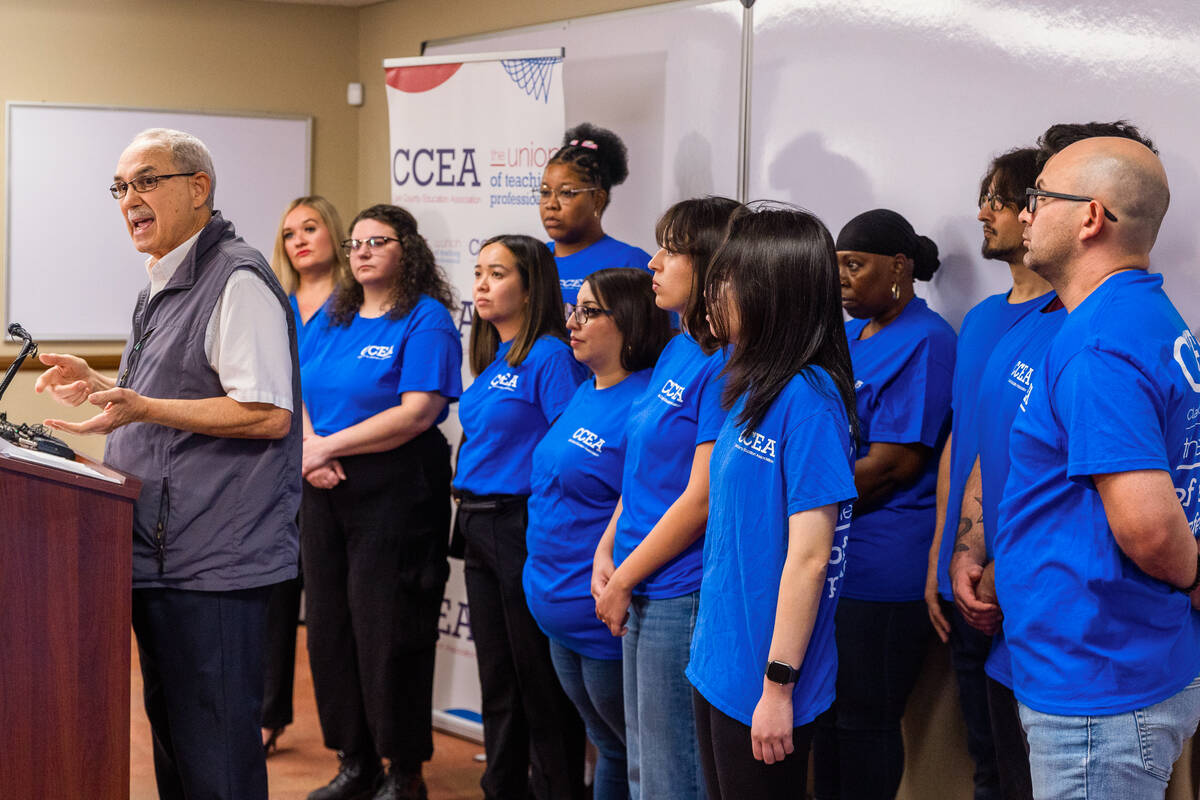
A leading Southern Nevada teachers union says public schools should reap the benefits of the state’s data center boom.
“We’re not calling for a moratorium, nor are we part of the status quo crowd to let it continue as it is,” said John Vellardita, executive director of the Clark County Education Association. “Our objective is to flip the script on what kind of relationship should a trillion-dollar industry controlled by billionaires have with the state of Nevada and our residents.”
At a press conference at the union’s headquarters in east Las Vegas on Wednesday, Vellardita unveiled an eight-point plan for how the state’s schools can cash in on the data center boom while protecting the environment. First and foremost, he said, data centers should pay the Local School Support Tax, which could generate millions for education.
The union has been meeting with tech companies, the governor’s office and state lawmakers to discuss reform, but leaders are still seeking a bill sponsor, Vellardita said.
It comes nearly two weeks after the interim revenue committee of lawmakers voted to draft a bill to pause data centers across Nevada and repeal the state’s generous tax abatement structure for those facilities.
Vellardita criticized the new bill and said the same lawmakers who voted in 2015 to create the abatement program are now campaigning on moratoriums while Nevada has an opportunity to make billionaires pay their fair share.
“We think that’s a disservice to this community, we think it’s a disservice to the state, and we clearly don’t think it’s a position that folks should be elected on,” Vellardita said. “Those that have passed that law created the problem. We’re here to clean up the problem, but on terms that are a new model.”
Eight points, from water to revenue
Included in the eight points is a requirement that data centers pay into the Local School Support Tax, a statewide, 2.6 percent tax on retail sales that is a major funding source for public K-12 education.
According to the union, data centers would have generated an additional $357 million for schools since 2015 had they been required to pay the local school support tax.
The union’s plan does not go as far as to make a recommendation for data centers’ property tax breaks — up to 75 percent for 10 or 20 years, provided the centers retain 10 or 50 full-time employees, respectively. Vellardita said those property tax cuts should be reviewed; if a bill mandates data centers to pay those taxes, the state could earmark that money for special education, universal pre-K or other programs.
Wednesday’s plan was met with swift condemnation from the Sierra Club, Nevada State Education Association, the progressive nonprofit Battle Born Progress and Assemblymember Selena La Rue Hatch, D-Reno.
“Adequately funding Nevada’s public schools should not depend on the continued growth of an industry facing increasing public opposition and raising serious concerns about our power grid, water supply, and utility costs,” said Alexander Marks, deputy executive director of the Nevada State Education Association, in a statement.
Union attempts to address larger issues
The union’s plan does speak to the fears communities have about data centers, asking any new law to control water use, require tech companies to build their own power generation, give communities final say in whether a facility moves forward and address other concerns like heat emissions, noise pollution and siting.
Asked about whether the union is firm on all of the plan’s points being taken together, Vellardita said the union is most set on requiring data centers to pay their full share of the Local School Support Tax.
“The reason we bring that stuff up is because the amount of revenue that we’re talking about, the areas of power, water, the community having a say, the impact on the environment — we don’t hold franchise to those issues alone,” Vellardita said. “That’s something that has to be acceptable to the residents.”
The state’s tech companies are well aware that tax abatements will be revisited in 2027, said Tray Abney, of the pro-industry Nevada Data Center Alliance.
Abney said his members are generally open to discussions about how best to reform the tax structure, but said an outright repeal of the abatements wouldn’t be fair because other industries benefit from them, as well.
While he cautions lawmakers from relying on any one industry to fund something as important as education, Abney said it will be on elected officials to decide exactly where extra revenue gets invested.
“This is the next industrial revolution,” Abney said. “We want Nevada to be on the forefront of that.”
But some still seek much stronger reforms.
Olivia Tanager, director of the Sierra Club’s Toiyabe chapter, said in a statement that asking communities to bear the brunt of data center impacts for the promise of better public schools is not a fair trade.
“Why should anyone buy into the idea that we ought to make the future of our schools dependent on the continued rollout of an industry that is creating some of the biggest environmental and infrastructure challenges our state is facing?” Tanager said. “The answer cannot be to simply build more of them and hope the revenue makes the impacts worthwhile.”
Contact Alan Halaly at ahalaly@reviewjournal.com. Follow @AlanHalaly on X.
Clark County Education Association’s eight-point data center plan
— Local control: All factors as determined by a community must be taken into account from location, to type of building, to noise issues, to job creation.
— Water: Cooling methods mustnot deplete water resources, only using dry cooling or a closed-loop system.
— Power: Sources must be stand-alone or must not adversely impact ratepayers or the environment.
— Environment: Concerns must be addressed and approved by the community in which it is built.
— Mandatory transparency: Audits must be performed to ensure the industry is in compliance.
— Sales tax: Abatements must end and all local school support tax must go into public education.
— Property tax: Abatements are to be reviewed with possible revenue to go toward universal pre-K and special education.
— Data center revenue: Must be used for workforce development and to address retraining opportunities for jobs displaced by AI.