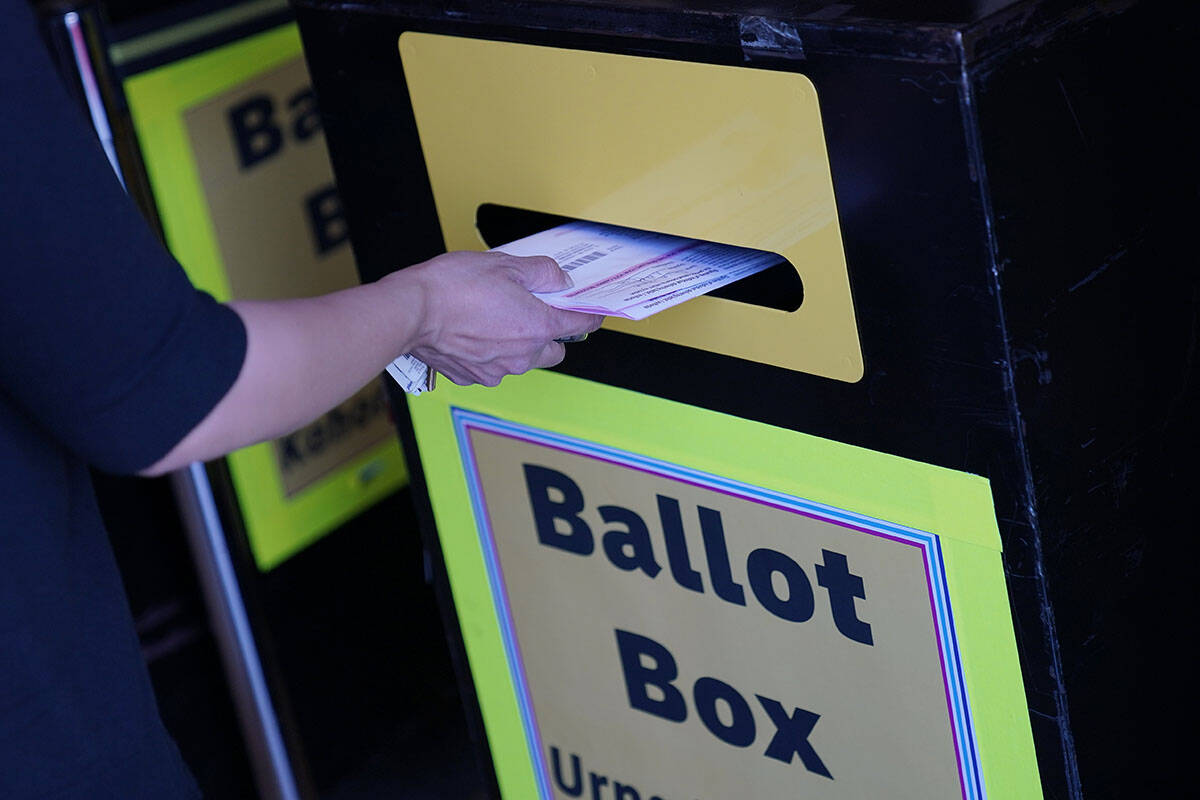
Democrats are in a tizzy over a recent Supreme Court ruling that allows a presidential order on mail ballots to move forward — for now. But the decision was technical in nature and will almost certainly have no practical effect on the November election in Nevada or elsewhere.
In March, President Donald Trump issued an executive order that he said was intended to boost election security and clamp down on voter fraud. One of the reforms calls on the U.S. Postal Service to not deliver mail ballots to those whose names don’t appear on a list of U.S. citizens that the federal government would compile from various sources. This was an effort to strong-arm states that were refusing to cooperate with federal efforts to collect the data that would be used to assemble the voter roster.
Putting aside the issue of how many non-citizens are actually voting in elections — the numbers are likely much lower than the administration has claimed — the order raises obvious questions about the president’s authority to unilaterally federalize certain voting procedures. Article 1, Section 4 of the Constitution prescribes that “the Times, Places and Manner of holding Elections for Senators and Representatives, shall be prescribed in each State by the Legislature thereof; but the Congress may at any time by Law make or alter such Regulations.”
In this case, Congress has not passed any legislation imposing mail-ballot delivery restrictions.
Following the executive order earlier this year, a number of states, including Nevada, filed a lawsuit challenging the White House. A federal court temporary blocked implementation of the new policies, and the administration responded by seeking Supreme Court intervention.
On Monday, the justices ruled 6-3 that the states lacked standing to intervene because no federal action had yet been taken against them. But they specifically noted that the decision in no way addressed the legality of Mr. Trump’s order. “The court’s disposition of this application,” the unsigned majority opinion noted, “does not mean that any measure taken by the Government to implement the Order will necessarily be lawful.”
Democrats responded with outrage. “The Supreme Court’s ruling,” read a statement from Nevada Secretary of State Francisco Aguilar, a Democrat, “is another attempt to attack states’ constitutional right to run elections, and it’s disheartening to see the justices give this executive order the ability to move forward.”
But the ruling does not “attack states’ constitutional rights to run elections.” It doesn’t even address that issue. The decision only delays litigation over the controversy — which will certainly again reach the high court in due time. Let’s spare the indignation until it’s actually warranted.