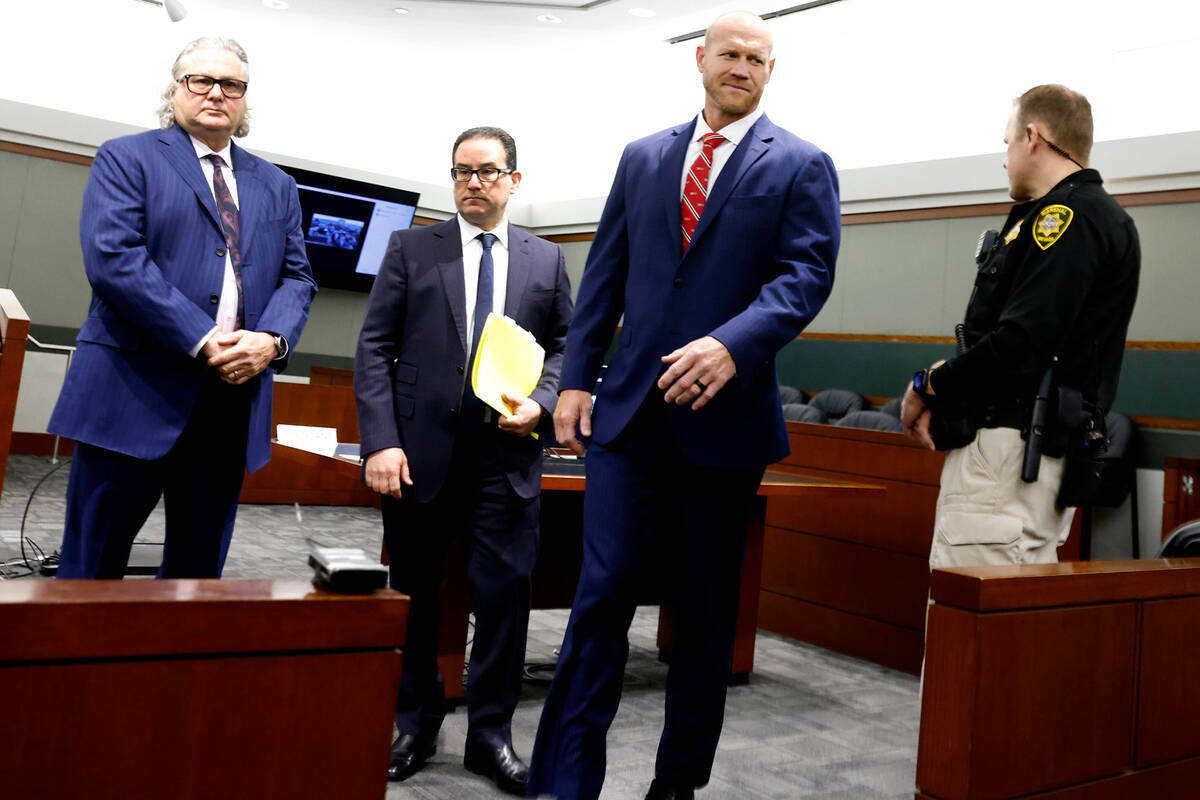
Attorneys for a former congressional candidate facing a murder charge want Metropolitan Police Department officers to answer questions about how attorney-client communications were intercepted during a wiretap.
Chief District Judge Tierra Jones previously declined to dismiss the case against Daniel Rodimer, who is accused of attacking and beating 47-year-old Christopher Tapp during an Oct. 2023 party at a Resorts World suite. Rodimer was angry that Tapp had offered his stepdaughter cocaine, police have said.
Rodimer, a former pro wrestler, was endorsed by President Donald Trump when he ran for Nevada’s 3rd Congressional District in 2020.
Attorney Richard Schonfeld told Jones at a Thursday hearing that investigators intercepted four calls covered by attorney-client privilege: three involving David Chesnoff and one with an out-of-state attorney.
Jones ruled last month that because prosecutors conceded the calls were privileged and agreed not to use them at trial she did not need to address the evidentiary issues regarding the communications.
Schonfeld and Chesnoff have since asked her to reconsider. Prosecutors oppose their request. Jones did not rule from the bench Thursday, but said she would issue a written decision.
The prior ruling addressed what evidence could be introduced at trial, but not how Metro could have intercepted the calls, including several involving Chesnoff, a longtime and prominent attorney, Schonfeld said.
“It’s not by chance that these were intercepted,” he told the judge. “So one of a couple of things happened. Either it was intentional, and they didn’t take their responsibility in the Fourth Amendment seriously, and they intercepted the communications with disregard for the court order requiring minimization as well as Nevada state law and constitution, or they didn’t take the minimization responsibility itself seriously.”
In the wiretap context, minimization is the concept of avoiding conversations not subject to the tap.
Metro did not respond to a request for comment. In an interview last month, Sheriff Kevin McMahill declined to comment on how police came to intercept the attorney-client communication, but defended the department.
“I don’t believe we did anything wrong,” he said. “I believe we followed the law.”
Chief Deputy District Attorney Binu Palal argued in court papers that intercepting a small number of calls did not establish a systemic failure worthy of a hearing.
“How do we know that?” Schonfeld asked in court.
He suggested that the officers involved could come to court and testify about how the privileged calls were intercepted or that the officer responsible provide a sworn declaration about what happened.
Defense attorneys have alleged that authorities used the privileged calls to build their case.
“(T)he identified calls were captured incidentally during a court-authorized wiretap, were never used by the prosecution team, generated no derivative evidence, and played no role in charging decisions or trial preparation,” Palal wrote.
Contact Noble Brigham at nbrigham@reviewjournal.com.