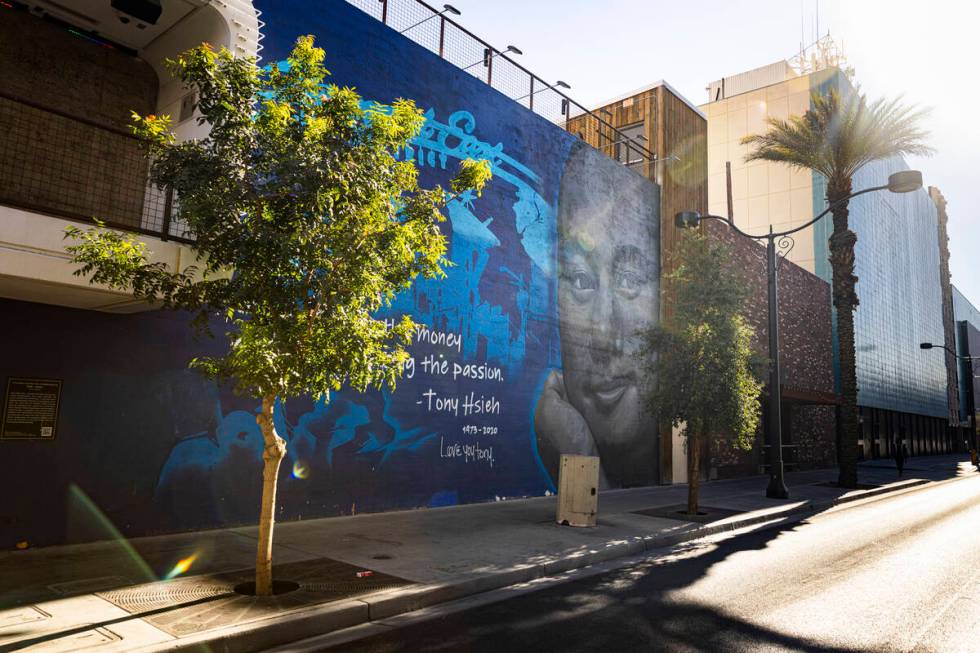
After Gerald LaPorte was tapped to examine the late Zappos chief Tony Hsieh’s will, he inspected the ink, paper, font, creases and staple holes.
Hsieh’s father had claimed the will was fake and sought forensic testing, albeit by other examiners. LaPorte, a forensic chemist and document dating specialist, came up empty-handed trying to figure out when it was written.
Then, his report was put under wraps — after a lawyer for Hsieh’s dad wanted the findings shielded from public view.
All told, the forensic report and its court-ordered sealing mark the latest twists in an already bizarre saga in Las Vegas surrounding the fate of the massive wealth Hsieh left behind.
Hsieh’s purported last will and testament surfaced under still-unclear circumstances long after his death, upending the Las Vegas mogul’s probate case and sparking a series of mysteries stretching from America’s casino capital to Wyoming and Pakistan.
‘Immediately expunged’
LaPorte’s 410-page forensic report provides an in-depth look at the physical characteristics of Hsieh’s will. He provides a detailed account of his scientific analysis of ink and paper, all in the quest to determine if the will was drawn up on its listed date or much later.
Hsieh, the former CEO of online shoe seller Zappos and face of downtown Las Vegas’ economic revival, died on Nov. 27, 2020, at age 46 from injuries suffered in a Connecticut house fire.

His father, Richard Hsieh, has been managing his son’s estate through a probate case in Clark County District Court, and the dad’s legal team stated multiple times that the younger Hsieh died without a will. However, in spring 2025, two law firms teamed up to file a copy of the purported will in court.
The Las Vegas Review-Journal obtained a copy of the now-sealed forensic report that LaPorte filed with District Court on the evening of July 20. The document was widely distributed through a service notification just minutes after it was filed in court, the newspaper found.
But at a hearing on July 21, Vivian Thoreen, a lawyer for Hsieh’s father, asked the court to “immediately expunge” the report.
Thoreen said that the younger Hsieh’s Social Security number was “all over” the report and that it should be refiled “confidentially,” according to a transcript of the hearing.

Zappos CEO Tony Hsieh speaks at the company’s All Hands employee event at the Smith Center for the Performing Arts in Las Vegas on Aug. 9, 2012. The event is a quarterly meeting to update employees of goings-on in the company. (Jessica Ebelhar/Las Vegas Review-Journal)
“Not that the damage hasn’t already been done,” she told District Judge Jacob Reynolds.
Jennifer Willis, an attorney for a participant in the case, agreed that the Social Security number should be redacted. But she objected to the report being submitted outside of public view, the transcript shows.
“They have to establish a basis to file it confidentially,” Willis said.
Thoreen then said the judge’s personal cell phone number was in the report and suggested this get redacted or left out of the resubmitted document.
Reynolds ordered the forensic report sealed, court records show.
‘The sealing is a temporary immediate solution’
Nevada court rules show that anyone can ask a court to seal or redact records in a case “by filing a written motion” and that a judge may conduct a hearing on the matter.
The case portal does not show any written motion to seal the forensic report.
Las Vegas attorney Maggie McLetchie, who handles public-records cases and has represented the Review-Journal in legal matters, said that all court records are presumptively public.
She said that to have a filing sealed, a motion must be submitted to court arguing why, and that this gives the public an opportunity to challenge the request.
Reynolds said in an emailed statement to the Review-Journal that the sealing he ordered “was based on oral motion when it was discovered personal information that should have been redacted was in the filing.”

He added: “The sealing is a temporary immediate solution so the information can be redacted.”
Thoreen, a partner with Holland & Knight, and lawyer Dara Goldsmith, a shareholder with Goldsmith & Guymon who is also representing Hsieh’s father in the case, did not respond to requests for comment.
Mystery figure
Hsieh was unmarried and died with a massive fortune, and last year, his probate case took a shocking turn that only became more bizarre.
Law firms McDonald Carano and Greenberg Traurig filed court papers in April 2025 with a copy of Hsieh’s seven-page last will and testament — dated March 13, 2015 — and a letter describing how it was found. The firms were representing named executors in the will.

The will was found in February 2025 in the personal belongings of the late Pir Muhammad, according to the letter, which stated Muhammad had suffered from Alzheimer’s disease and was not aware Hsieh had died.
The letter did not say when Muhammad died or where he lived, nor did it provide any details about his career or his association with Hsieh.
As outlined in the will, Hsieh had named Muhammad an executor and gave him “exclusive possession” of the original, in part to prevent anyone from destroying the document.
But several people who knew Hsieh told the Review-Journal that they never heard of Pir Muhammad.
The Review-Journal also checked property records, court records, business-entity registrations, online phone directories, search engines and other databases but found nothing that linked the name to Southern Nevada or confirmed who he was.
‘We have no idea’
In June 2025, McDonald Carano and Greenberg Traurig filed court papers that included a copy of Muhammad’s death certificate. The document was written in both English and Urdu, and as shown at the top, it was issued by the government of Balochistan, a province in Pakistan.

But much of the death certificate was redacted, including Muhammad’s cause of death, place of death, and address. It still showed his name; his nationality, Pakistani; and his date of birth, shown only as 1931.
It also showed his date of death, shown only as October 2022 — which meant that Muhammad died more than two years before Hsieh’s will was supposedly found in his possessions.
Goldsmith and Thoreen previously wrote in court papers that even if the document could be authenticated, it only showed that someone named Pir Muhammad died and did not show that it was the same Pir Muhammad who was named in the will.
The Review-Journal previously found more than 1,000 profiles on Facebook with the name Pir Muhammad. Many of them said they lived in Pakistan.
During a court hearing last summer, Goldsmith said that her team still didn’t know where exactly the will was found.
“We don’t know where in the world this document was located,” she said. “We have no idea.”
Questions mount
Pir Muhammad’s identity and death certificate are just two of the many mysteries that have swirled around Hsieh’s will.
Another key figure in the saga, Kashif Singh, wrote the letter explaining the will’s discovery. No contact information or details on Singh were provided in that filing, though according to subsequent court papers, Singh was Muhammad’s grandson, and he provided the redacted death certificate.
As part of an order for courthouse administrative records, lawyers for Hsieh’s estate obtained a phone number and mailing address for Singh, who did not respond to the legal team.
The phone number had a 307 area code, which covers Wyoming, and the mailing address was the same as a registered agent in Wyoming’s capital, Cheyenne. Such businesses handle incorporation filings and other corporate paperwork.

Moreover, the will was signed by several witnesses, three of whom had a Las Vegas address listed with their name and signature in the document.
But property managers could not find any records that the witnesses had lived there, court records show.
On top of all this, probate lawyers were left scratching their heads at how the will was written, telling the Review-Journal that the document was confusing and clunky, did not follow key estate-planning principles, and featured language and details they don’t normally see in such documents.
‘Creating a false trail’
Eventually, in December, Richard Hsieh claimed the will was bogus.
His legal team said in court papers that Tony Hsieh’s signature in the will was forged, that none of his family, friends or colleagues had ever heard of key names in the document, and that the witnesses who signed it “likely do not exist.”
The lawyers did not accuse anyone by name of orchestrating the alleged forgery. But they wrote that whoever was “behind this scam went to extraordinary lengths to cover their tracks by creating a false trail.”
Meanwhile, two outside lawyers were also given a role in the proceedings. In an order dated Jan. 9, then-District Judge Gloria Sturman appointed Nevada attorneys Robert Armstrong and Mark Ferrario as co-special administrators of Hsieh’s estate.

They had been named executors in the will but never met Hsieh or even worked on his estate planning, court records show.
Sturman’s appointment was for the “limited purpose” of letting the lawyers argue to admit Hsieh’s purported will to probate and defend any contest to it, court records show.
Hsieh’s father asked the Nevada Supreme Court to reverse the ruling, claiming it created “absurd and unworkable consequences.”
Then, in March, Richard Hsieh set out to broaden his team’s investigation of the will with CSI-style testing.
‘Special master’
His legal team sought court approval to conduct forensic analysis of the document, including “semi-destructive” testing that would not actually destroy the document but instead take pinhole-sized samples of ink and paper.
With this testing, the lawyers argued, examiners could figure out who made the ink, when the ink was manufactured, and how long it had been on the document. This would help determine if the will was signed around the time of the date listed on the document, or if it was signed later, the legal team said.
Judge Reynolds told the parties to identify forensic experts to be considered for the role of “special master” to conduct the analysis, court minutes show.
Legal counsel for Hsieh’s father then filed court papers seeking approval for his experts to start testing “immediately,” without waiting for the appointment of a special master.
That same day, Ferrario and Armstrong also filed court papers with their recommendation for the role: the forensic science firm co-founded by LaPorte.
In an order dated May 4, Reynolds appointed LaPorte — who is also the forensic laboratory director for the federal Homeland Security Investigations agency — as the special master.
‘One and done’
In his forensic report, LaPorte said he conducted an on-site examination of the will on June 1 at the District Court facility known as the Phoenix Building, at 330 S. Third St. in downtown Las Vegas.
He analyzed the paper, printer toner, writing ink, and other elements of the document.
Overall, his examinations and chemical testing did not “provide sufficient evidence to conclude” whether the will was drawn up on its listed date or at a “much later” time, he reported.
His report was electronically filed with the court at 7:53 pm on July 20. Then, at 7:57 pm, a notification of service was emailed with a link to download the report.
Dozens of people were listed in the notice as service contacts.
At the court hearing the next day, Thoreen, the lawyer for Hsieh’s father, said: “As now the world knows, the Special Master has filed his report publicly, and he did so last night.”
She asked for a court order that the special master “cease all work” and argued that LaPorte was trying to “create additional assignments for himself,” the transcript shows.
“He is done with his assignment, and I haven’t had a chance to review 400-plus pages of his report, but I would say it is one and done,” Thoreen said.
Contact Eli Segall at esegall@reviewjournal.com or 702-383-0342.