Inside Raeya Wellness in Boca Park, guests are greeted by soft earth tones, curved organic designs and attendants who speak in hushed voices. The atmosphere feels more like a luxury retreat than a medical office.
Founder Kelley Nemiro has built a wellness brand around that experience. With more than 85,000 followers on Instagram, where she shares videos about nutrition, healthy habits and daily routines, she has cultivated an audience eager to invest in preventive health.
Raeya, which bills itself as a “luxury women’s wellness sanctuary,” offers memberships ranging from $295 to $1,195 per month. Members can redeem credits for services such as lymphatic massage, red-light therapy and reiki, while specialty packages and a la carte offerings can cost thousands of dollars.
Across the valley, entrepreneur Justin Hibbert is preparing to open Everhaus, a private wellness and lifestyle club centered on seven pillars: movement, light, infusion, oxygen, contrast, touch and community. The club, scheduled to open in the fall, will feature hyperbaric oxygen therapy, cold plunges, saunas, IV infusions, fitness training and social programming.
From luxury wellness clubs and high-end spas to red-light therapy and longevity treatments, Las Vegas is increasingly positioning itself as a destination for the rapidly expanding wellness economy. Industry leaders say shifting consumer habits, declining alcohol consumption and growing skepticism toward traditional health care are helping fuel demand for wellness experiences that can cost anywhere from hundreds to thousands of dollars each month.
“People are looking for a better standard of care, and they’re willing to invest in preventive health versus this kind of ‘let’s go to the doctor after the symptoms already arrive’ mentality,” Nemiro said.
The global wellness economy reached $6.8 trillion in 2024, according to the Global Wellness Institute’s Global Wellness Economy Monitor 2025. The United States accounts for roughly $2.14 trillion of that total, representing about 7.3 percent of the nation’s gross domestic product. By 2029, the wellness economy is projected to reach $9.8 trillion.
Wellness tourism is the third-largest wellness sector in the United States, generating $330.2 billion annually. Personal care and beauty ranks first at $411.7 billion, followed by physical activity at $406.9 billion.
“I think Las Vegas wanted to pivot from casinos and decadence for years,” said Beth McGroarty, vice president of research and forecasting at the Global Wellness Institute. “That kind of alcohol culture is really on the decline.”
McGroarty pointed to Gallup data showing that 54 percent of Americans reported drinking alcohol in 2025, the lowest level in decades.
“Las Vegas has to reinvent itself and is reinventing itself,” she said.
Wellness comes to the Strip
The Strip has long served as an incubator for new trends, and wellness is increasingly becoming part of the resort industry’s growth strategy.
At Fontainebleau Las Vegas, LIV Beach hosts Sunday Circuit, a wellness-focused event held on the final Sunday of each month. The resort’s Awana Spa offers an Aufguss sauna ritual, a guided sauna experience more commonly associated with Europe.
Meanwhile, spas at Resorts World Las Vegas, Bellagio, Caesars Palace and Canyon Ranch have either undergone significant upgrades or introduced new wellness offerings designed to attract affluent travelers.
Michael Londo saw the trend emerging years ago.
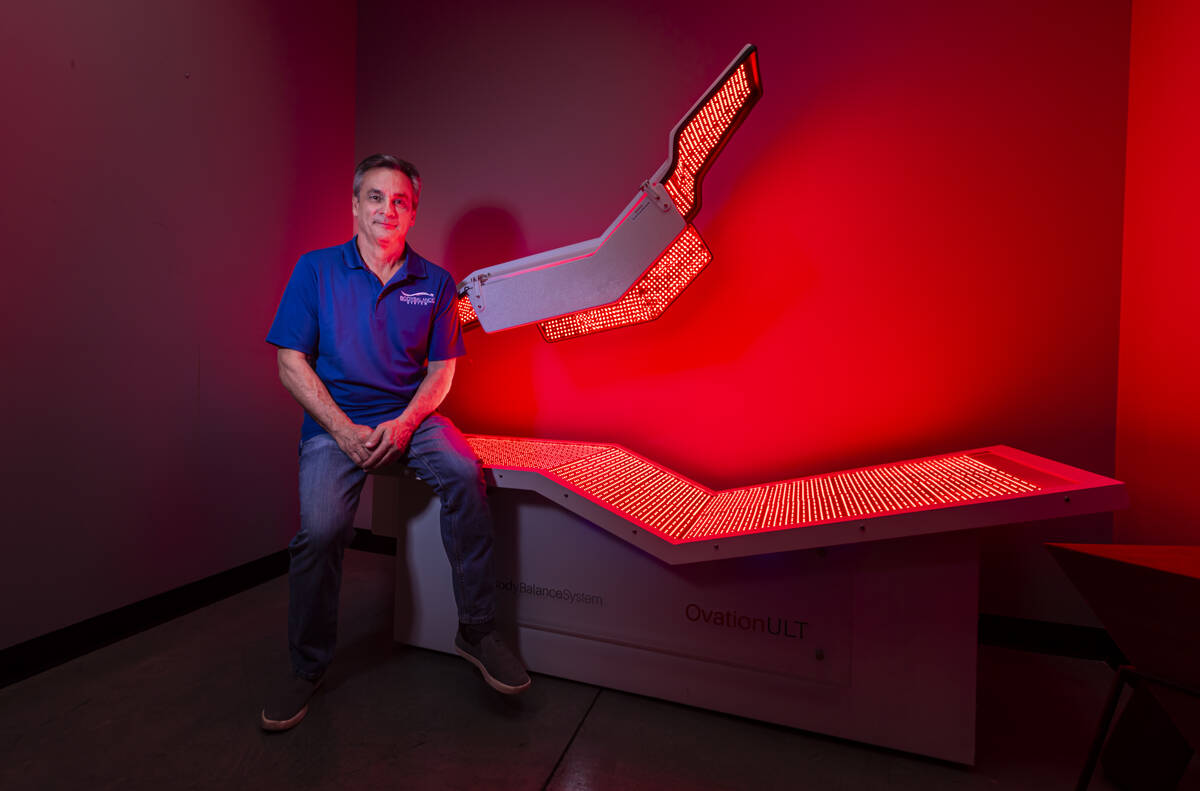
Londo founded Body Balance System in 2004, initially selling ionic foot baths before shifting to red-light therapy in 2013. Today, his Las Vegas-manufactured devices can be found in spas nationwide, including at Aria and Bellagio.
At Aria’s spa, one treatment room glows bright red behind frosted glass panels. Inside sits one of Londo’s therapy devices.
“People come and stay at the resorts and want to spend money,” Londo said. “Aria has a great setup. People will come out and say, ‘What’s that red stuff?’ and they end up doing it.”
Londo said potential deals are in the works with Fontainebleau, Green Valley Ranch and Red Rock Resort.
“A client asked if I’d heard about red-light therapy, so I went online and researched it,” he said. “There were only a handful of companies doing it, and we decided to get into it. We started making red-light devices, and it quickly became a big product for us.”
Body Balance System’s devices range from about $15,000 to $60,000 and are primarily sold to businesses. The company says the machines can generate between $8,000 and $25,000 in monthly revenue.
When Anne Weisman began her role as director of well-being and integrative medicine at UNLV, she made a deliberate change to her title — removing the word “wellness” altogether. She said the shift reflected her discomfort with what she sees as the growing commercialization and overuse of the term. “I saw such a proliferation of these wellness things that, to me, were not in line with what I believe wellness or well-being to be,” Weisman said.
Weisman, who holds a doctorate in public health from UNLV and is an associate professor at the Kirk Kerkorian School of Medicine, said modern wellness culture has been amplified by social media and easy access to information, creating an environment where health trends spread quickly and often without context. She also described aspects of the industry as increasingly inaccessible. “We’re looking for quick fixes,” she said. “Often what really helps us is longer term — sleep, movement, what we’re nourishing ourselves with, how we’re spending our time and being in community with others.”
While she said some wellness practices such as acupuncture, reiki, red light therapy, hydrotherapy and hyperbaric oxygen therapy have varying levels of research behind them, she urged caution and discernment in how they are marketed and consumed. Weisman said she personally uses some of these practices but emphasized that many effective approaches to well-being are simple and low-cost, and do not require expensive treatments or memberships.
Beyond the resorts
For many wellness entrepreneurs, the business is deeply personal.
Nemiro founded Raeya after experiencing thyroid issues during her pregnancy in 2019. Frustrated with what she viewed as limited treatment options, she pursued alternative approaches to health and later became a certified Integrative Nutrition health coach. She launched a coaching business in 2020 before opening Raeya last year.
Hibbert arrived at wellness from a different path.
After spending roughly 15 years working in nightlife, he said years of heavy drinking and late nights eventually pushed him toward endurance sports and healthier habits. He completed his first Ironman triathlon and later produced a documentary chronicling his attempt to break the 10-hour mark in the race.
Both founders say the wellness boom is being fueled, in part, by dissatisfaction with traditional health care.
“We’re not getting the standard of care that we all want and need from our medical providers,” Nemiro said. “Here we’re looking at everything because we’re not running anything through insurance.”
Neither Raeya nor Everhaus accepts insurance, a decision both founders say is intentional.
“The system that human beings in America relied on forever has failed them,” Hibbert said. “People are understanding that, and they’re wanting to take their health into their own hands. It’s becoming easier and easier to do.”
That belief — whether consumers embrace it or not — is helping reshape Las Vegas’ wellness landscape. From a softly lit wellness sanctuary in Boca Park to a soon-to-open private health club across town, entrepreneurs are betting that more residents and visitors are willing to invest in feeling better before they ever feel sick.