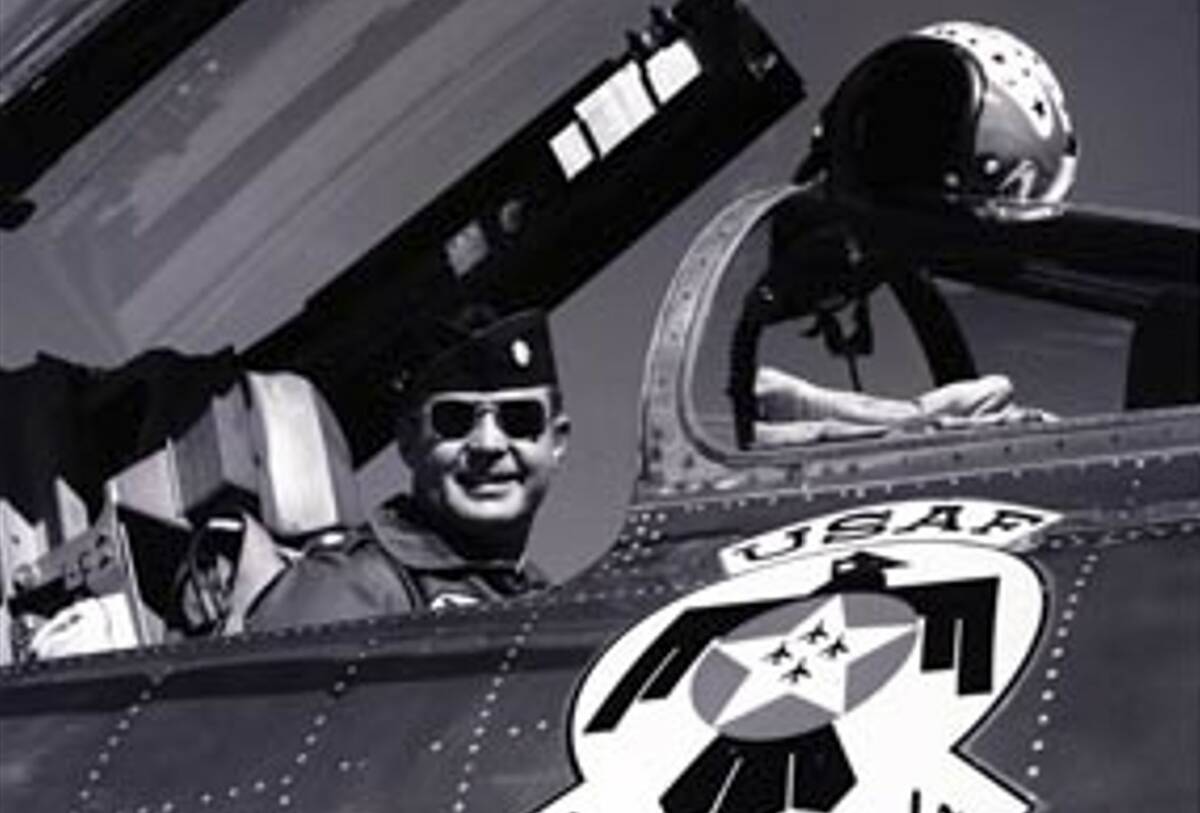
Longtime Las Vegas resident Neil Eddins, a decorated Vietnam combat pilot who rose from enlisted airman to Air Force major general and commander of the Thunderbirds, died last month, his family said. He was 94.
Retired Air Force Gen. Merrill McPeak, who flew under Eddins while serving in the Air Force Thunderbirds in the late 1960s, said Eddins rose through the Air Force the hard way.
“Nothing was ever given to him. He was a self-made man,” McPeak, now 90, said.
Eddins died peacefully at a care home near Las Vegas on June 26, his son, Craig Eddins, said in an interview with the Las Vegas Review-Journal on Tuesday.
Humble beginnings
Neil Eddins was born in 1931 on his family’s homestead ranch in Thayne, Wyoming — about 70 miles south of Grand Teton National Park. He graduated from Star Valley High School in 1950.
After high school, Eddins attended the University of Wyoming for one semester before enlisting in the Air Force in February 1951 as an air policeman, guarding aircraft on the flight line. He later rose to the rank of sergeant before entering the Aviation Cadet Program in 1954, a transition that shifted him from ground training to combat pilot training.
Eddins began his first operational assignment in June 1954 with the 452nd Fighter-Day Squadron at Foster Air Force Base, Texas.
Following stints as an instructor pilot in Morocco and as a flight commander in Virginia, Eddins joined the U.S. Air Force Fighter Weapons School at Nellis Air Force Base in May 1959. He worked as an instructor pilot and operational test and evaluation pilot at the school. He also became the slot man for the Thunderbirds, the Air Force’s aerial demonstration team, in 1959 and was on that team until April 1961.
Eddins met his wife, Las Vegas native June Gravelle, in 1958 in the valley during a temporary duty assignment at Nellis Air Force Base. The couple married on New Year’s Eve that year at the now-closed Tropicana. Eddins’ military career would remain closely tied to Las Vegas, where he served multiple assignments and eventually made his home.
Command and combat
During the Vietnam War, Eddins flew 100 combat missions over North Vietnam between July 1966 and November 1966. In one mission in July 1966, he led a strike that destroyed a heavily guarded bridge near Hanoi, navigating intense anti-aircraft fire and missile threats without the loss of a single aircraft or pilot. He was awarded the Silver Star for his actions, and he returned to Nellis later that year.
In early 1967, he took command of the Thunderbirds, serving as the team’s lead pilot.
While still serving in the Air Force, Eddins earned a bachelor’s degree in political science from Shippensburg University of Pennsylvania, graduating with honors in 1973.
Over time, his responsibilities expanded beyond demonstration flying. He went on to lead operational units and take on senior command roles — including serving as chief of the U.S. Military Training Mission to Saudi Arabia — before retiring.
McPeak, the retired Air Force General, said that by the time Eddins reached senior leadership, he had already experienced nearly every level of service. He added that his leadership style was direct and consistent throughout his career.
“He was dead honest,” he said, adding that Eddins had “a great sense of humor.”
Later life
Eddins retired from the Air Force in 1984 as a major general.
Las Vegas remained his primary home after retirement, according to his son, although his work later took him to Europe, where he lived for several years.
He later worked in military aircraft sales at McDonnell Douglas, which became Boeing. About three years after retiring, he was sent to Switzerland, where he lived for about ten years, selling military jets to that country’s military.
Even in retirement, his family says he stayed connected to the Air Force community, mentoring younger pilots and remaining active with Thunderbird alumni. And during much of his retirement, he and his late wife, June, split their time between Las Vegas and Star Valley Ranch, Wyoming, near his hometown of Thayne.
His son, Craig Eddins, said that even outside of the Air Force, he was known for his steady leadership style and straightforward approach.
“He was fair, honest and hard-working,” he said.
Craig Eddins added that after his father died, countless people contacted him and said he was the greatest boss they ever had.
Memorial services will be held Aug. 14 in Afton, Wyoming, according to his family.
Contact Lucas Hellberg at lhellberg@reviewjournal.com.