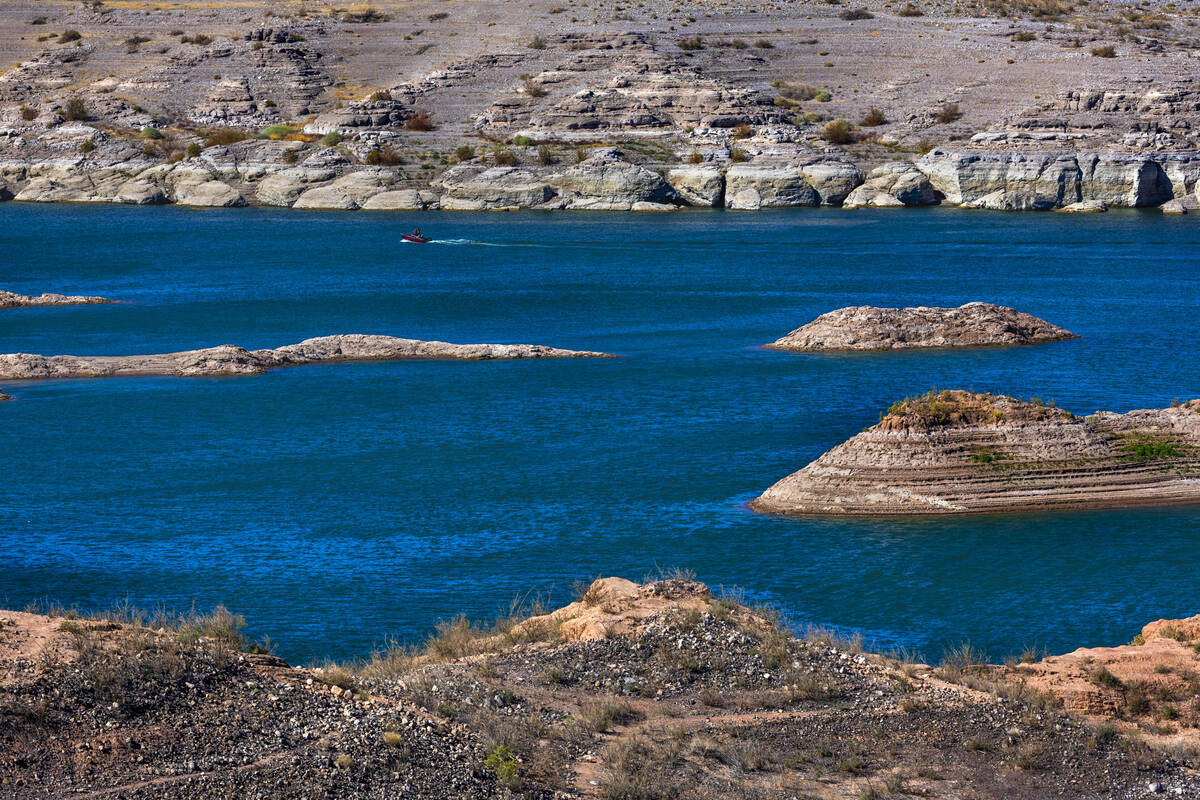
LOS ANGELES — A major Southern California water agency has struck a deal with federal officials to boost water levels in Lake Mead, part of a broader effort to keep the country’s largest reservoir from reaching critically low levels — at least for a while longer.
The Metropolitan Water District of Southern California’s board of directors approved an agreement in which the U.S. Bureau of Reclamation will pay the agency to leave up to 200,000 acre-feet of water from the Colorado River in the reservoir, or enough to serve about 600,000 households.
It’s one of several partnerships in California, Arizona and Nevada that will conserve close to 700,000 acre-feet in the artificial lake near Las Vegas, said Bill Hasencamp, manager of Colorado River resources for MWD. Some see the effort as a stopgap as longer-term solutions are worked out.
Following an exceedingly warm year that has left the Colorado River’s headwaters in the Rocky Mountains largely snowless, Lake Mead is nearing a record-low level. If the water level drops too low, it could slash hydropower generation by 70% at Hoover Dam, a key electricity supplier to the Southwest, according to MWD.
“Protecting Lake Mead’s water levels and mitigating the loss of hydropower generation at Hoover Dam requires timely, collaborative action and we value the proactive partnership we have with Metropolitan Water District,” said Genevieve Johnson, acting regional director for the Reclamation Bureau’s Lower Colorado Region, in a statement.
By December, MWD’s deal will add three feet of water to the reservoir, according to Hasencamp. Per the terms, the federal agency will pay MWD up to $65 million for the water, or $325 per acre-foot. Each acre-foot is about 326,000 gallons.
“It’ll buy us time,” Hasencamp said. “Three feet is not a drought buster — it’s not going to refill the reservoir — but it will mean Lake Mead stays above critical levels for a bit longer.”
Consensus among weather experts is that an El Niño climate pattern is brewing, with a high chance of being very strong. That might bring an infusion of rain and snow this winter, replenishing Lake Mead. “Mother Nature might come to the rescue here,” Hasencamp said.
MWD also approved agreements that will allow federal officials to pay the Quechan Tribe and Bard Water District to send up to 19,000 acre-feet of conserved agricultural water to the lake in 2027 and 2028.
That’s expected to add around another foot to the lake, with all deals across the three states projected to eventually boost it by about 10 feet, Hasencamp said. Federal officials are compensating partners using funds from the 2022 Inflation Reduction Act, he said.
Yet those contributions might end up just slowing the decrease in water levels, he added.
As of Wednesday, the lake sat at close to 1,043 feet above sea level, or only two feet above the record low set in 2022. While a subsequent wet winter brought it back up 20 feet, it’s been dwindling since. This year the decline has been fast, and Hasencamp believes it will reach a new record low by the end of the month or early next month.
According to Hasencamp, the billions of gallons his agency is leaving in Lake Mead this year won’t mean less water for the 19 million people it serves.
MWD receives water from the Colorado River and the Sacramento River, and a May snowstorm in the Sierra Nevada bumped up its overall supplies, he said.
“We could either store it in one of our systems for later use or sell it to the feds to help out Lake Mead,” he said of the 200,000 acre-feet. “And we decided it was more prudent to do the latter and add the water to Lake Mead to benefit the whole Southwest.”
In a news release, MWD Board Chair Adán Ortega Jr. said the action greenlit Tuesday was made possible by “investing in diverse water supplies, incentivizing conservation and capturing and storing water whenever it’s available.”
Yet MWD general manager Shivaji Deshmukh described it as a temporary solution.
“[W]hile these agreements provide important near-term support, lasting progress will require long-term solutions,” he said in a statement. “If we all commit to reducing our use, we can avoid deeper cuts and create lasting change that will benefit future generations who rely on the Colorado River Basin.”
The Reclamation Bureau’s Johnson similarly suggested the work is ongoing: “Long-term stability for the Colorado River depends on continued conservation, thoughtful planning and ongoing cooperation across the basin.”
Seven states rely on water from the Colorado River, and guidelines that include how they operate Lake Mead will expire at the end of September, Hasencamp said.
California, Nevada and Arizona have committed to reduce how much they take from the river by 1.25 million acre-feet next year, but an agreement among all states has not been reached — and is not expected to be by the time the guidelines expire, he said.
Instead, he said, the federal government is preparing its own two-year plan for the states, which is likely to arrive in the coming weeks.