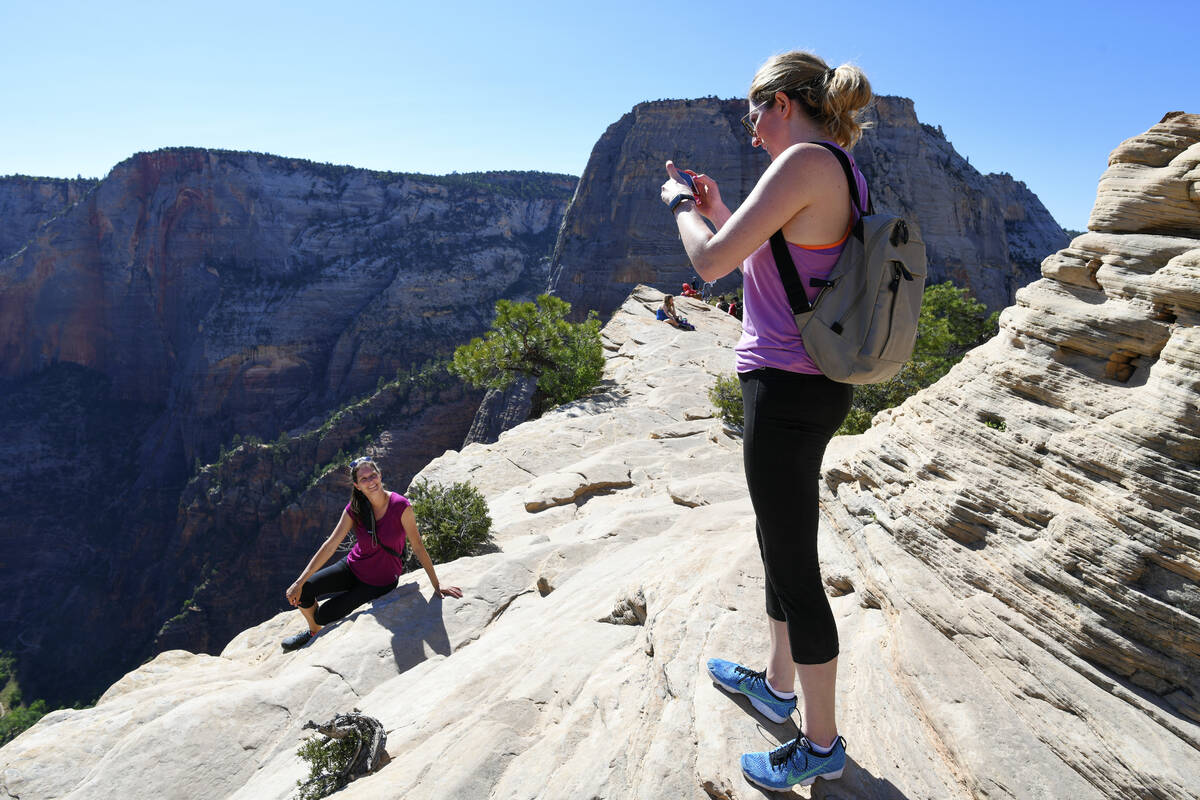
The roughly 1,500-foot elevation gain up to the summit of Angels Landing is enough to frighten even the most experienced hikers. It’s a long fall to the bottom.
Twenty years ago, New York-New York casino cocktail waitress Bernadette Vander Meer, 28, made it all the way to the highest peak with her husband before, according to him, she fell to her death. At the time, David Vander Meer told investigators he was preparing to take her photo when she went over the edge, according to an affidavit.
When they asked if he had been unfaithful, he said no. What David Vander Meer didn’t mention was that he was deep into an affair with a woman that had started years prior, when she was underage.
According to Bernadette Vander Meer’s mother, her daughter had told him she was considering breaking off the marriage.
Yet the trip to Zion National Park in southwestern Utah had been planned to celebrate the couple’s upcoming 10-year anniversary.
“It’s not just about opportunity, it’s about motive,” said Randi Minetor, author of the 2017 book “Death in Zion National Park,” in an interview. “Why would Bernadette’s husband have pushed her off of Angels Landing? I don’t think they ever found anything that would make them think that was a possibility.”
Minetor’s passage about Bernadette Vander Meer declares that readers will never know what really happened. Rather, all that could be deduced is that she fell into the canyon.
That narrative changed this week in a big way. Authorities alleged that David Vander Meer, a Las Vegas school counselor who turned 49 in jail on Wednesday and died on Thursday, intentionally pushed her.
Las Vegas police declined all interview requests related to David Vander Meer’s death in their custody. They have said only that a 49-year-old male inmate was taken to a hospital Wednesday to be treated for “self-sustained injuries” and was pronounced dead on Thursday.
The affidavit, penned by Washington County attorney’s office Lt. Investigator Jessica Bate and released Tuesday, has renewed a nationwide fascination with the perilous trail, after authorities took a deeper look into the circumstances of the Vander Meer death and other fatalities at Angels Landing since 1987. In short, Bate determined that the husband’s story didn’t add up.
Officers who worked in the park considered the location of the fatal fall “very unusual, as accidents don’t usually happen there,” Bate wrote. “An officer recalled David’s statements and demeanor to be ‘contrived.’ Another officer stated the incident seemed strange because it was far too convenient — the location, the time of morning and no witnesses.”
Reached by phone, attorney’s office spokesman Philip Soelberg declined to share how Bate evaluated the suspiciousness of each death. He could not confirm whether other old cases may be reopened.
All Soelberg could offer is that “other cases were looked at.”
It comes at a time, too, when the Interior Department is now barring employees from confirming deaths or details about severe injuries for the media, according to an internal memo reviewed by The Washington Post. Only “appropriate authorities” can do so after conferring with park staff and notifying next of kin, the memo states, breaking from longstanding practice.
According to a 2025 study, there had been 17 hiking fatalities at Angels Landing as of 2024. Bate’s affidavit also referenced 17 deaths there, and another hiker died this year.
Affidavit: Two other cases suspicious
Supposed homicides in national parks are not without precedent, and some cases have eerie similarities to that of the Vander Meers.
With most cases, concrete evidence that can secure a murder conviction is hard to come by.
In 2010, a jet skier rescued Glenn Moss’ wife after he pushed her off a cliff at Nelson’s Landing above Lake Mohave. Moss initially faced an attempted murder charge, but his lawyers negotiated a deal in which he pleaded guilty to a misdemeanor assault conviction that came with five years of probation.
One Zion death, mere miles away from Angels Landing, could have been a parallel to the Vander Meer case.
Patricia Bottarini fell to her death in 1997 at Observation Point, a less exposed trail. Deaths were and continue to be a rarity on this particular trail, investigators noted, and a curious blood mark raised eyebrows but was later disputed by forensic experts, according to Minetor’s book.
Prosecutors and some family members were certain that her husband killed her, and relatives later sought to exclude him from inheriting her estate. Federal prosecutors did not have the legal authority to pin a murder charge on James Bottarini, and the state ultimately never tried to, either.
In a federal case five years after her death, prosecutors argued that he was a serial gambler on his trips to Las Vegas who wanted to cash a life insurance check to settle his debts. A jury acquitted him of four counts of mail fraud, one of making false statements to an officer and one of interstate domestic violence, the latter of which could have carried a life sentence.
In Bate’s affidavit, she wrote that two other deaths thought to be accidental falls raised red flags. Both occurred close to where Bernadette Vander Meer might have been pushed.
The two other deaths at Angels Landing declared suspicious were far apart in timelines, the first in 1989 and the other in 2019. The 1989 case involved Jeffrey Robert Dyer, 28, who fell to his death on a hike with his wife and child, according to the affidavit. Authorities found blunt force trauma injuries to his head and body, and they investigated it as a possible homicide.
Pradeep Beryl, described as an experienced hiker, took off work to hike Angels Landing in 2019 and was not answering his phone, Bate wrote. Witnesses saw it happen but heard no yell as he fell to his death.
As for the other deaths, Bate identified two as suicides, while the remaining 12 were accidental.
Are national parks ‘the perfect crime scene’?
Considered one of Zion National Park’s crown jewels, the Angels Landing trail was constructed in 1926.
What officials didn’t consider in its initial design, says Bowling Green State University professor Travis Heggie, was that people could die there without precautions. Heggie is the lead author of a 2025 study that identified 17 fatalities at Angels Landing, now a known hot spot for deaths.
It wasn’t until the 1950s or 1960s when guardrails were added to the 5.4-mile out-and-back trail, according to Heggie’s study, and in 2010, officials installed some 180 feet of chains and 60 posts. As of 2022, to avoid overcrowding, a permit is required for all hikers.
“It doesn’t surprise me,” Heggie said of the Vander Meer case. “People go missing in national parks all the time. They’re almost the perfect crime scene.”
Heggie agrees with investigators that a pure fall at the highest point of the trail is unlikely without other contributing circumstances. That portion is flatter than the rest and has much more surface area, he said.
Minetor said the Angels Landing trail is notoriously strenuous. She refers to a certain point before extreme altitude gain as “chicken-out point,” where many hikers decide to turn around.
One case that sticks out where risky behavior led to an unnecessary death is the case of Kris Jones, 14, who was dared by his Boy Scout troop members to climb down off the main trail and fell some 1,000 feet to his death in 2004.
“Every death in the national park is tragic, but some of them are more tragic,” Minetor said.
In an emailed statement, after declining an interview request, a Zion National Park spokesperson who didn’t provide a name said officials are diligent about maintaining the trail and temporarily closing it when necessary. Each incident requires a different response, the spokesperson said, but the park service’s goal is to provide timely medical care, evacuate injured visitors and protect first responders.
Transparency challenges persist
With the National Park Service’s reported policy change to conceal information about deaths, it is already harder for the public to learn of deaths when they happen. The agency did not issue a news release when a 23-man died at a waterfall in Yosemite National Park on June 20, nor did it when a 17-year-old girl drowned in a river at Sequoia National Park the previous day.
A lack of transparency is nothing new in the national parks system, Heggie said.
In the early 2000s, Heggie said, he was the National Park Service’s first-ever public risk management specialist and tort claims officer, and he evaluated cases like the Bernadette Vander Meer death for potential civil liability. At the time, Heggie said, Zion National Park did not turn over the incident report when he asked for it.
The Vander Meer report was left off of the documents delivered per a Freedom of Information Act request he made for his later research, too, Heggie said. Minetor, the author, said that because of a lack of cooperation from park officials, her books are often based on media accounts and, increasingly, social media.
“The park service has a culture of secrecy,” Heggie said. “They don’t realize they’re a public agency, and that information is public in a lot of situations. They also have a reputation of bad record-keeping.”
Both Heggie and Minetor said it’s often difficult to determine, based on incident reports or media accounts, whether a death should be considered a homicide. Heggie believes Utah investigators are on the right track and should continue to comb through past incidents at Angels Landing.
The two experts say deaths shouldn’t be a reason to turn people away completely from Angels Landing.
“What I always tell people: Trust your gut,” Minetor said. “If you’re looking at that and thinking, ‘I can’t do it,’ you probably shouldn’t. If you don’t feel comfortable, don’t put yourself in that position, because people do die up there.”
If you’re thinking about suicide, or are worried about a friend or loved one, help is available 24/7 by calling or texting the Lifeline network at 988. Live chat is available at 988lifeline.org.
Contact Alan Halaly at ahalaly@reviewjournal.com. Follow @AlanHalaly on X.