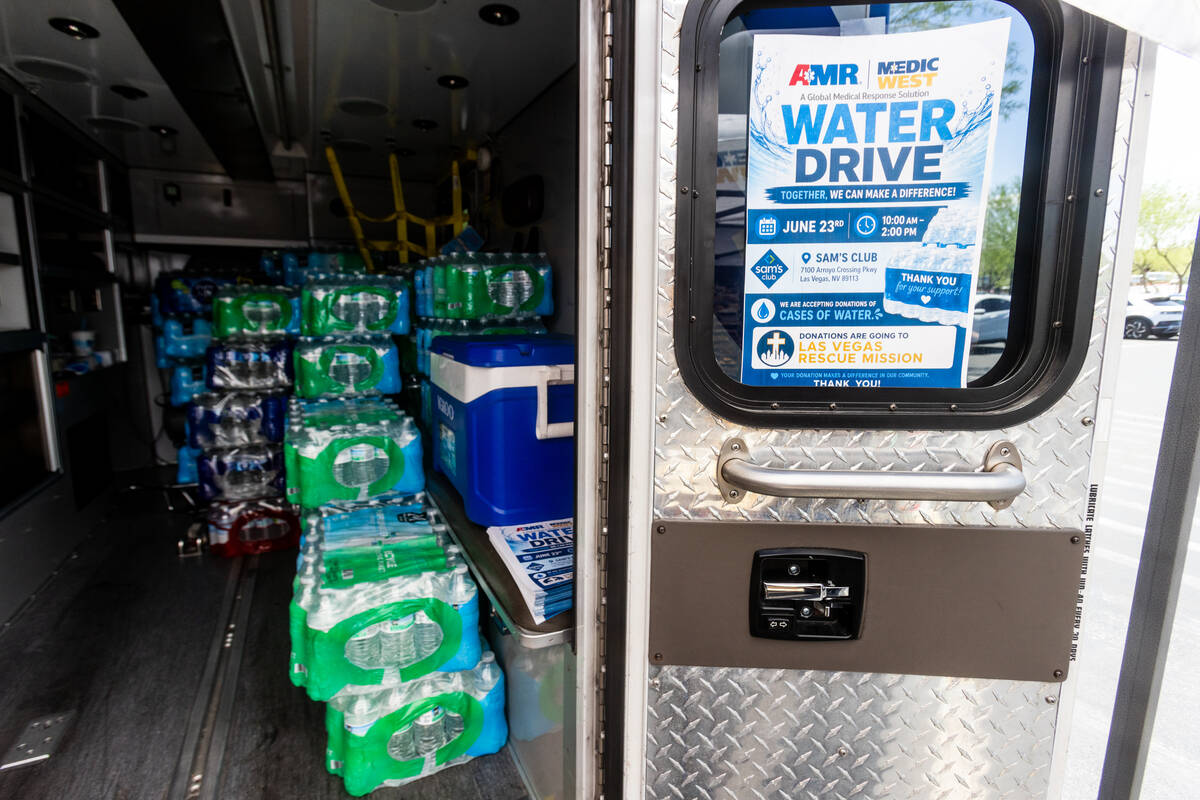
It’s hot enough to kill in Las Vegas this summer, and one company is stepping up to help a vulnerable population stay hydrated.
Outside a Sam’s Club at the southern tip of Spring Valley, one of the valley’s three private emergency responders on Tuesday collected an ambulance full of water to deliver to the Las Vegas Rescue Mission homeless shelter.
Mike Whitehead, AMR’s clinical manager, said in an interview that access to water, shade and air conditioning is crucial to staying safe in the heat. In very hot summers, his company’s crews are often the first on the scene, starting people on intravenous fluids, dousing them in ice baths and blasting portable air conditioning units.
“When it comes to dealing with patients in the summer, most everybody in the Las Vegas area is dehydrated to some level because of the arid environment,” Whitehead said. “That is already starting the process of a heat-related incident.”
Extreme heat in Southern Nevada can morph into deadly heat illness fast, and risk factors such as old age, drug use and homelessness compound the dangers. The Clark County coroner’s office investigated more than 800 heat-related deaths over the past two years, with 2024 marking the deadliest summer on record.
According to the Southern Nevada Health District, at least 26 percent of those deaths in 2025 and 34 percent in 2024 were homeless people, though experts say a heat death can happen to anyone.
Las Vegas consistently ranks as the nation’s second-fastest-warming city, and efforts are underway to dedicate local, state and federal resources to preventing heat-related deaths. One state assemblymember has said she will propose a bill in 2027 to create a statewide heat office in charge of obtaining hard-to-get funding and directing emergency response.
Symptoms vary between heat exhaustion and heat stroke, Whitehead said. Heat exhaustion corresponds to clammy skin, dizziness, headaches and muscle cramps, while heat stroke ventures into loss of consciousness, unresponsiveness and even seizures or death in the worst cases.
“It’s dangerous for the brain, and it’s dangerous for the body to keep functioning,” Whitehead said.
‘Little things go a long way’
One of the donors who helped fill the ambulance Tuesday was James Dunlap, who said he runs a catering business nearby and gave two full cases of water bottles.
Dunlap said he often carries water bottles with him to give to the homeless who may be struggling to stay cool. When he saw AMR staff at the front of the grocery store, Dunlap said it was the least he could do to help others.
“Any time we can give back, we should try to do what we can,” Dunlap said. “The little things go a long way.”
Whitehead said the amount of heat-related calls his team responds to often directly correlates to how extreme the summers are. In 2024, the hottest summer on record where the all-time 120-degree reading was set, daily highs stubbornly sat in the triple digits for weeks on end with little relief in the nighttime.
“Once we start hitting 100 degrees, it’s hot, but it’s still remotely comfortable,” Whitehead said. “When we start hitting the 110s and one-teens, those are the extremes that you really have to be aware of.”
Whitehead is banking on the upcoming El Niño season to provide the Las Vegas Valley with more cloud cover and cooling monsoon season rains, he said.
Some measures residents might consider to protect themselves from the heat include taking advantage of dedicated cooling stations throughout Clark County, moving outdoor exposure to the sun to early morning or late hours and avoiding direct sunlight as much as possible.
Contact Alan Halaly at ahalaly@reviewjournal.com. Follow @AlanHalaly on X.