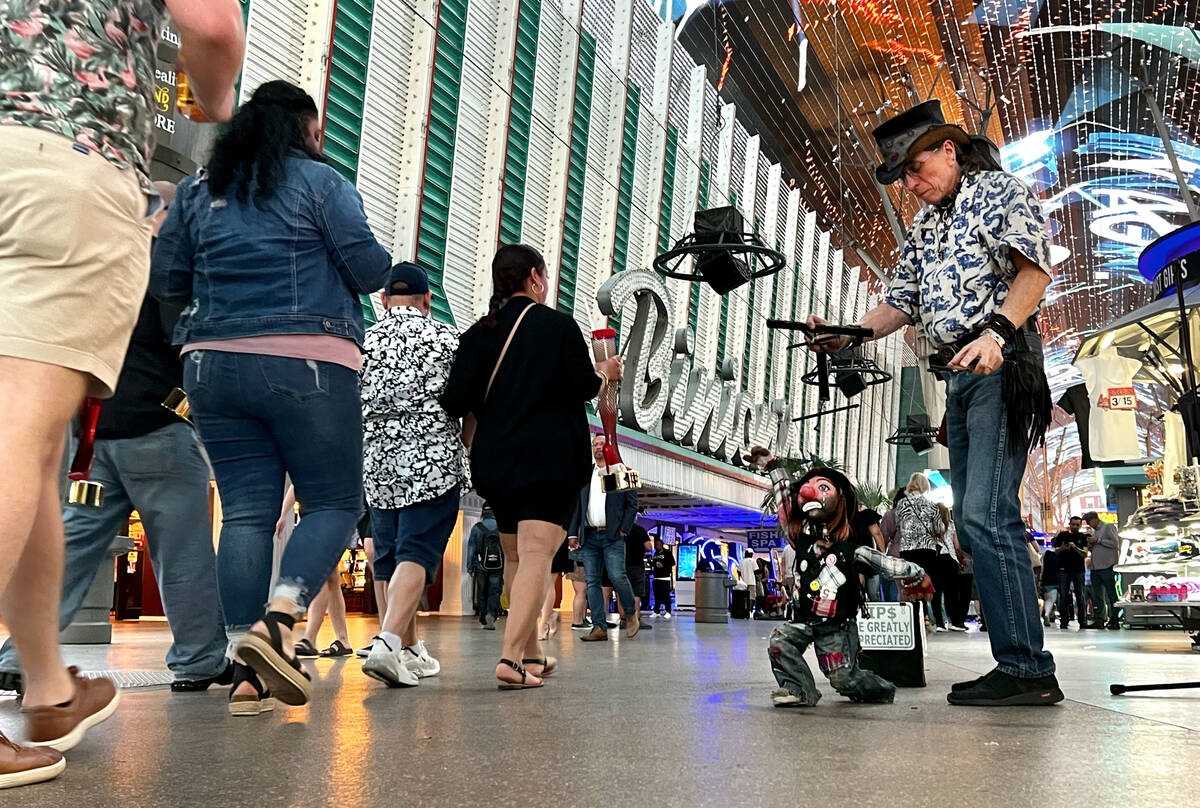
Jared Crawford said he has entered the lottery to secure a place to perform on the Fremont Street Experience every day since the lottery system for busking was established in 2015.
But Crawford, a bucket drummer, said he’s only won a spot once or twice.
“It’s broken — that’s what I’m telling you,” he said. “The system is broken.”
Crawford joined around 40 other community members on Monday afternoon for a town hall to discuss proposals to improve the lottery registration and performance circle system that currently dictates the bounds of expressive performance on the five-block pedestrian mall.
Under the current system, street performers are confined to one of roughly three dozen six-foot circles painted on the pavement. Performers register with the city and are randomly assigned performance spots for two-hour windows through a daily lottery system.
More than 10 years after the city established these rules, officials are weighing changes aimed at curbing fraud and improving enforcement, reigniting long-standing tensions over how expressive activity on Fremont Street should be regulated.
City Council unanimously approved the current rules in September 2015, after facing pushback from buskers who said the ordinance would threaten their livelihood.
According to the city’s website, the program is intended to manage the time and place performances occur from 3 p.m. to 1 a.m. to ease congestion and assure public safety.
City Attorney Jeff Dorocak gave a brief presentation Monday in which he outlined a series of concerns with the system and potential strategies to address these issues.
“We’re here to work together and find a way to come up with some ideas that we think will help make that pedestrian mall enjoyable again for everybody,” Dorocak said.
Several of the city’s proposals were relatively uncontroversial. For instance, Dorocak said the current system presents enforcement challenges, and he proposed creating a civil enforcement alternative to criminal prosecution.
However, attendees repeatedly voiced additional concerns relating to alleged fraud in the lottery system. Several street performers claimed that some individuals and groups are able to register numerous times, while others actively sell and barter for the in-demand permits.
Toney Foote, a Michael Jackson impersonator, criticized what he perceives as inconsistent enforcement of the rules that govern expressive performance on Fremont Street.
“When I did the moonwalk, barely out of the circle, I got a citation,” Foote said. “But you have random people out there that are on camera that will literally sit there and sell a circle right there in front of their face, and they’re not getting a citation.”
Two suggestions in particular received the most attention: one would require street performers to have an access card featuring their photo, while another would require performers to audition or pay a fee to enter the lottery.
While the two proposals generally received support from the assembled street performers, Athar Haseebullah, the executive director of the American Civil Liberties Union of Nevada, at times interjected to assert that the ACLU would staunchly oppose these changes as he said they would be unconstitutional.
“If the city wanted to do that, I’ll have a lawsuit ready for them in 24 hours and I’ll win that one,” Haseebullah said.
The Fremont Street Experience has long been the subject of a debate on free speech. Since street performing is protected under the First Amendment of the U.S. Constitution, the city’s efforts to enact more restrictive rules regarding entertainment on the pedestrian mall have been struck down in court.
Still, Dorocak said that after reviewing the feedback from Monday’s meeting, the city could feasibly bring proposed changes to City Council for a vote.
Throughout the meeting, several attendees spoke to the value the performers bring to Fremont Street and the city as a whole. Attendee Heidi Giffin said this underscored the necessity for reform.
“This is what people are coming to Las Vegas to see, and it’s very disappointing for tourism, and for us too,” Giffin said.
Contact Sophie Baker at sbaker@reviewjournal.com.