A piece of Nevada’s prehistoric past is taking center stage in the nation’s capital.
On Thursday, the Smithsonian National Museum of Natural History in Washington D.C. opened its “From These Lands: Sharing Our Natural and Cultural Heritage” exhibit celebrating the upcoming United States semiquincentennial.
The exhibit, which will run through December 2029, features more than 600 specimens and cultural objects — many of which are rare and have never been displayed — from all 50 states, the District of Columbia, Puerto Rico, Guam, the U.S. Virgin Islands, American Samoa and the Northern Mariana Islands.
“This exhibition brings the entire country into one gallery, letting visitors encounter the extraordinary breadth of America’s natural and cultural heritage,” said Kirk Johnson, the museum’s director, in a news release. “As the country marks its 250th anniversary, ‘From These Lands’ presents an opportunity to celebrate the diversity of our landscapes, the depth of our history and the connections that link people and the natural world across borders.”
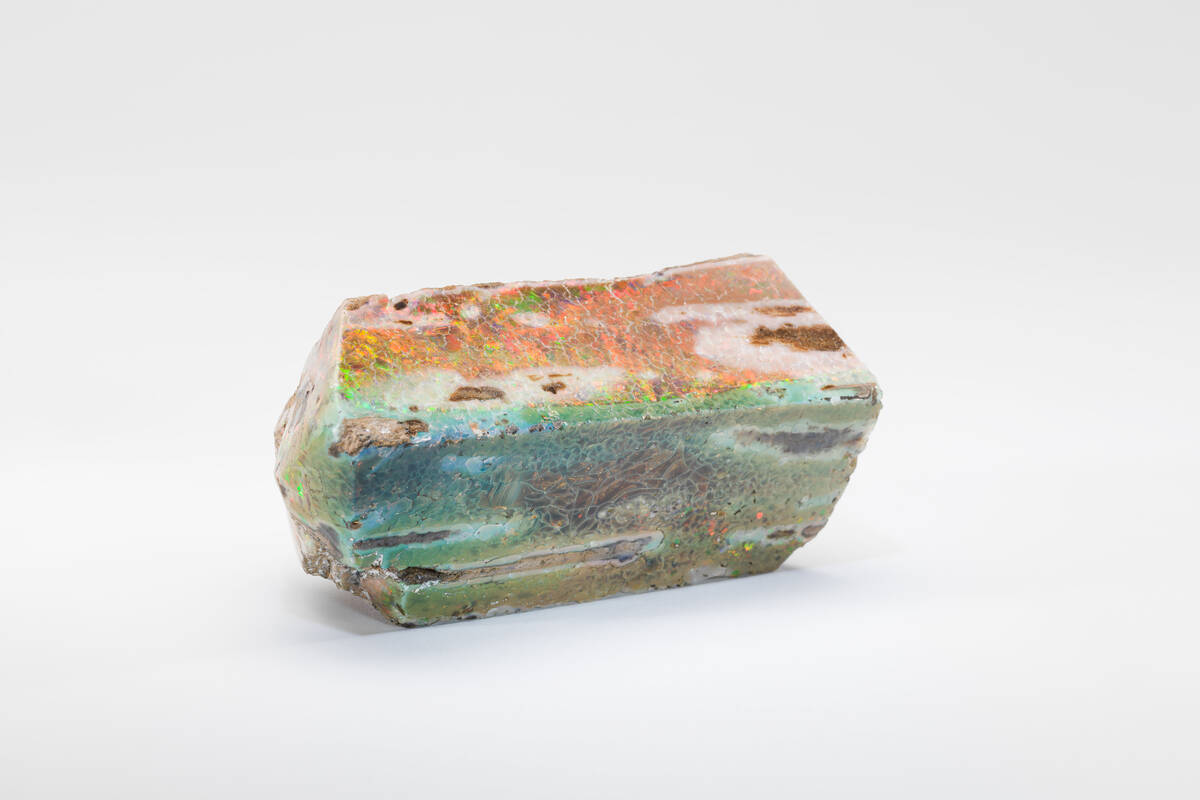
Nevada’s contribution to this patriotic exhibit includes seven objects, highlighted by the Silver State’s official precious gemstone: the Virgin Valley black fire opal.
This gemstone is incredibly rare, found only in Nevada’s northern Virgin Valley, in Humboldt County near the Oregon border, and New South Wales in Australia.
It formed in Nevada 17 million years ago as a result of an interaction between hydrothermal fluids and buried wood, according to Simon Jowitt, director of Nevada Bureau of Mines and Geology at the University of Nevada, Reno.
Just like all precious opals, the Virgin Valley black fire opal displays play-of-color, defined as a “display of spectral colors due to the diffraction of light as it passes through organized, submicroscopic spherical particles” by the Gemological Institute of America.
In 1917, The Roebling Opal, a 1.5-pound, 2,585-carat piece of black fire opal discovered in Virgin Valley and renowned for vivid blue and green flashes, was donated to the Smithsonian — though it is not the gemstone displayed in the recently-opened exhibit. Towards the end of the century, in 1987, the Virgin Valley black fire opal was declared Nevada’s official precious gemstone.
The other six objects from Nevada displayed in the exhibit include a twinned gold crystal, a Great Basin bristlecone pine, caddisflies in adult and larva cycles and rodent bot flies in adult and pupa cycles.
Contact Alex Streinger at astreinger@reviewjournal.com.