A retired seismologist who spent his career studying the potential for major earthquakes said a temblor that shook Las Vegas earlier this month is a reminder we live in an active earthquake area, with a much larger earthquake impacting the Las Vegas Valley a real possibility.
Jerry King, of North Las Vegas, specialized for nearly 40 years in studying strong earthquake ground motions and seismic hazard analysis, with a focus on risk at nuclear facilities. He worked for years on the proposed Yucca Mountain repository project for storage of used nuclear fuel rods deep in the ground at the Nevada National Security Site.
King said the 3.8 magnitude temblor epicentered at Red Rock Canyon on June 4 “wasn’t a surprise.”
“It’s only a surprise in that earthquakes this size happen here maybe once every 10 years or so, but in terms of the regional geology, it is completely expected,” King said.
The Las Vegas Valley could, however, one day experience a major earthquake, he said, with a significant threat found in the ground at Frenchman Mountain.
“The biggest fault by far, the most dangerous fault, is the Frenchman Mountain fault that runs along the base of Frenchman Mountain,” King said. “There’s no question it is geologically active. You can walk up and look at it. It is exposed in road cuts. It is probably capable of a 7 to 7.5 earthquake.”
The most likely source of strong shaking in the Las Vegas Valley would come from the west, he said.
“In California, along the Death Valley Furnace Creek fault zone, it is capable of a magnitude 8 earthquake,” King said. “That would cause pretty strong shaking in Las Vegas.”
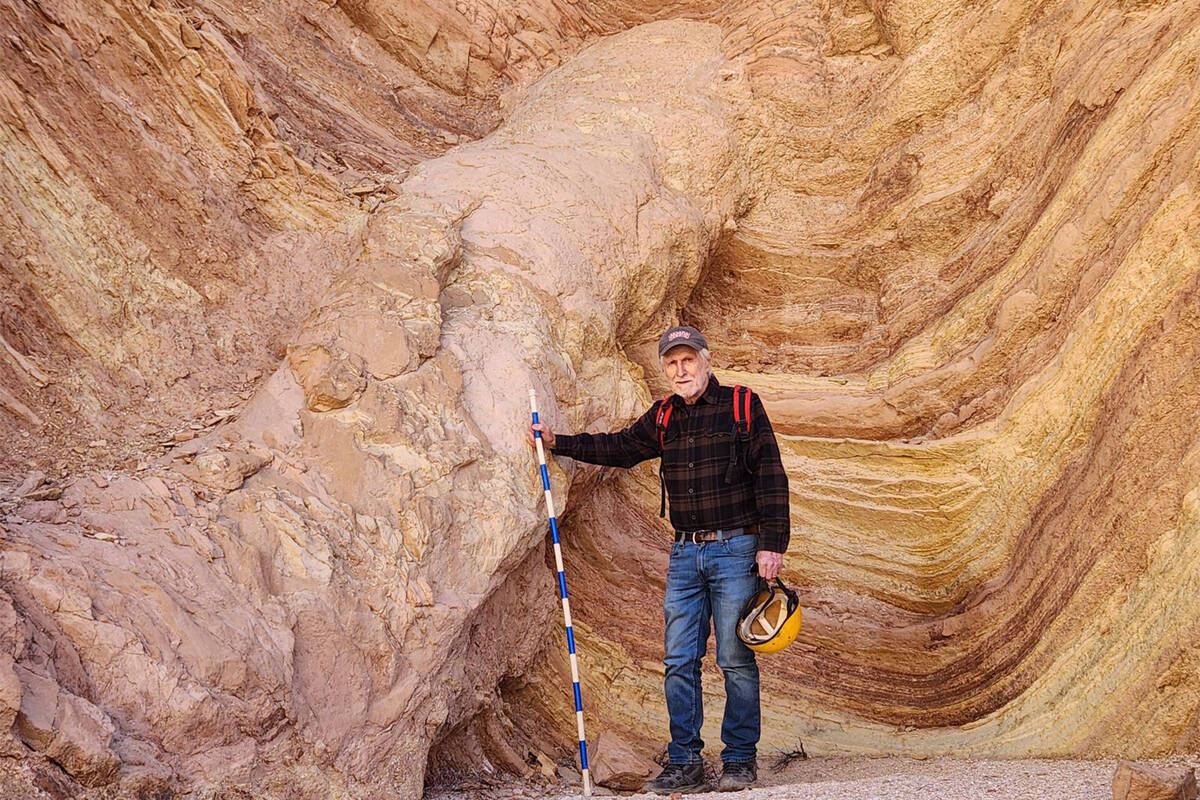
King and UNLV Professor Emeritus of Geology Steve Rowland recently authored a scientific paper about an intriguing, earthquake-caused geological structure — known as a clastic pipe — which was identified by avid hiker and geology enthusiast Jeffrey Cuneo near Lake Mead. The paper was published in May in the scientific journal Geology of the Intermountain West.
The structure was created by a significant earthquake with origins in the Las Vegas Valley sheer zone, which is north of the valley, millions of years ago. The earthquake forced a watery, silty solution out of the earth, creating a formation that over time lithified into hard rock that is harder and more resistant to erosion than surrounding sediment.
The pipe is near a popular hiking trail known as Anniversary Narrows, within a few miles of Lake Mead.
“It is like a column that sticks up out of the ground,” Rowland said. “There are several examples up in Utah that have been very well studied, but we’ve never seen them before in Southern Nevada. It is a feature triggered by shaking.”
King said he believes structures in the Las Vegas Valley have a good chance of withstanding a strong earthquake. This is largely because Clark County has stringent building codes mandating construction meet rigorous requirements aimed at limiting earthquake damage.
“The high-rise structures on the Strip, steel frames, they are designed to withstand earthquake motion,” King said. “They will sway a lot and people will be scared, but the buildings aren’t going to fall down. Our single-family homes, with construction and building codes, require plywood be nailed to the vertical joists. When you nail plywood to those vertical joists, you create a very strong sheer wall.”
King said that “newer homes are pretty earthquake resistant.”
“It is certainly possible there will be disruptions to gas lines and water lines and optic cables,” King said. “It would be very disruptive. No question.”
He said if the big one does strike, there will probably be little if any warning.
“We are talking thousands to tens of thousands of years for major earthquakes on our local faults, compared to hundreds of years in California,” King said. “But, there’s no telling when the next earthquake is going to be. It might be 5,000 years from now. It might be tomorrow.”
Contact Glenn Puit at gpuit@reviewjournal.com.