Under no projections for global temperature rise can the United States supply the amount of water demanded by lithium mines proposed across the nation, a new study has found.
Since the price of lithium spiked to a record high in early 2023 and politicians zeroed in on weaning the United States off its dependence on China for minerals, 22 projects have emerged that are at varying stages of federal review.
The researchers, who analyzed public mine proposals and available data, say declining water availability is a problem in rapidly warming and water-starved states like Nevada, the driest in the nation with the country’s two fastest-warming cities.
“The need for holistic water planning for the nation is really important,” said Jennifer Dunn, a study author and Northwestern University engineering professor. “It’s not very well done in the U.S., and now that’s impacting our ability for a secure mineral supply chain.”
The study, published at the end of last month in the peer-reviewed journal Communications Earth & Environment, contends that water is the ultimate limiting factor to lithium mining, said Dunn, director of the university’s Center for Engineering Sustainability and Resilience. Lithium is a key component for batteries, especially those used in electric vehicles.
Nevada has been at the heart of the boom for the better part of a decade. It is home to two fully permitted mines under construction, as well as Silver Peak, the country’s only operational lithium mine, in Esmeralda County, the state’s most sparsely populated county, located halfway between Las Vegas and Reno, with about 1,000 full-time residents.
Most proposed lithium mining hot spots are in the West, with a few exceptions, such as a relatively new deposit called the Smackover Formation that spans from eastern Texas to the Florida Panhandle. Dunn said the study should be a warning to mining companies that still have the chance to explore how to reduce their water use.
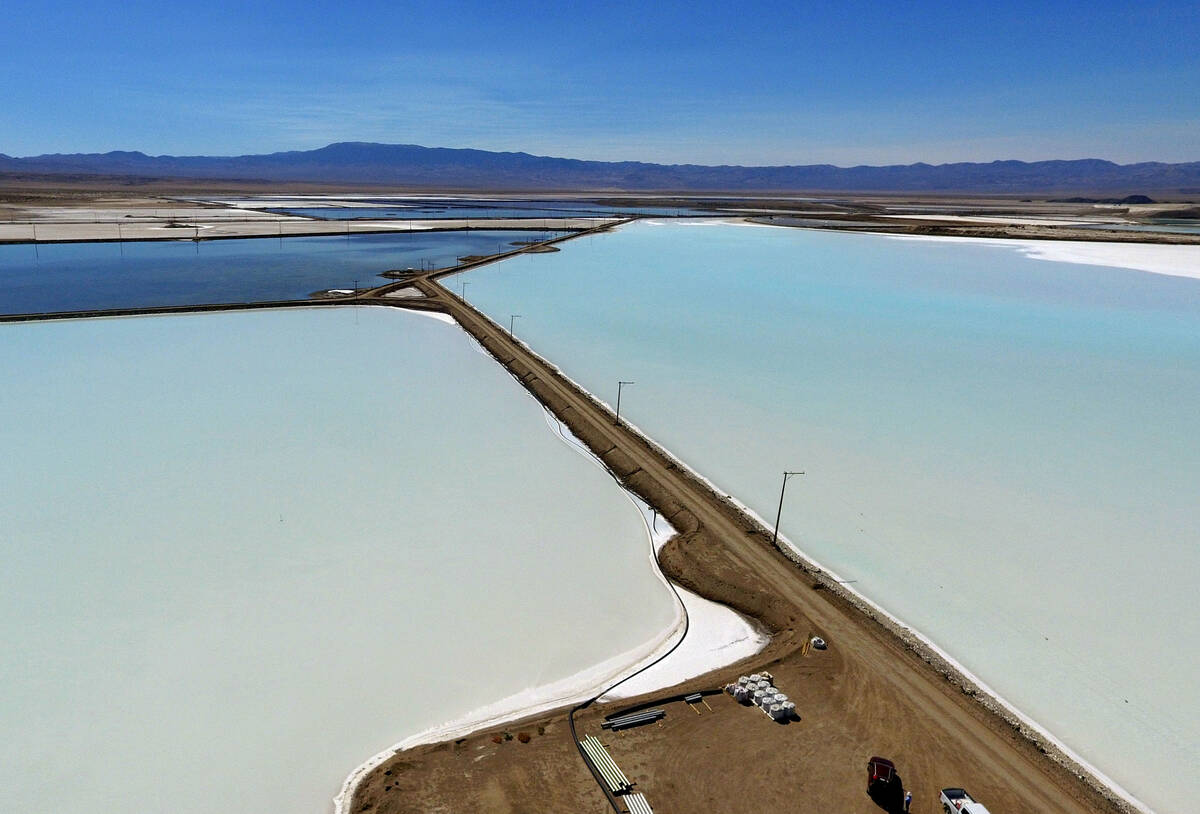
Lithium mining is water-intensive, though use is dependent on the method used and the chemistry of the deposit. Lithium from brine deposits is often produced by letting minerals dissolve in huge evaporation ponds, while lithium from hard-rock or clay deposits uses water and chemical processing.
“What we try to do with this type of work is identify where things could go wrong when we still have a chance to do something about it,” Dunn said.
At least two lithium mines on the way
In addition to Silver Peak, two fully permitted lithium mines are under construction in Nevada. In most cases, to avoid straining desert rivers and aquifers further, companies choose to purchase existing water rights from ranchers.
One is the Thacker Pass mine — near the Nevada-Oregon border and mired in controversy with some Native Americans and environmentalists — which executives expect to begin producing lithium at a commercial scale in its first phase in 2028.
In an unusual move, the Trump administration purchased a 5 percent stake last year in the Thacker Pass mine and mining company Lithium Americas, signaling how officials have banked on its success.
The other is Rhyolite Ridge, a lithium-boron mine set for Esmeralda County that drew the ire of environmentalists who sued and lost in federal court over potential impacts to a rare wildflower. The mine’s parent company, Australia-based Ioneer, is still trying to recover from the loss of its biggest investor since the price of lithium plummeted following the early 2023 high.
Another lithium mine outside of Tonopah, the Tonopah Flats Lithium Project, which federal regulators have granted a FAST-41 expedited permitting timeline, will probably have permits to begin construction before the end of next year.
Some cracks in the promise of large-scale lithium mining in Nevada have already come to pass in terms of water, however.
A prospecting company in Esmeralda County sued the executives behind the Silver Peak mine and the state’s top water regulator over water availability. Attorneys alleged in Nevada Supreme Court arguments that the state engineer allowed Silver Peak to “hoard” water rights it wasn’t using and failed to allow new companies to step in and use them.
That argument didn’t hold up, but it’s a reflection of the steep competition over water in overstressed hydrographic basins.
The study’s authors note that not all 22 of the mines will come to fruition, using the five proposed lithium mines near Silver Peak as an example, all of which are hoping to use the same limited water source.
Study holds merit, experts say
While the study acknowledges its own limitations, experts say a main takeaway is clear: Obtaining water rights for a mine doesn’t guarantee water availability in an era of warming and climate change.
Sean McKenna, a hydrologist with the Desert Research Institute who did not contribute to the study, said it’s important to consider what method a lithium mine may use, such as whether it is extracting lithium from brine or clay.
McKenna said he’s confident in what he’s seen from Thacker Pass about water reuse. So much so that he personally is a shareholder in the mine.
“Water is a scarce resource,” McKenna said. “As that becomes more scarce, looking for efficiencies and conservation measures becomes more critical.”
One effort that might alleviate some water stress is a granular update to all of Nevada’s 256 hydrographic basins that the Desert Research Institute, U.S. Geological Survey and Nevada Division of Water Resources is set to wrap up this year, he said. Previously, basin-level data had not been updated since the 1960s.
“The water rights that exist now might be based on 1960s work,” McKenna said. “Those are changing all the time, not just because of climate, but because of population growth and new uses of water. We need to have an accurate and up-to-date estimate of those.”
‘Stuck in this lithium moment’
Having such a wide focus can be limiting to making conclusions about specific proposed projects, said Kate Berry, a professor of geography at the University of Nevada, Reno, who studies water governance, mining and environmental justice and did not work on the study.
In general, and especially in the context of mining, Berry said water isn’t given the value it deserves as a public asset. One of Berry’s studies has looked at how lithium mining is draining aquifers across the world.
“We talk about how water is life, but we also, at the same time, assume that it’s going to be there, and it’s going to be cheap or free and that it’s going to be clean and easy because we’ve made it that way,” Berry said. “As soon as it’s not that way, there are changes.”
Berry said the study doesn’t take into account how proposed lithium mines may ramp up mining in the future and require more water, as is the case with newly proposed mining phases at Thacker Pass.
In addition, she said it’s hard to capture the effects of dewatering, or the process of removing excess groundwater to prevent flooding, on the larger basin. Mining doesn’t occur in a bubble, either, meaning that new mines are in direct competition with other uses, such as agriculture, Berry said.
Particularly in Nevada, where state officials are all in on lithium mining, Berry said she hopes Nevada doesn’t get “stuck in this lithium moment” as technologies for producing batteries evolve throughout the world.
“I think we in Nevada have gotten stuck in it,” Berry said. “People have seen this as an opportunity and forgotten that’s the way the minerals industry has run, on this notion of ‘I’m going to strike it big with gold on this.’ But, in fact, it’s far more complicated than that.”
Contact Alan Halaly at ahalaly@reviewjournal.com. Follow @AlanHalaly on X.