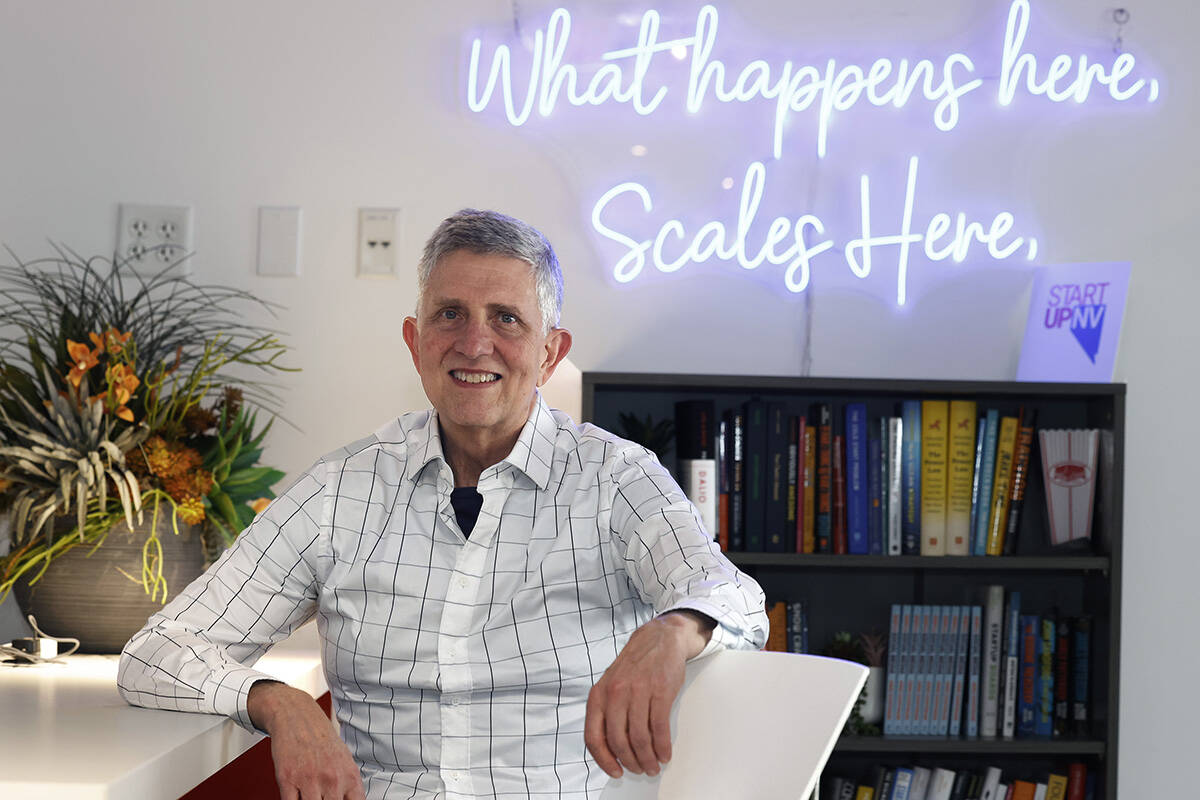
Jeff Saling was part of three successful startups before co-founding StartUpNV, a nonprofit business accelerator and incubator based in Las Vegas.
After the serial entrepreneur’s first company, a Silicon Valley startup, went public, he moved to Nevada, where he was frustrated to learn the state did not have a startup ecosystem.
Saling then ventured outside Nevada to work with two more startups that went public. He was inspired to launch StartUpNV in 2017 after working at the Capital Factory, a venture capital investor and startup accelerator in Austin, Texas.
Saling recently sat down with the Las Vegas Review-Journal to discuss StartUpNV. Answers have been edited for clarity and length.
QWhat was it about Austin’s Capital Factory that inspired you to launch StartUpNV?
AIn it were a bunch of startups and venture capitalists, and they were all working in the same office, and the energy was off the charts. It was a really awesome professional experience for me. I thought surely there was a version of the Capital Factory in Nevada. But there were none. So it was like, ‘OK, it’s time to give back.’ Let’s do a version of the Capital Factory. We’re going to call it StartUpNV. We’re going to do it as a nonprofit. Our primary mission is economic development. Let’s teach these entrepreneurs how to do kind of what I have done starting these technology startup companies. We want to have a robust startup ecosystem mainly so that we can have a diversified economy here.
How have your investments performed?
The nonprofit entrepreneurial teaching program has lived on, and then we started funds along the way, and they’ve been investing since 2021. We’ve now invested $25 million in 28 different startups and we’ve been successful. That $25 million is now worth a little over $100 million. When you measure our success against big Silicon Valley venture firms, we’re actually in the top 1 percent. Now, they would scoff at us saying, ‘Yeah, it’s only on $25 million, we invest $250 billion.’ It’s easier to do it on a smaller number, which is true, but we’re starting from zero. So we feel pretty good.
What are the funds affiliated with StartUpNV?
FundNV is a pre-seed investing fund, which means companies are created but are not very big. FundNV invests in those types of companies. Early, early days. Another fund is called 1864. That’s for once you’ve grown your company to at least half a million dollars. We’d like to think FundNV will invest, you’ll grow it to a half million dollars revenue and be at the beginning of product-to-market fit, and we’ll invest larger amounts of money with 1864. If the company needs money after that, we’ll put together a syndicate of investors and invest more money.
You recently hosted the AngelNV 6 “Shark Tank”-style finale. How does that fund and competition work?
AngelNV is one of our grant-funded programs. It teaches investors how to do angel investing. And there are companies that want to get investments from angels. We tell entrepreneurs, as founders who want to raise money, we’re going to have at least $200,000 to invest in at least one company. Forty people are going to invest $5,000 each in this annual fund and all these companies apply. This year, we had about 160 companies apply. Then we narrow those down to our final six. This year, we had 68 investors and $400,000 to invest (which was matched by the State Small Business Credit Initiative through the Nevada Governor’s Office of Economic Development). We’ve used this process to help these new investors figure out which companies are best and why they’re the best and doing all the due diligence. When we do our finale at the Las Vegas City Hall Chamber, usually there’s 300 or 400 people who show up to hear these companies make their last pitch. It’s like “Shark Tank,” but we’d like to think we’re a little nicer. After the last pitch, the investors leave the room and vote on who gets the investment, or investments. Then we get those goofy (oversized) checks and haul them out to the auditorium and award them. It’s a lot of fun.
What kind of return should investors expect?
One of the things we teach investors in our investing pre-seed or seed stage is we follow this convention called the Power Law. The Power Law says, at the earliest stages, out of every 20-company cohort, one of them is going to succeed wildly, three or four of them are going to do pretty well, and about half of them are going to zero. If you look back 50 or 60 years of venture capital investing, for every dollar you put in, you better plan on getting $50 back. You want to get a 3x return because you know some are going to go to zero, some are going to only return 1x, 2x, 3x or 4x, and one is going to maybe hit 50x or more. When you combine all that together, hopefully you’re going to get a 3x or more because if you invested that money in the stock market in an index fund, you’d get 2x in 10 years. So for all the risk you’re taking, you better get at least 3x. Most venture capital funds still don’t get to three. We’re right now at four, but we’re only about halfway through that journey.
Is there something people don’t know about you?
There are two things, when I tell people are part of my work or lexicon of things that I do, that seem to impress people. One is teaching a university class. I do teach a class at UNR on high-tech entrepreneurship in the fall. Not sure how people will feel about that in Las Vegas. And the other is I’ve helped get a couple bills passed through the Nevada Legislature, working with various politicians to help get laws passed that are helpful to our startup ecosystem. The ideas that I had were SB9 in 2021 and AB75 in 2023. The idea for SB9 was to make our Blue Sky Laws in Nevada more like most of the other states. For AB75, we worked to create the Nevada Certified Investor, which is a more reasonable standard than the national standard. It opens up our market.
Is there a piece of advice, personal or professional, that still resonates with you?
The thing that we tell founders all the time is build something people want, when you’re doing a startup. And how do you know? You ask them. You don’t just build something because you think it’s a good idea. That could be your inspiration but make sure you’re building something that people want. It’s good advice for anybody who’s starting a business. And if you’re investing, invest in a founder who has built something that people want.
Contact reporter
Todd Dewey at tdewey@reviewjournal.com.
Follow @tdewey33 on X.