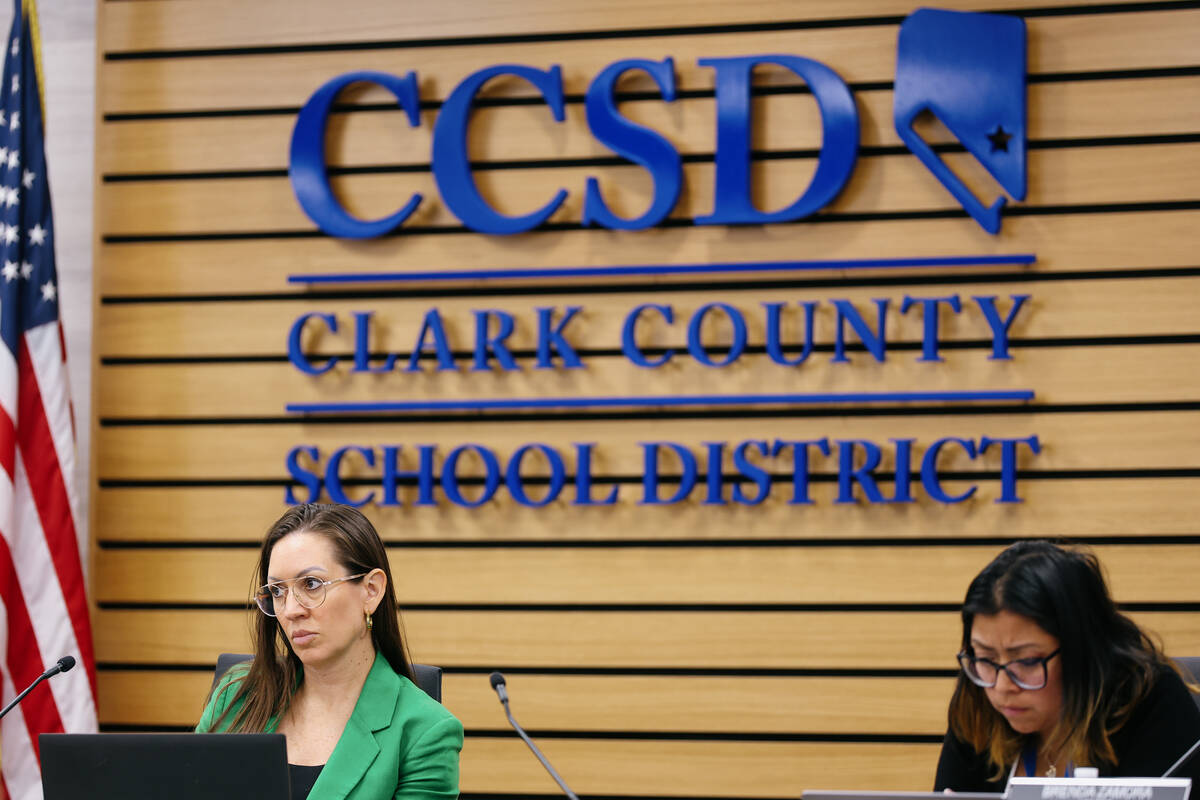
The Clark County School District should redesign its special education programs, rework bus routes and prioritize language development to improve educational outcomes and save nearly $80 million per year.
Those are some of the recommendations from a new efficiency study presented to the Clark County School Board on Wednesday by Texas-based education consultancy firm Gibson Consulting Group. Gibson previously conducted a similar study for the school district in 2011.
Consultants examined two factors: how the district can improve student achievement, and how the district can better use its existing resources. Student enrollment decline is projected to continue and will cause the school district to receive fewer dollars from the state.
The school district could save up to $34.6 million by July 2027 and up to $79.65 million annually by July 2031 in its $3.8 billion general fund if all of the study’s recommendations are implemented, according to the report. The district awarded the consulting group more than $1.4 million in January to conduct the study.
“They found some places where we’re doing well, but right now we’re looking at those places where we can do better,” Superintendent Jhone Ebert said during the school board’s Wednesday work session, where consultants presented the report.
Much of the savings can be realized by eliminating spending on unused software and licenses, reconfiguring the school district’s bus fleet and conducting school building maintenance proactively instead of reactively, the study determined.
“Any of the funds that we save through some of the things that were identified here in the efficiency study give us that opportunity to reinvest back in the classroom,” said Jesse Welsh, deputy superintendent of teaching and learning.
He added that the school district will try to accomplish as many of the report’s recommendations as it can.
Multilingual students struggle in English, math
The report found that English language learners are falling behind in the classroom.
English language learners, defined as students whose first language is not English, represented more than 15 percent of all students last school year, according to the study.
But English learners showed just a 14.4 percent proficiency in English language arts on a standardized test in the 2024-25 school year, according to the report. More than half of their English-fluent counterparts showed proficiency in the subject that same year.
A similar gap existed in math, the study said. English learners were only 13 percent proficient in the subject, while non-English learners showed 37.9 percent proficiency on the test.
Minimal progress has been made toward narrowing the achievement gap between English learners and non-English learners, the report said, as more than half of multilingual students who took an English proficiency test over the last ten years have shown limited or no growth in English proficiency.
“These gaps have remained largely unchanged over time, suggesting that existing instructional approaches have not been sufficient to accelerate ELL academic achievement,” the study said.
It added: “Language development appears to be treated as a supplemental service instead of a shared responsibility across all content areas.”
The report suggested that the school district intentionally integrate language development into instruction across all areas to try to eliminate this achievement gap.
Special education changes recommended
Consultants recommended a broad redesign of the school district’s special education programming, adding that the district’s autism programming has the greatest need for improvement.
Compared with four school years ago, fewer students with disabilities are spending more than 80 percent of their day in general education classrooms, according to the report. At the same time, the study found, more students with disabilities are being placed in general education classrooms for less than 39 percent of their day, which consultants identified as the most restrictive placement.
More time in general education settings often leads to better academic outcomes for students with disabilities, Welsh said.
“They’re going to be exposed to more grade-level content, higher levels of rigor, and that’s just going to help them in the long run,” he said.
These trends have continued to worsen even after a 2020 review of the school district’s special education services found that the district was well below the state’s target rate for incorporating students with disabilities in general education classrooms, the report noted.
“This trend spans the district’s most common disability categories (autism, other health impairment, and specific learning disabilities), signaling a systemic move toward more restrictive placements,” the study said.
Students with autism are affected the most by this trend, according to the report. They comprise a majority of the growing population of students with disabilities in the school district since the 2021-22 school year.
About 58 percent of students with autism last school year learned in general education classrooms for less than 40 percent of their school day, the study said. It added that less than 25 percent of students with autism spent more than 80 percent of their school day in general education settings.
Teachers in autism classrooms were also often not using best-practice instructional techniques with their students, the report found after 12 classroom observations.
Consultants identified the school district’s insufficient number of special education staff as a factor in fewer students with disabilities being primarily taught in general education classrooms.
Without enough special education teachers, the study said, schools often rely on pulling students with disabilities out of general education classrooms to provide special education instead of working with them inside the classroom.
The report recommended that the school district find a solution to improve special education staffing and develop a plan to redesign special education programming.
Bus changes could save millions, report says
The school district operates the nation’s largest school bus fleet, but not all of its routes are needed to get kids to school efficiently, the report found.
The study determined that improved routing could reduce general education bus runs by 10 percent and special education bus runs by 25 percent. Reduced costs from needing fewer bus drivers and less bus maintenance could save the school district up to $18 million annually five years from now, the report said.
Consultants added that the district currently plans a bus ride for every eligible student, regardless of whether they ride it, creating inefficient routes. The report recommended that the district ask parents to indicate whether their child will ride a bus to school to save money.
Deputy Superintendent of Business Operations Felicia Gonzales said the school district will look to implement the recommended opt-in or opt-out bus policy, but added that it likely won’t take effect this year. She said the district will communicate any changes to parents before the policy is enacted.
If the school district needs fewer bus drivers, Gonzales said, the district believes that retirements and resignations from its current bus driver staff will winnow the workforce enough without the need for layoffs.
Advocates fear study is all talk, no action
Now that the study is completed, some education advocates at the school board meeting said they were skeptical about whether its findings will be used effectively.
David Gomez, a candidate running for the school board, said he worried about the school district’s lack of detail on where the savings generated by the study’s recommendations will go.
He also criticized the school district’s decision to spend more than $1.4 million to commission the report from a Texas-based company rather than turning to experts in Nevada.
“I just don’t see how bringing someone in from the outside is going to really help us get the real data we need to formulate the outcome that we’re all looking for,” Gomez said.
Education advocate Anna Marie Binder panned what she described as a lack of follow-through from past studies on the school district.
She called on the school district to publicly report how the recommendations are implemented and monitor which ideas succeed or fail so future administrators can focus on solving problems instead of identifying them.
“Otherwise, we’re just spending money after money, or getting recommendations after recommendations, and nothing goes anywhere,” Binder said.
Contact Spencer Levering at slevering@reviewjournal.com or 702-383-0253.