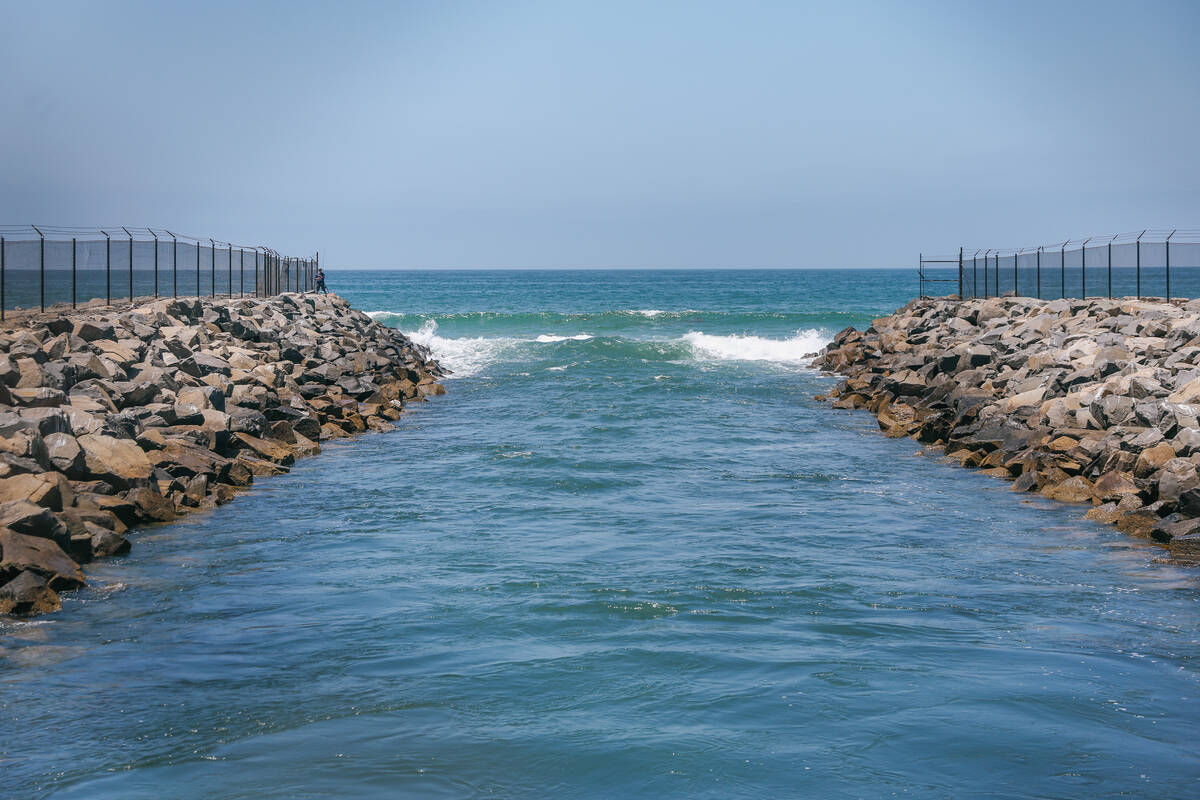
Sipping freshly desalinated water from the Pacific Ocean, water managers from Nevada, Arizona and California ushered in what could become a game-changing agreement for the drought-stricken American West.
Because San Diego has excess water available in its larger portfolio of supply, Nevada and Arizona officials are exploring how their states — part of the Colorado River system on the brink of collapse — could benefit.
They signed a memorandum of understanding Wednesday at a press conference outside the Claude “Bud” Lewis Carlsbad Desalination Plant in northern San Diego County.
The agreement reflects a priority to find new ways to solve drought, said Scott Cameron, acting commissioner of the U.S. Bureau of Reclamation, the federal agency responsible for managing water in the West. The Trump-Vance administration is interested in expanding desalination in the future, Cameron added.
“The Colorado River’s future depends on collaborative planning and effective implementation,” Cameron said. “No single state agency or sector can solve these challenges alone. Today’s agreement reflects the shared responsibility we all carry to protect this river.”
In essence, without building any more infrastructure, the agreement could allow Nevada or Arizona to utilize a portion of California’s share of the Colorado River while California fills that gap with the plant’s water. If a legal framework is established, it could allow for similar agreements for water sharing across state lines, involving water recycling or desalination, according to the Bureau of Reclamation.
The agencies that signed the non-binding agreement include the Bureau of Reclamation, the San Diego County Water Authority, the Metropolitan Water District of Southern California, the Southern Nevada Water Authority, the Arizona Department of Water Resources, the Central Arizona Project and the Salt River Project.
Nevada’s representative at the signing was Colby Pellegrino, deputy general manager of resources at the Southern Nevada Water Authority.
What are the specifics?
However, the key issue is that the details — which have not been worked out — matter.
Nick Serrano, chair of the board of directors at the San Diego County Water Authority, emphasized in his speech Wednesday that the memorandum of understanding is just a first step. It’s not clear how much a transfer would cost.
“Much like the Colorado River itself, there will be twists and turns ahead,” Serrano said. “There will be technical details to work through. There will be accounting questions, operational questions and policy questions. But the destination is clear: a more stable, secure and flexible water future for all of us in the Southwest.”
According to Dan Denham, general manager of the San Diego County Water Authority, the annual capacity of the plant is 56,000 acre-feet per year. He said that within existing permits, that number could grow to 62,000 acre-feet per year if one of the interested states helps fund the plant’s expansion.
An acre-foot of water, by most estimates, is enough to sustain two single-family households for a year.
In an interview last month, Southern Nevada Water Authority General Manager John Entsminger declined to say how much water Nevada could gain, pointing to the fact that San Diego County’s demands could change over time.
“As Colorado River conditions grow more challenging, regional partnerships like this are an essential tool to help ensure sustainable water supplies,” Entsminger said in a statement Wednesday. “This agreement allows us to explore forward-thinking, strategic investments that will strengthen water resilience in Southern Nevada.”
Potential for outsized impact in Nevada
A transfer could be a huge boon to Southern Nevada, a region that is only able to take up to 300,000 acre-feet of water per year from the Colorado River, the least of any state.
Southern Nevada’s consumptive use, after it cashed in credits from recycling, came in at 198,000 acre-feet last year.
Under current proposals for shortages and in the face of the worst snow season in decades, Nevada could agree to a cut of anywhere between 50,000 and 100,000 acre-feet of water in both 2027 and 2028.
San Diego County is prepared to transfer all the water the plant generates, Denham said last month.
Some of that may go to Arizona, the state that stands to lose the highest proportion of its water allocation under an imposed agreement from the federal government.
“We’re looking to do things that have never been done before, and I think that’s something that’s both invigorating and challenging,” Denham said Wednesday.
Contact Alan Halaly at ahalaly@reviewjournal.com. Follow @AlanHalaly on X.