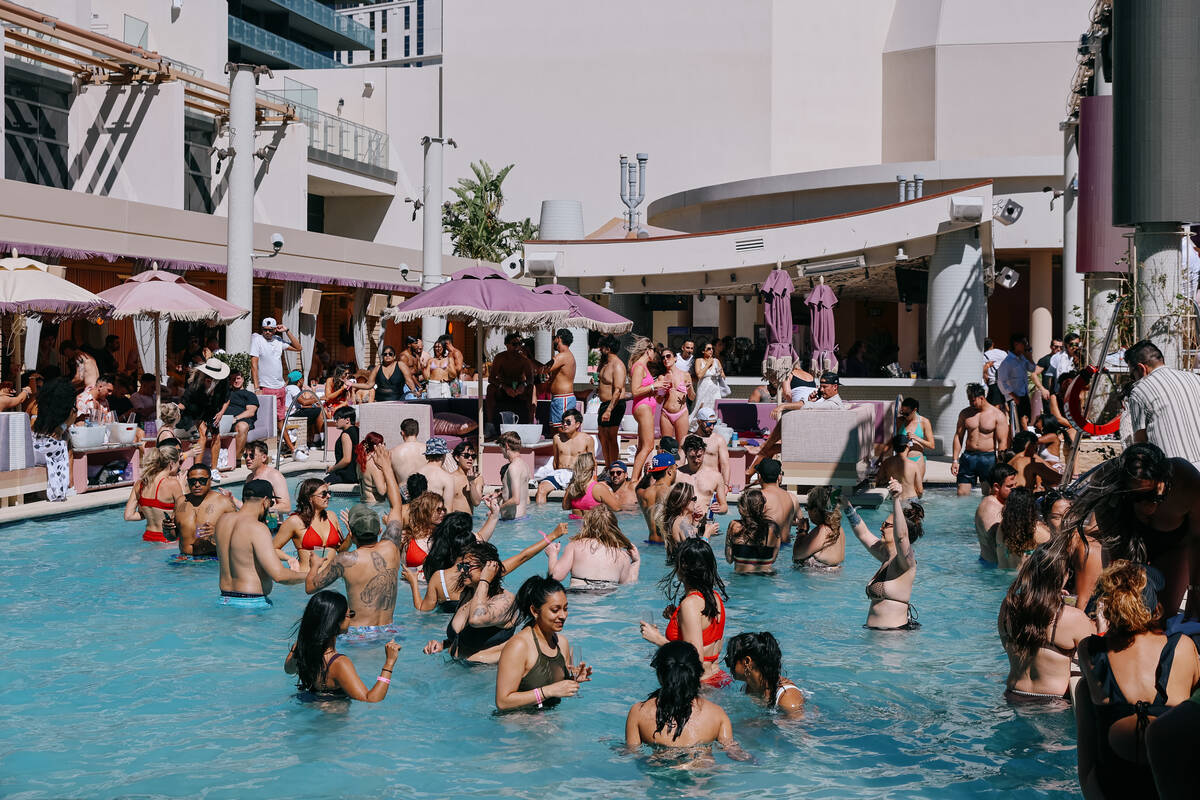
For decades, the standard Las Vegas financial engine ran on neon lights, late-night slot pulls and dimly lit, smoke-filled theaters. In 2026, some of the highest revenue generators on the Strip are operating under the blazing desert sun, where a single poolside cabana during a midday DJ set can command a larger minimum spend than a high-limit blackjack table.
Las Vegas casino resort operators have been capitalizing on this shift with high-energy daylife venues that appeal to younger customers who are increasingly less enthused by standard bars or lounges and traditional gambling but are more than willing to pay top dollar for unique experiences.
The market’s evolution has sparked aggressive investment and lucrative partnerships, while redefining what a Las Vegas casino resort can offer its guests.
This year’s pre-Memorial Day debuts of Omnia Dayclub &Skybar at Caesars Palace and Tailgate Beach Club at Mandalay Bay illustrate how valuable daytime venues have become.
Jason Strauss, co-CEO of Omnia Dayclub operator Tao Group Hospitality, described the May 15-17 grand opening weekend of the 46,000-square-foot, multilevel venue as “incredible.” The star-studded festivities featured appearances by NBA superstar LeBron James, actress Sofia Vergara and model Ashley Graham, and were capped off by action sports star Colby Raha using the Caesars Palace fountain as a background while jumping nearly 100 feet on a dirt bike.
“We sold out all three days,” Strauss said. “We hit revenue numbers we never thought possible, numbers I’ve never seen during an opening in 20 years in Las Vegas.”
Essential for resorts’ success
Results such as those underscore why Las Vegas daylife venues have become essential pillars to a resort’s success. The venues are part of a broader recalibration in Las Vegas hospitality, where daytime entertainment has evolved from a seasonal amenity into a near-continuous revenue stream with its own marketing budgets, VIP departments and dedicated host teams.
Executives say the appeal is straightforward: Dayclubs reliably deliver high-margin food and beverage revenue, draw a younger and more diverse crowd and keep guests on property longer. Operators like TAO Group and Clique Hospitality, whose May 16 grand opening of the sports-centric Tailgate Beach Club featured a performance by rapper Snoop Dogg, say the business has become increasingly sophisticated as customers seek curated experiences instead of simple sunbathing and cocktails.
“It’s no secret to everybody in town that all the casinos would like to keep as many people on their property as possible,” said Clique Hospitality COO Craig O’Keefe. “(Our role) is about understanding what is lacking at those properties that we can provide to people, so they don’t have to get in an Uber and go somewhere else or walk down the Strip to another property.”
As the market matures, operators say some of the narratives around shifting guest behavior, particularly the idea that Generation Z and younger millennials are drinking less, need more nuance.
“I think some of the narrative got pushed a little too far,” O’Keefe said. “It’s true younger guests aren’t drinking as much as previous generations, but they still want to go out and have a great time with their friends. Whether it’s catching a game or seeing a DJ, the demand is absolutely there.”
Amanda Belarmino, an associate professor of hospitality at UNLV, said the rise of daylife venues has reshaped the competitive landscape on the Strip.
“Like nightclubs, dayclubs not run by the casino tend to do better because it’s a unique business,” Belarmino said. “Dayclubs were particularly appealing to millennials, but they continue to attract international tourists and Gen Z. Dayclubs are a very Vegas experience, and they help with the branding of properties.”
Driven by luxury
A premier Las Vegas dayclub can generate between $40 million and $70 million in annual revenue, even though most operate only six or seven months of the year. When paired with a connected nightclub, a single complex can clear $80 million to more than $100 million annually, according to industry estimates. Collectively, the Strip’s daylife sector drives hundreds of millions of dollars in high-margin food and beverage sales each season.
Those numbers vary by venue size. Megaclubs such as Encore Beach Club (Wynn) and Tao Beach (The Venetian) represent the top tier, regularly posting more than $1 million in revenue on a single Saturday during peak months. Midsize clubs like Marquee Dayclub (The Cosmopolitan) or Ayu Dayclub (Resorts World Las Vegas) typically fall in the $25 million to $45 million range annually. Smaller boutique pools, including venues such as Liquid Pool Lounge (Aria) or Rouge Room Pool (Red Rock Resort), generate lower topline numbers but focus on intimate, high-spend experiences that carry a strong return.
Operators say the economics are driven by one thing: luxury. Roughly 60 percent to 70 percent of a dayclub’s revenue comes from cabanas and VIP table minimums, while alcohol, which is often sold at steep markups, accounts for another 25 percent to 30 percent. Cover charges and ticketing typically make up the remainder.
A prime cabana on a holiday weekend can require a minimum spend of $5,000 to more than $20,000, depending on the headliner. Premium liquor bottles that cost a few hundred dollars at retail routinely sell for $600 to $1,000 or more. And unlike nightclubs, which spread revenue across long operating hours, dayclubs pack the majority of their business into a compressed six-hour window.
That combination — high margins, limited hours and predictable demand — has turned daylife into one of the Strip’s most reliable profit engines. It has also intensified competition among operators, who are increasingly focused on creating differentiated experiences, from celebrity-backed branding to multilevel architecture and dedicated food programs.
The ultracompetitiveness of the daylife business has resulted in innovation and venue turnover, such as at Mandalay Bay, where Tailgate Beach Club emerged from the former Daylight Beach Club.
“We found, over the last certainly five years, that just competing with the amount of other dayclubs in the city who were bringing in massive (DJ) talent was something that we just weren’t comfortable competing with anymore,” O’Keefe said of Clique’s strategy to pivot toward a venue that leaned on sports, a proven commodity with the success of Circa’s Stadium Swim in downtown Las Vegas. “We saw the success that they were having down the road and thought, ‘What can we do to differentiate ourselves from them, and also provide something we know people are looking for?’ ”
Despite the rising stakes, operators say the appeal of daylife ultimately comes down to something far simpler than revenue models or headliner lineups. It is the same ingredient that defined Las Vegas long before the first megaresort took shape.
“Dayclubs deliver the ‘wow’ that Vegas is known for,” Strauss said. “Where Vegas wins, in the dayclub business, is no other city can do what this city does.”
Contact David Danzis at ddanzis@reviewjournal.com or 702-383-0378. Follow @AC2Vegas_Danzis on X.