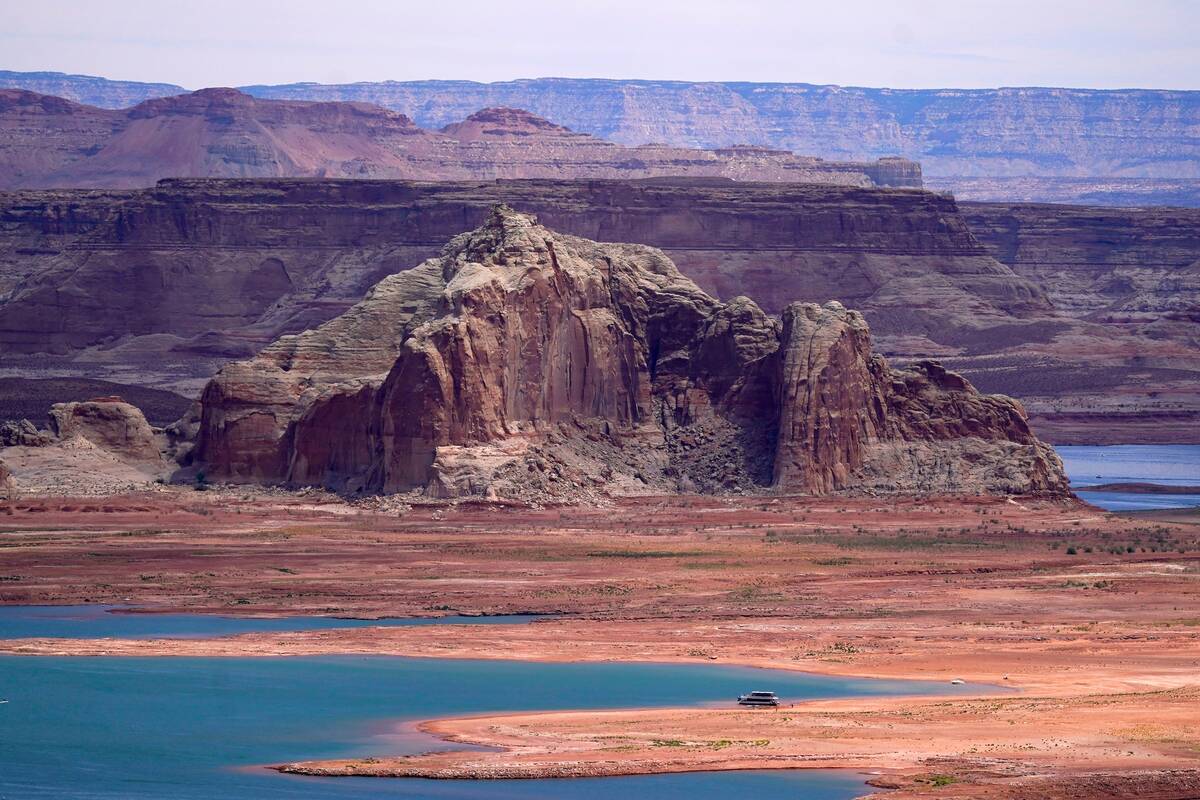
The federal Bureau of Reclamation recently announced extraordinary actions to shuffle water between the Flaming Gorge and Lake Powell reservoirs in an effort to stabilize the Colorado River system. The result will be as if using one credit card to pay the minimum balance on another reduces debt.
Instead of juggling a diminishing supply of water, the Bureau should consolidate the storage of Colorado River water in Lake Mead, which supplies water to roughly 25 million people and irrigates millions of acres of farmland, rather than continuing to prop up Lake Powell, which directly serves fewer than 10,000 people. Doing so would enhance the reliability and security of water supplies and sustain agricultural productivity and hydropower generation, while not reducing water available to other states.
Lake Mead is less than one-third full. Its remaining storage capacity can hold more than three times the volume of water currently stored in Lake Powell — close to twice the entire volume of water stored in the main reservoirs of the upper Colorado River.
Earlier this month, the states of Arizona, California and Nevada requested that the U.S. Department of the Interior complete a plan by the end of 2027, which would allow more water to flow from Lake Powell through or around Glen Canyon Dam, and downstream through the Grand Canyon into Lake Mead. Yet, instead of bolstering Lake Mead, the Bureau has chosen to augment Lake Powell with up to 1 million acre-feet of water from Flaming Gorge — roughly equivalent to the combined annual municipal water demand of Denver, Salt Lake City, Phoenix, Tucson and Las Vegas — and restrict releases from Lake Powell to about 1.5 million acre-feet fewer than any year this century.
These actions are intended to keep Lake Powell from falling to a level that would jeopardize Glen Canyon Dam’s hydropower production and to protect the dam’s structural integrity. But adding water to Lake Powell does not increase the supply available to anyone. There is no practical way to withdraw significant quantities of water from the reservoir for municipal, agricultural or other uses — the water sits there or evaporates until it is released through Glen Canyon Dam.
The intended benefits of boosting Lake Powell to preserve hydropower production from Glen Canyon Dam and protect its structural integrity may not materialize. The agency’s most recent forecast estimates that, by early 2028, Lake Powell could drop low enough to preclude hydropower production. At that point the only way to release water from the dam is through its outlet tubes located below the dam’s turbines. The tubes were never intended for long-term use at low reservoir water levels. Just 72 hours of high-capacity use caused structural damage that took nine months to repair, and the repairs will not prevent future damage.
Based on that experience, in 2024 the Bureau adopted guidance not to rely on the tubes as the sole means for releasing water from the dam.
The Bureau will be robbing Mead to pay Powell. The agency will fill Lake Powell, while Lake Mead will shrink. This will trigger significant mandatory cuts in water use in Arizona and Nevada. And the reservoir’s elevation is expected to remain low enough that the cost to operate and maintain Hoover Dam will exceed the revenue gained from hydroelectric sales.
The Bureau’s latest actions will not prevent protracted and costly litigation about how to allocate the dwindling water resources of the Colorado River.
Some of the largest stakeholders have signaled a willingness to sue the agency to protect their interests. At its May 7 meeting, the Central Arizona Project’s Board of Directors established a $60 million “extraordinary cost reserve” for Colorado River litigation. And the states of Arizona, California and Nevada warned the Department of the Interior this month that “litigation necessarily remains” an option in their proposal for operating the Colorado River in 2026-2028.
Litigation will not provide solutions quickly, if ever. Arizona and California have squabbled in the U.S. Supreme Court for decades about access to Colorado River water.
Instead of propping up Lake Powell to benefit Glen Canyon Dam, the Bureau should consolidate water in Lake Mead — the reservoir that sustains millions, irrigates millions of acres of farmland and provides affordable hydropower from Hoover Dam.
Ronald L. Rudolph has been involved in infrastructure development and water resources issues in the Southwest for more than 50 years and is also a former assistant executive director of Friends of the Earth. He writes from Golden, Colorado.