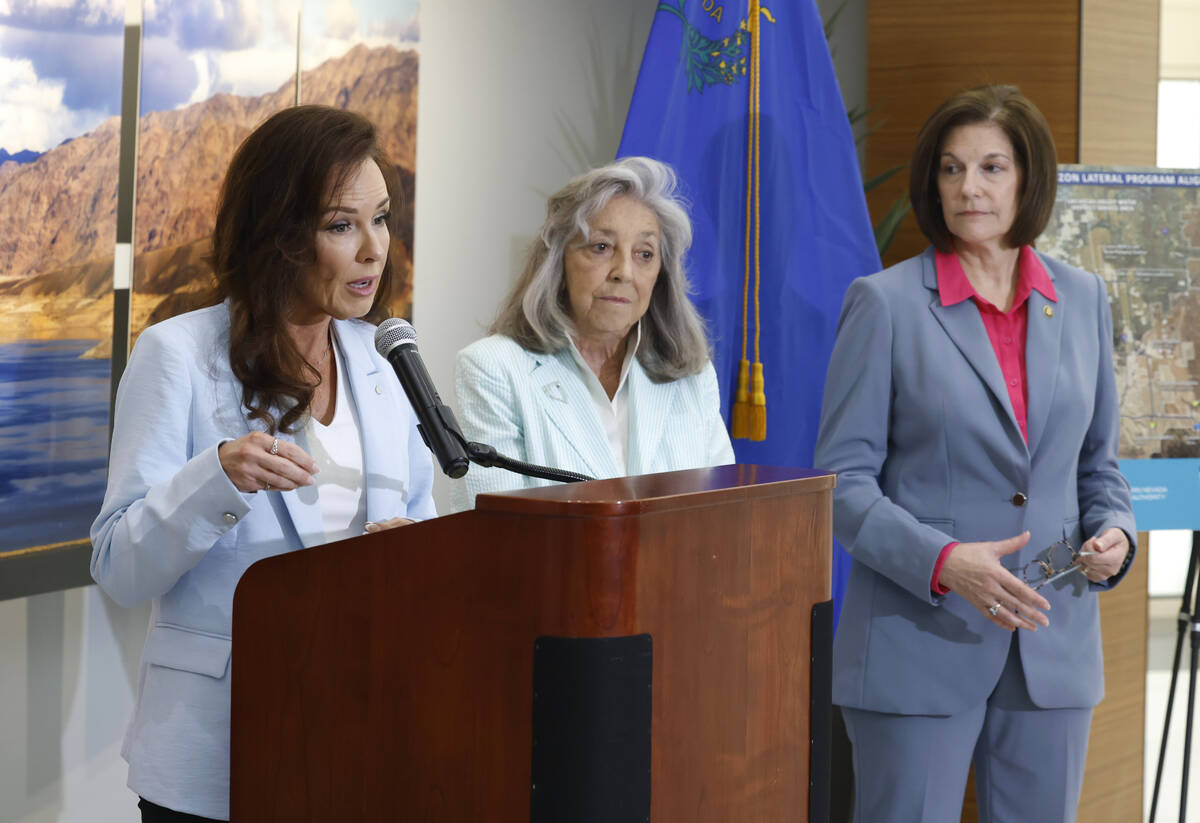
A colossal water service pipeline in the south Las Vegas Valley will be drilled under the Sloan Canyon National Conservation Area, with the blessing of both political parties and some conservation advocates.
Water managers’ route for the so-called Horizon Valley Lateral Pipeline involves tunneling pipes large enough to drive a truck through. If not for this $2 billion pipeline, up to a million customers could be left without service if the existing and aging South Valley Lateral needed to come down for repairs, officials said.
“What we see around the country is, a lot of times, infrastructure costs come last,” said Clark County Commissioner Marilyn Kirkpatrick, who chairs the Southern Nevada Water Authority board. “This is the one thing on water, as we’ve heard today, that is very important to our community on how we use it and reinvest in the infrastructure ahead of time, so that future generations are welcome.”
President Donald Trump signed the Sloan Canyon Conservation and Lateral Water Pipeline Act last week to allow the pipeline to route through the national conservation area. With 9,280 acres added to the 48,438-acre national conservation area, it marks the only piece of signed conservation legislation this session, according to the Nevada Democrat bill sponsors, U.S. Sen. Catherine Cortez Masto and U.S. Rep. Dina Titus.
Several speakers at a press conference hosted at the Las Vegas Valley Water District on Friday said without Gov. Joe Lombardo’s direct engagement with the White House, the bill may not have moved forward.
“I also advocated for this deal directly with the White House, and I appreciate they recognize the importance of this effort, and the president signed it into law,” said Lombardo, who left before taking questions from reporters.
Traffic delays possible with other route
Previously, the other route that water managers considered would have forced the closure of major roads in Henderson. That would have cost an additional $200 million to execute, officials said.
Henderson Mayor Michelle Romero thanked the water authority and the city’s federal representatives for fighting to pass the bill and listening to the community’s concerns.
“The alternate route would have completely torn up the entire edge of Henderson: Our parks, our travel, our transportation corridors — things that our residents rely on every single day that add to our quality of life would have been destroyed or disrupted for years and years,” Romero said. “This saves money, and it saves our residents.”
The fear of up to a million Las Vegas Valley residents losing service without a redundant water system is not unfounded.
Doa Ross, the water authority’s deputy general manager of engineering, said the South Valley Lateral did once already have to come out of service because of a leak — something water managers were able to fix in about 10 days.
Most customers didn’t notice the pipeline stopped delivering water because officials filled Henderson reservoirs up with extra water to accommodate the delay in service, Ross added.
“This is just getting to a point where the South Valley Lateral is reaching an age where we would like to do assessments and rehabilitations to it to keep it up,” Ross said. “This extra pipeline allows us to do that.”
Officials say no wildlife impacts
The Sloan Canyon National Conservation Area, designated through an act of Congress in 2002, is home to some of Southern Nevada’s most cherished landscapes just miles from urban view.
According to the Bureau of Land Management, it features 300 rock writing panels, or petroglyphs, and nearly 1,700 designs representing Native American cultures dating back hundreds of years.
“It’s a vital place for people to enjoy the outdoors,” said Titus, whose congressional district includes the area. “A place of serenity, kind of a holy place.”
Asked about the potential for impacts to wildlife such as bighorn sheep or desert tortoises, Ross said the drilling will take place outside of the national conservation area boundary. The water authority will fly in a rig to take core samples of rock to minimize disturbance to habitat or plants, she added.
Bertha Gutierrez, of the Conservation Lands Foundation, said her organization was consulted throughout the process. Intentionally, drilling will not occur during bighorn sheep mating season, she said.
“This deal is really a show of how we can achieve important infrastructure needs and address them, while also upholding conservation,” Gutierrez said.
Contact Alan Halaly at ahalaly@reviewjournal.com. Follow @AlanHalaly on X.