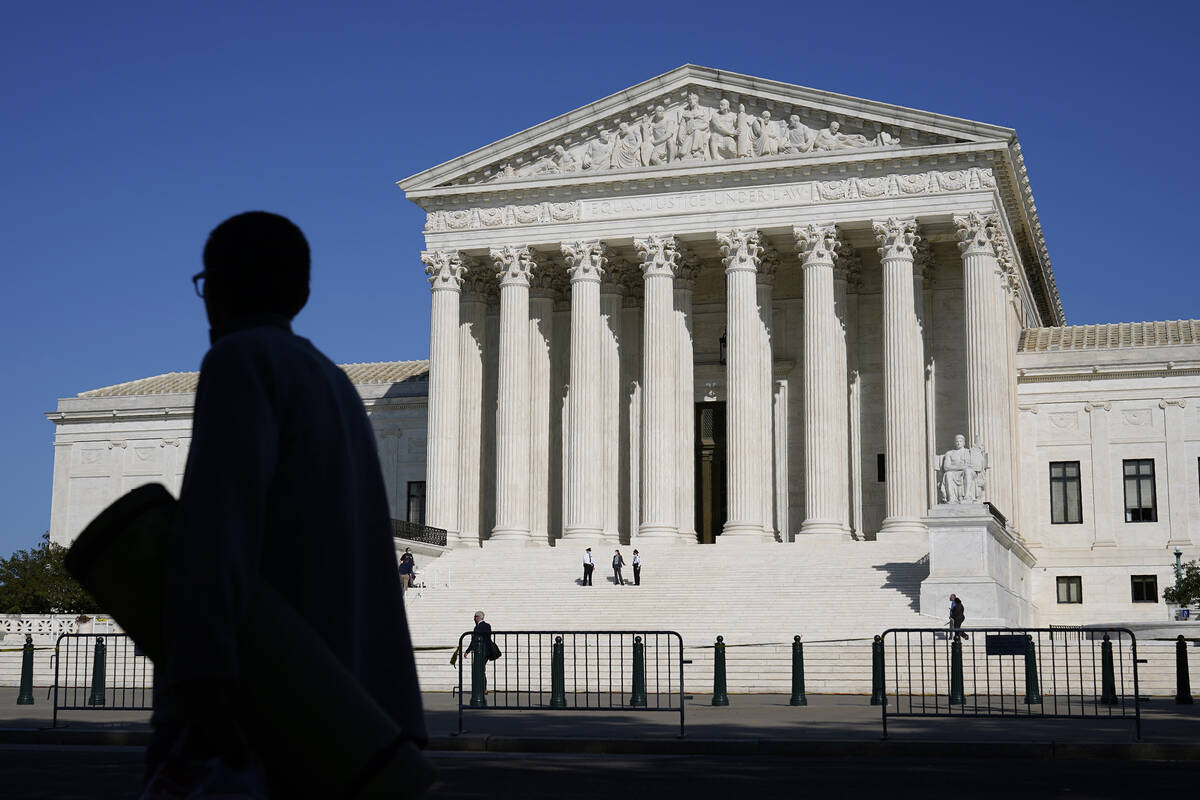
The Supreme Court has done something remarkable. It has been declared that the Constitution means what it says. The Equal Protection Clause forbids racial discrimination. Apparently, this is controversial.
The court’s decision striking down Louisiana’s court-mandated congressional map has sent Democrats into theatrical fits of outrage. Chuck Schumer calls it a return to Jim Crow. Barack Obama says the court is abandoning its role in protecting minority rights. Kamala Harris warns of a grand conspiracy to suppress the Black vote.
Before accepting this narrative, it is worth asking a straightforward question: If Democrats are so deeply concerned about Black Americans, why does their concern so reliably align with their electoral interests?
Consider what the Louisiana court-ordered map actually looked like. To manufacture a second majority-Black congressional district, a court forced the state to draw a district stretching 150 miles (from New Orleans to Shreveport), carving through the heart of the state to stitch together Black populations in communities more than a hundred miles apart. Geographic compactness, one of the fundamental standards for legitimate districting, was thrown out. The goal was not a coherent representation; the goal was racial arithmetic.
Justice Samuel Alito, writing for the majority, stated the principle plainly: Section Two of the Voting Rights Act was designed to enforce the Constitution, not collide with it. When courts force states to draw majority-minority districts, they are not fighting racial discrimination. They are mandating it. They are requiring the government to sort citizens by race and draw boundaries accordingly. The 15th Amendment forbids that.
Democrats will not say this part out loud, but Hakeem Jeffries said the quiet part loud enough. His complaint about the decision was not primarily that Black voters would suffer. His complaint was numerical and nakedly partisan. By some estimates, he warned, this ruling could cost Democrats as many as 19 additional House seats. There it is. The concern is not Black representation. The concern is Democratic representation.
The civil rights vision of the 1960s — equal treatment under the law regardless of race — had been quietly replaced by a political vision requiring racially proportional outcomes engineered by the government.
The Supreme Court decision is a partial return to the original vision. The response from the Democratic establishment confirms this diagnosis. When you strip away the rhetoric, what Democrats are arguing is this: Black voters vote Democratic, Democratic seats are at risk, therefore any map that reduces Democratic seats is racist. That is not a civil rights argument; that is a party apparatus protecting its own infrastructure.
The facts on the ground make the “voter suppression” narrative increasingly difficult to sustain. Black voter turnout has exceeded white voter turnout in several of the past five presidential elections. More than 60 Black Americans serve in Congress, the overwhelming majority of them elected from districts where white voters constitute a significant share of the electorate. Barack Obama won two presidential elections. White candidate Abigail Spanberger won 90-93 percent of the Black vote in her Virginia gubernatorial contest, while the Black candidate, Winsome Sears, won 61 percent of the white vote in hers.
A country that systemically suppresses the Black vote does not produce these results.
Justice Alito noted something else worth mentioning: the calendar. The Voting Rights Act was passed in 1965 to address nearly a century of entrenched, explicit, legally enforced discrimination in the post-Confederacy South. Poll taxes, literacy tests, outright intimidation — these were the mechanisms the law was designed to dismantle. The social landscape of 2026 is not the same as that of 1965. Applying the same emergency remedies to conditions that no longer exist is not justice. It is a political habit dressed up as a principle.
Meanwhile, some of the most racially segregated cities in America — Milwaukee, New York, Chicago, Detroit, Philadelphia — are not in the South. They are in the urban north, governed for decades by the Democratic coalition that now presents itself as the guardian of Black America. The pattern is easily recognizable. The people claiming to solve a problem have presided over its worst manifestations.
Rep. Wesley Hunt, R-Texas, when asked about the absence of Black Republicans in a new congressional term, gave the only answer consistent with genuine racial equality: “I’m not here because I’m Black. I am here because I am qualified.” That is the civil rights ideal — a person judged by their competence and character, not sorted into political categories by the color of their skin.
The Democratic Party’s argument, stripped of its moral costuming, is that without racially engineered districts, Black political power collapses. That argument is an insult to Black voters. It assumes they cannot compete on the same political terrain as everyone else. It treats their votes not as the expressions of free citizens but as resources to be harvested and redistricted into safe Democratic columns.
The Supreme Court said no to that arrangement. Good.
Craig J. DeLuz is a Project 21 ambassador. He wrote this for InsideSources.com.